[Worldcraft Vol. 1, No. 0] | A Guide to Worldbuildimg
Volume 1, Number 2. On the strange labour of making a place that never existed feel as though it always had.

Worldcraft is a series about the oldest trick in fiction, which is persuading a reader that a place made entirely of sentences has weather. Each issue takes one principle, watches a few books perform it, hands you something to take apart, and then, because watching is the easy part, asks you to try it on your own pages. This first issue is the overview, which makes it the issue most likely to be wrong in interesting ways; later numbers will correct it, and some of them will correct each other.
What worldbuilding is
Worldbuilding is every decision about a story’s setting that a reader can feel, whether or not the story ever states it. The term belongs, by long custom, to science fiction and fantasy, which is a little like letting astronomers claim the sky: every novel has a world, and most novelists simply inherit theirs. A novel set in a Richmond law office has a currency, a set of taboos, and a context and texture within time, which is to say a past, a present and a future. And just as that office sits at a distinct point in time, it sits at a distinct point in Euclidean space, shaped by the objects around it and shaping them in turn. Its location and its history define its present: whether the neighborhood has known wealth or poverty, which laws and which developers have had their way with it, who has lived there and what they were like.
A novelist who sets a book in that office inherits all of this, because Richmond has already done the building and the reader has already done the believing. The writer of an invented world has to develop these qualities, make them feel essential and natural, and then resist the urge to overdevelop them or to point needlessly at them. Of the three tasks, the last is the hardest, and the one most writers fail without noticing.
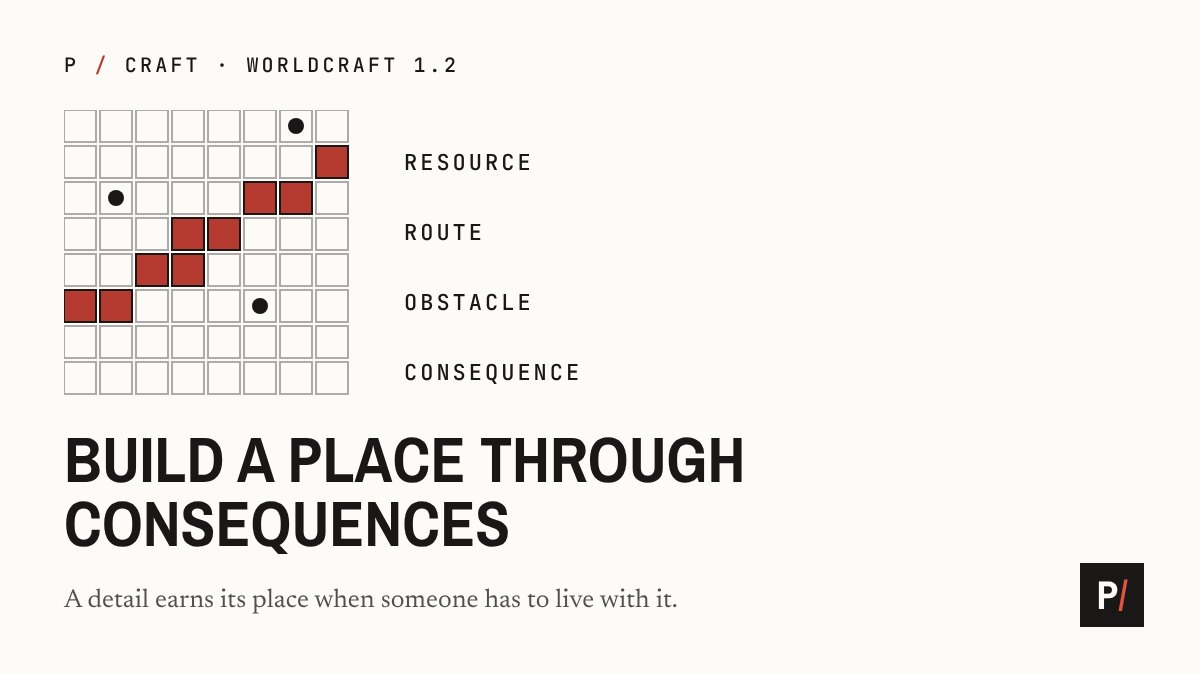
The sharpest objection to the whole enterprise comes from inside the genre. M. John Harrison, who has made some of the strangest invented places in English, has argued that worldbuilding is the dull part of fantastic fiction: a survey of somewhere that does not exist, driven by an urge to complete it that smothers the story it was meant to serve. He is right about the failure, and the failure is common enough to deserve a place at the front of any series like this one. The answer, though, is not to build less. It is to remember what a world is for, which is to put pressure on people. A detail earns its place when someone in the story has to live with it, pay for it, or lie about it.
Principle 1: Imply, do not explain
A believable world is one whose inhabitants do not explain it to each other, for the same reason you do not explain a stoplight to the person in your passenger seat. They pay the toll, cover the ear, buy the jar, and the reader, deprived of a guide, does the inferring, which turns out to be most of the pleasure and nearly all of the belief.
Here is one paragraph written twice. Tap the shaded phrases in the first version, then switch to the second, which contains exactly the same facts and none of the life.
The difference between the two is not information but occupancy. The first version has a person in it who wants to get across a river; the second has a narrator who wants to be understood, which is a reasonable ambition in an encyclopedia and a fatal one in a story. Keep the second kind of writing in your notebook, where it is indispensable, and out of the manuscript, where it reads as a confession that you did the homework.
Principle 2: Pick a method
No two good worlds are built the same way, which is one reason books on how to build them tend to disappoint: each describes a method, and the best novels have each chosen a different one. Some worlds are accumulated, some are deduced from a single premise, and some arrive through a witness the reader has every reason to doubt. Two writers I return to more than any others stand at nearly opposite ends of that range.
China Miéville builds by excess in one book and by rigor in the next, as if to prove that both work. Perdido Street Station overwhelms: its city, New Crobuzon, is so crowded with districts, species, trades and punishments that most of it never touches the plot, and that waste is exactly what makes it feel inhabited, since a real city is mostly irrelevant to any one person’s story. The City & The City does the opposite, taking one impossible premise, two cities on the same ground whose citizens are trained not to see each other, and following it with the patience of a police procedural, which is also what the book happens to be. Embassytown goes further still and builds a world out of grammar, among aliens who cannot say anything untrue.
Marlon James, in Black Leopard, Red Wolf, hands the world to a witness, and not a reliable one. The novel is a prisoner’s testimony to an inquisitor, given by a man who announces the ending first and contradicts himself on the way back to it. The world, drawn from African myth and history, reaches the reader as contested oral record, with no neutral narrator standing by to certify any of it, which is a reminder that a world can be built out of doubt as thoroughly as out of detail.
Those four, and three more, are laid out below, each with something to try.
You do not need all seven. Most strong books commit to one or two and let the others go. The common failure is to use none of them and deliver the world instead in paragraphs of summary between scenes, like a tour guide who keeps stopping the bus to point at things the passengers could have seen through the window.
Principle 3: Draw the map
Robert Louis Stevenson drew the map of Treasure Island before he had written a word of the book, to amuse a boy on a wet holiday, and then found the story in it. Tolkien said he began with a map and made the story fit, which is either the soundest advice in the history of fantasy or the origin of its worst habits, depending on what the writer does next. Ursula K. Le Guin drew the islands of Earthsea first and found her stories by asking where the boats would have to go.
A map is not decoration, and it is certainly not the endpapers. It is the cheapest instrument there is for discovering what your world forces people to do: distance decides who has heard the news, a river decides where the city stands, a border decides who becomes a smuggler. Draw one, however badly, and plot problems you had been solving by hand begin to solve themselves, or at least to explain why they would not.
The most useful thing a map can show is not a mountain range, which is merely large, but a fault line: a place where two systems meet and do not agree.
From my desk: the map for Lossless
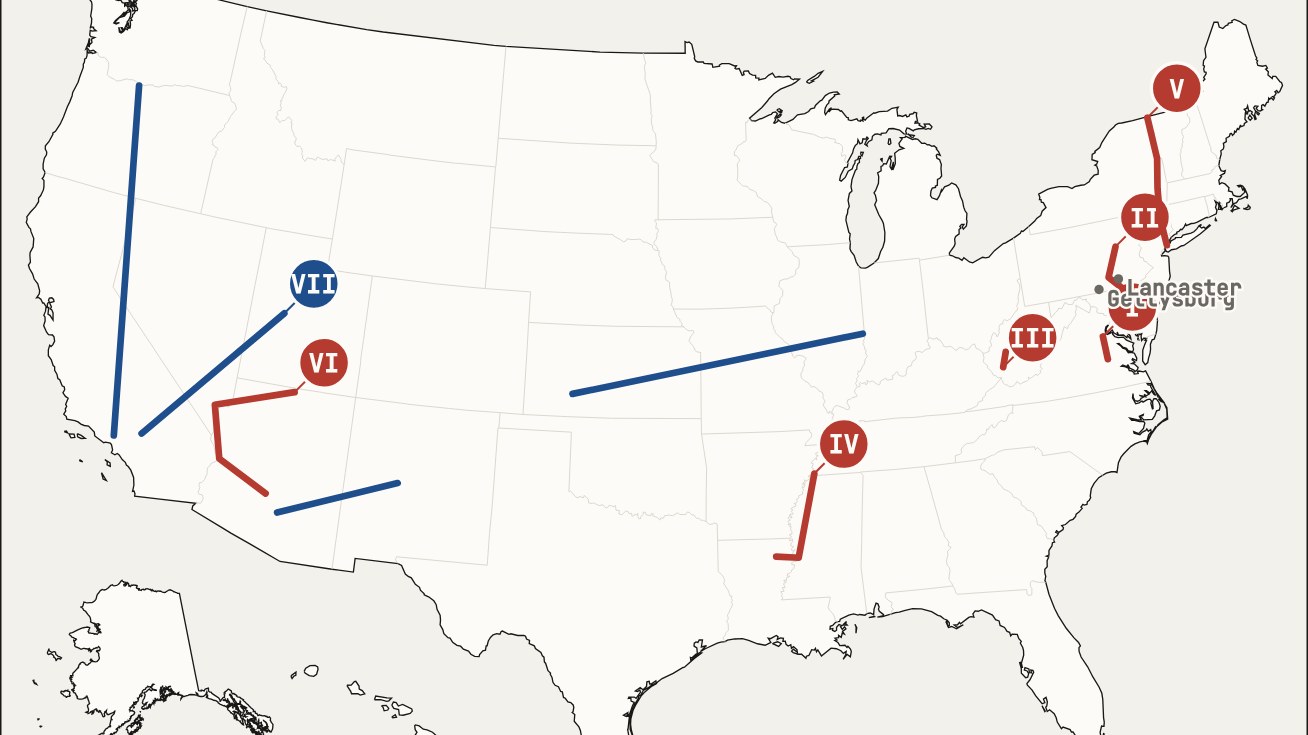
My own manuscript, Lossless, is set in a near-future America during a second civil war, which is exactly the kind of premise that tempts a writer to invent everything and then explain it. When I came to map the outbreak, I did not want to invent the lines the country splits along; I wanted to find them, on the theory that a reader’s fear grows with how much of the map they recognize. So the map began as research into seams the country already has: in the power grid, in the highways, in old borders, in the rock itself.
There are seven. Every one of them is real.
What the map taught me is that an invented war is more frightening when none of its geography is invented, and that the principle scales down as easily as it scales up. If your world is entirely made up, give it fault lines with the same logic anyway: an old treaty, a soil, a road built for one purpose and used for another. Readers have lived among such things all their lives, and they will recognize them even in a country that does not exist.
How to start
Before you write the history of your world, and you will be tempted, because history is the most pleasant way yet devised to avoid writing a scene, answer seven questions in a sentence each. They are the questions the three principles keep asking. The engine below will take your answers, draw a first map from them, find where they collide, and deal you a scene to write.
Five ways it goes wrong
- The guided tour. A character walks through the city noticing things on the reader’s behalf, as no resident of any city has ever done.
- The lecture in dialogue. Two people tell each other what both already know, for the benefit of a third party who is not in the room and is holding the book.
- The complete system. Magic, politics and religion with no gaps, no exceptions and nobody cheating, which is to say a system no human society has ever managed.
- The world with no past. Everything is exactly as old as the plot. Nothing is ruined, repurposed or remembered wrong.
- The unused map. Distance and borders cost no one anything, and the characters cross a continent between chapters like a passing thought.
The exercise
- Answer the seven questions above, or run the engine and argue with what it gives you.
- Write one paragraph, under a hundred words, in which a person crosses from one place to another in your world. Use at least four of your answers. Explain none of them.
- Draw the crossing. Mark one line on the map the person is not supposed to cross, and decide what it would cost them to cross it anyway.
Next
Worldcraft No. 2 takes up rules, and the more interesting question of who is permitted to break them.
Verse / versa,
C. Harder