Worldcraft
Build a place through consequences

Build a place through consequences
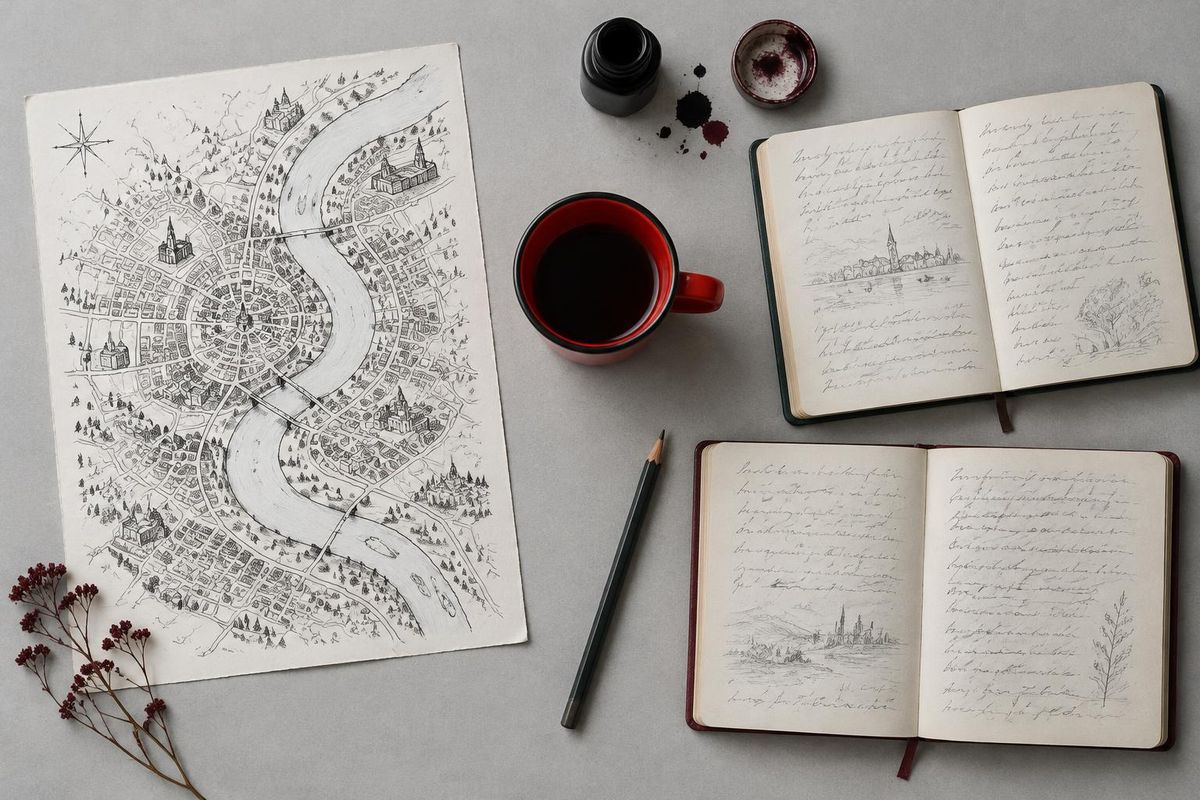
A map becomes a story when its distances distribute opportunity. Put a resource somewhere, put a barrier between it and a person who needs it, then decide who controls passage. A river is geography; a toll bridge is an institution; a character without the toll has a scene.
Build locations at two scales. At city scale, track water, food, work, travel and authority. At street scale, track a door, a route, a witness and an immediate cost. Link each invented custom to someone who benefits and someone who must negotiate it. A setting can remain strange while its consequences stay legible.
Treat an event as a stress test of the world. Close a gate, interrupt a supply, or change who may enter a room. Follow one consequence into another location. A world feels connected when an action elsewhere alters the options here. Decide what your point-of-view character knows, misreads and cannot see; the map need not become an encyclopedia in the prose.
Three ways into the work
- Consequence cartography. Map a resource, a route and an obstacle. Build a scene from the least powerful person’s journey between them.
- The city in three ledgers. For each district record what enters, what leaves and what is concealed. Give one imbalance a human beneficiary.
- Counterfactual weather. Change one environmental condition. Trace its effect through labor, custom, conflict and one sentence of bodily experience.
Start with a physical detail, a practical desire and a cost.
Consequence atlas
Eight by eight cells; one place in conflict. Select a cell, set its terrain, then attach a location with a resource, a rule and a cost.
Location ledger
The consequence engine
Give a character a want and an obstacle. An event earns its place when a choice changes the available future.
What becomes possible—or impossible—after the choice?
What value does this choice betray? What does the character still insist they believe?
Literature as a craft laboratory
Read each book in the linked edition or your own copy. The commentary is Poetic.ly’s reading; the underdeveloped and revised passages are invented teaching examples, not quotations.
Perdido Street Station
Infrastructure as political pressure
New Crobuzon combines industrial production, varied inhabitants and coercive institutions. A useful reading asks how the city’s work, waste and authority affect what its characters can attempt. Strangeness operates inside an economy rather than beside an inventory of invented names.
Source / reading destination ↗
Reading experiment. In your copy, follow a journey through the city. Mark one detail of labor, one of material environment and one of power. Invent a different city where those three forces collide.
Underdeveloped: The city had twelve species, seven towers and a very rich history.
Revision direction: The night shift crossed the only bridge before the militia raised it. Inventory becomes a timed constraint.
Scope: This lens selects infrastructure; it does not exhaust the novel’s aesthetic or political concerns.
The City & The City
A border practiced by perception
The investigation moves between Besźel and Ul Qoma, whose relationship makes border crossing psychological as well as spatial. Read for the habits of attention that maintain separation. An institution becomes vivid when its rules shape perception and conduct.
Source / reading destination ↗
Reading experiment. Invent a boundary that two neighbors interpret differently. Write a crossing from each viewpoint; keep the physical street the same.
Underdeveloped: Nobody could cross the border because that was the rule.
Revision direction: She lowered her eyes before the neighbor’s window; looking back would require an explanation. Put enforcement inside an ordinary gesture.
Scope: The invented exercise is not an account of real border communities.
Black Leopard, Red Wolf
The route as disputed knowledge
Tracker’s search for a missing boy carries a group through cities, forests and rivers while their motives remain uncertain. Follow how travel and the credibility of companions shape what can be known. Treat this as a reading question grounded in the premise, not a claim that a summary substitutes for the novel.
Source / reading destination ↗
Reading experiment. Read a journey in your copy. Separate what the traveler senses, what a companion claims and what remains uncertain. Build a route with three conflicting witnesses.
Underdeveloped: The forest was dangerous, but everyone arrived safely and nothing changed.
Revision direction: At the ford they lost the guide who knew which city had hired them. Travel changes knowledge as well as distance.
Scope: Research specific African traditions rather than borrowing a generalized aesthetic; this exercise supplies no cultural authority.
Your practice edition
Your notes live only in this tab. Save the project to keep them, then restore it here later.