[Draftcraft | Vol. 1, No.1] The Anatomy of Creativity
[Draftcraft | Vol. 1, No.1] An exploration of the qualities in a writer’s process that result in a productive, publishable collection of writing.


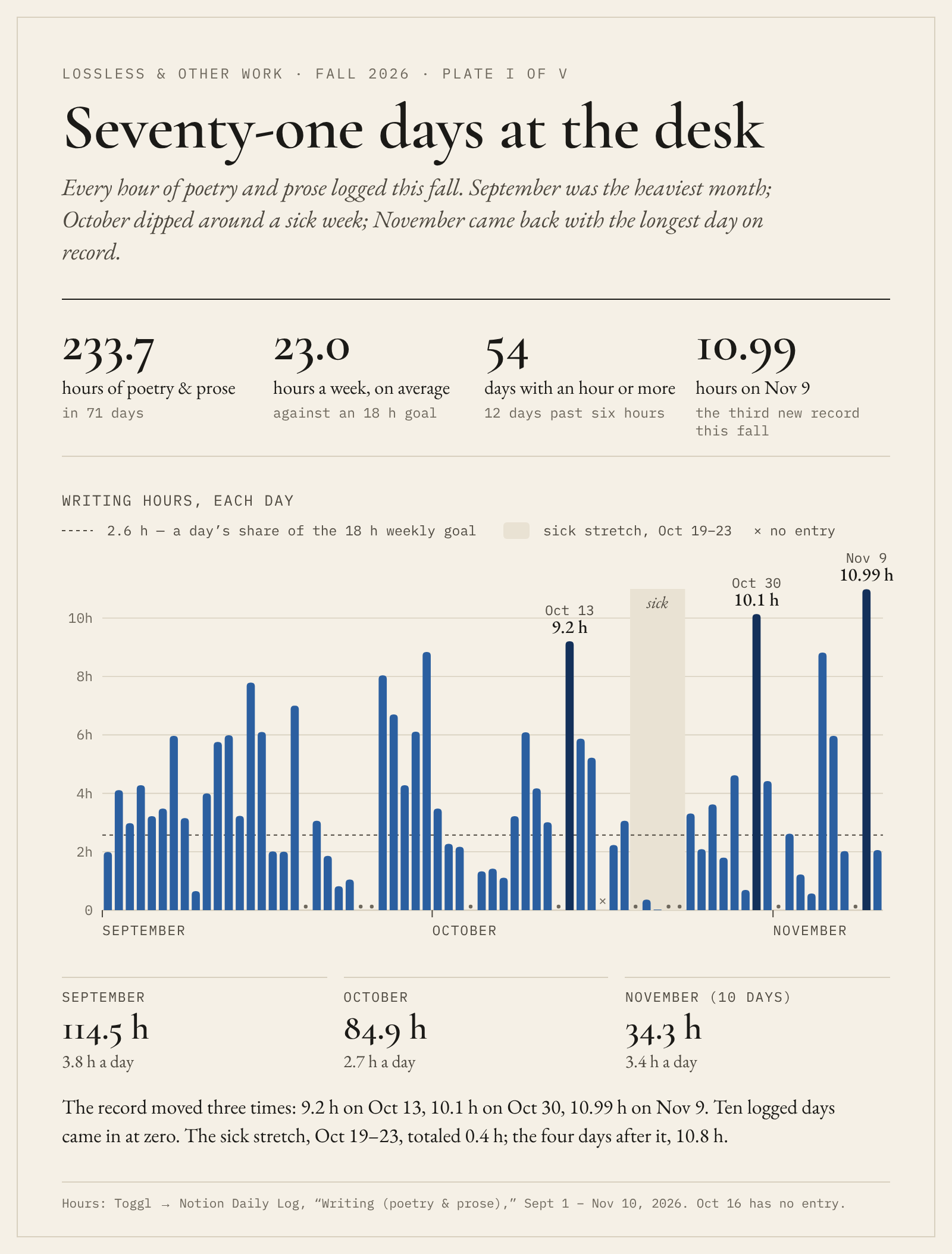
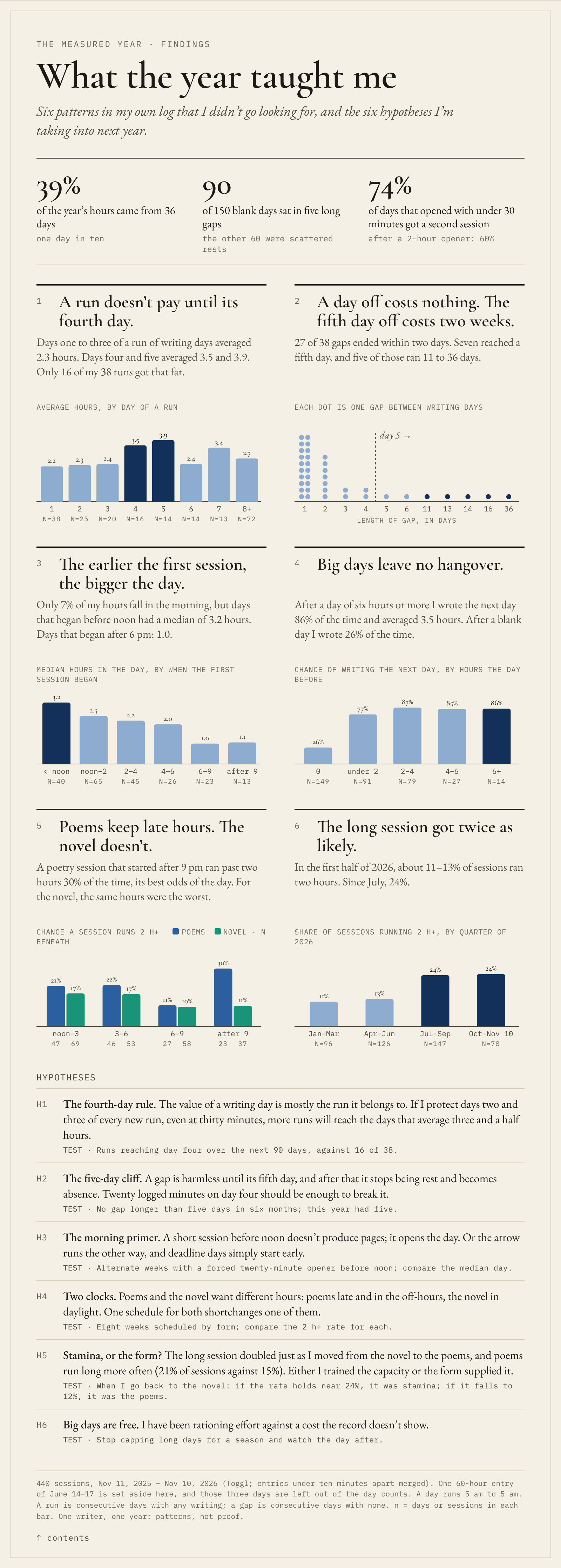
I measured the time, amount, quality & origin of the best writing I produced (using various productivity trackers like Notion & Toggl) of my work that received positive feedback, higher-tier rejections and (less often) publication.
Find the results of this project below!
This post will be followed by a how-to craft feature that will teach you how to measure / analyze your own writing process. More importantly, it identifies easy adjustments to make to your writing process to improve the quality of your writing.
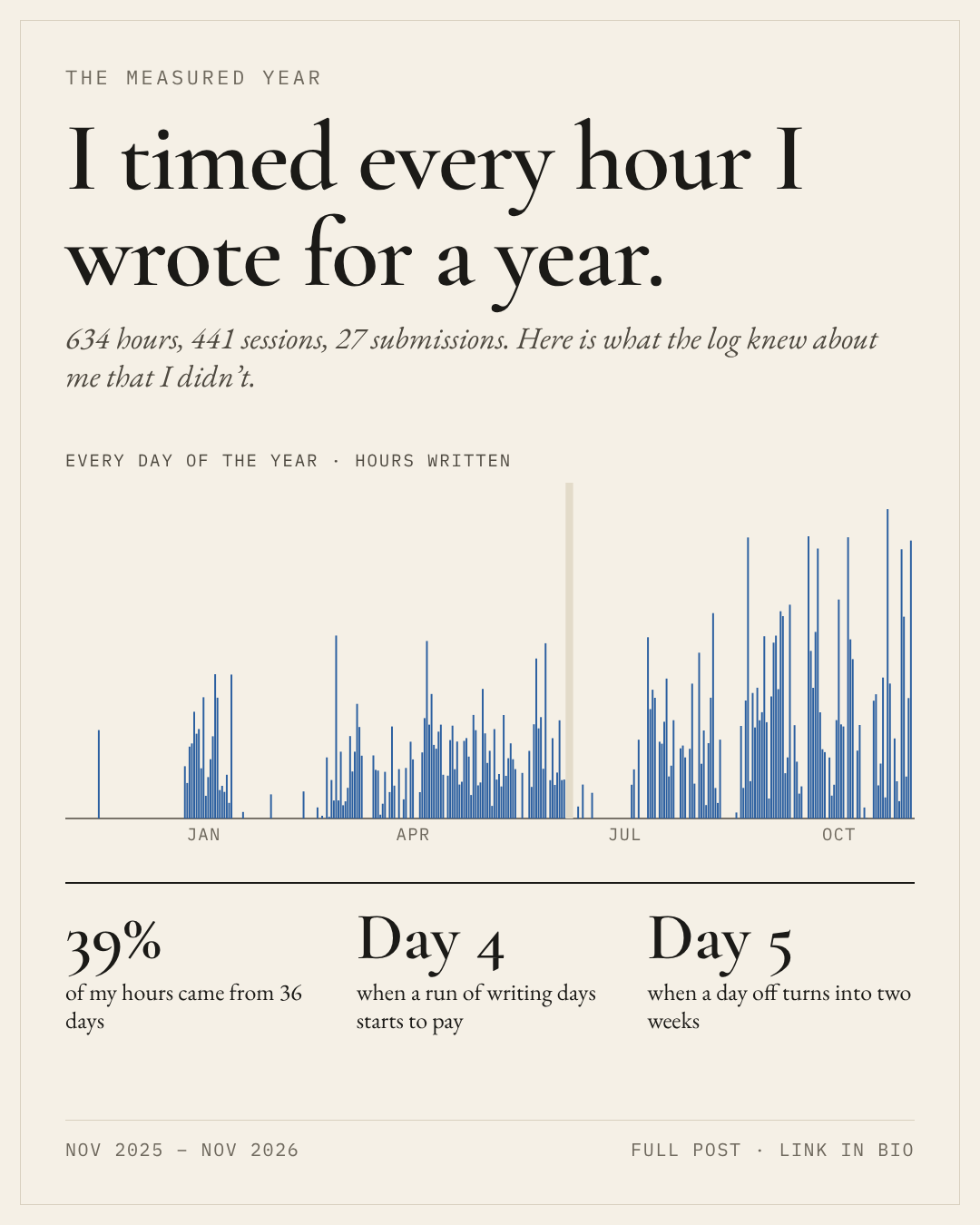
I started measuring broad features of my creative process about a year ago, with the same intention that led me to found prosedata.com; I intended to prove, then as now, that great literature does, in fact, rely on certain, definable qualities; furthermore, these qualities—like figurative language & semiotic construction—recur in similar forms in books that appear on their face to be superficially distinct.
The Writing Chronotype
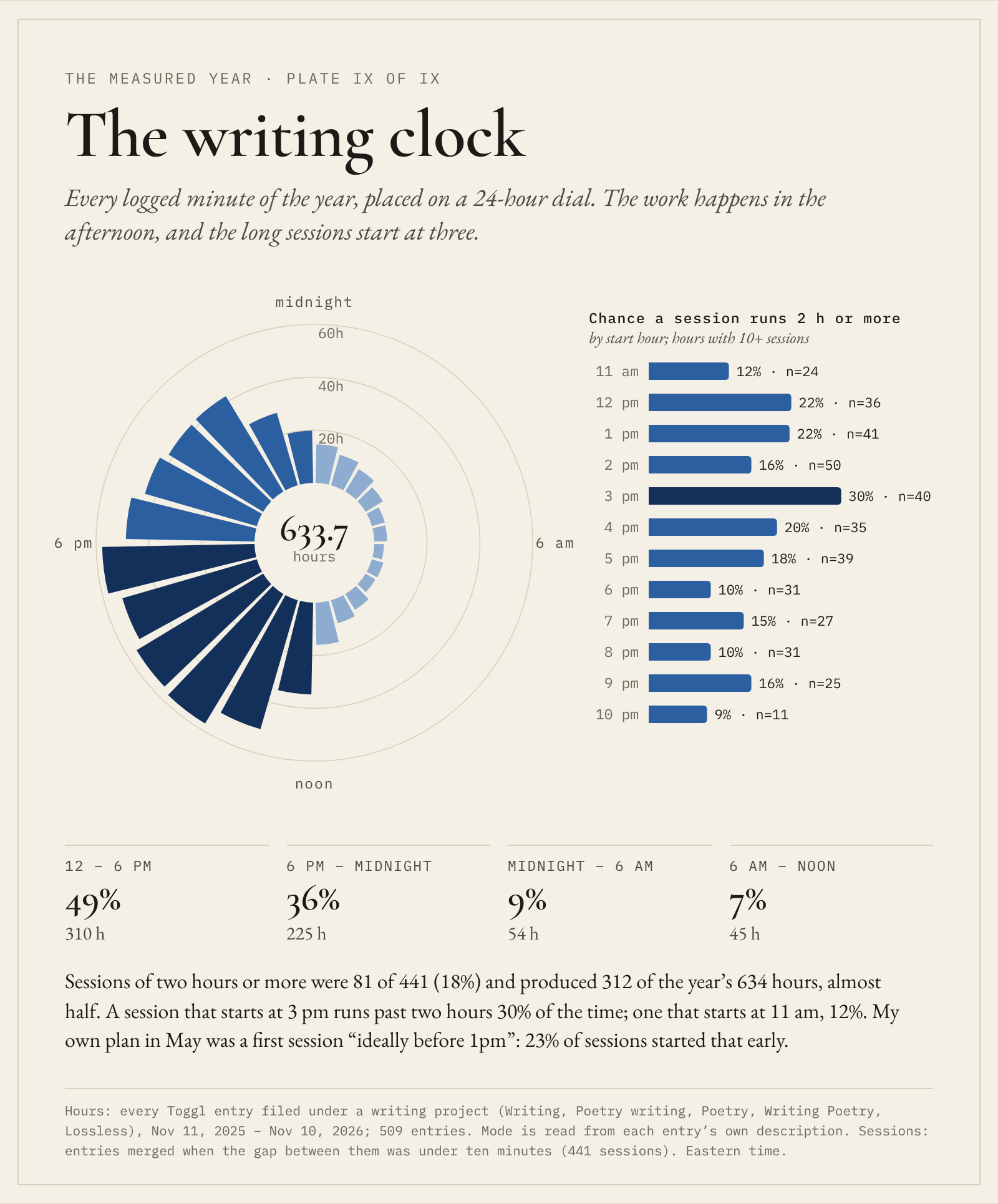
Until my early thirties, I considered writing something delivered to you by a complex, unknowable constellation of quasi-divine muses & fates, I never really examined the success or failure of my writing to be related to anything measurable or willful like work, effort, or consistency.
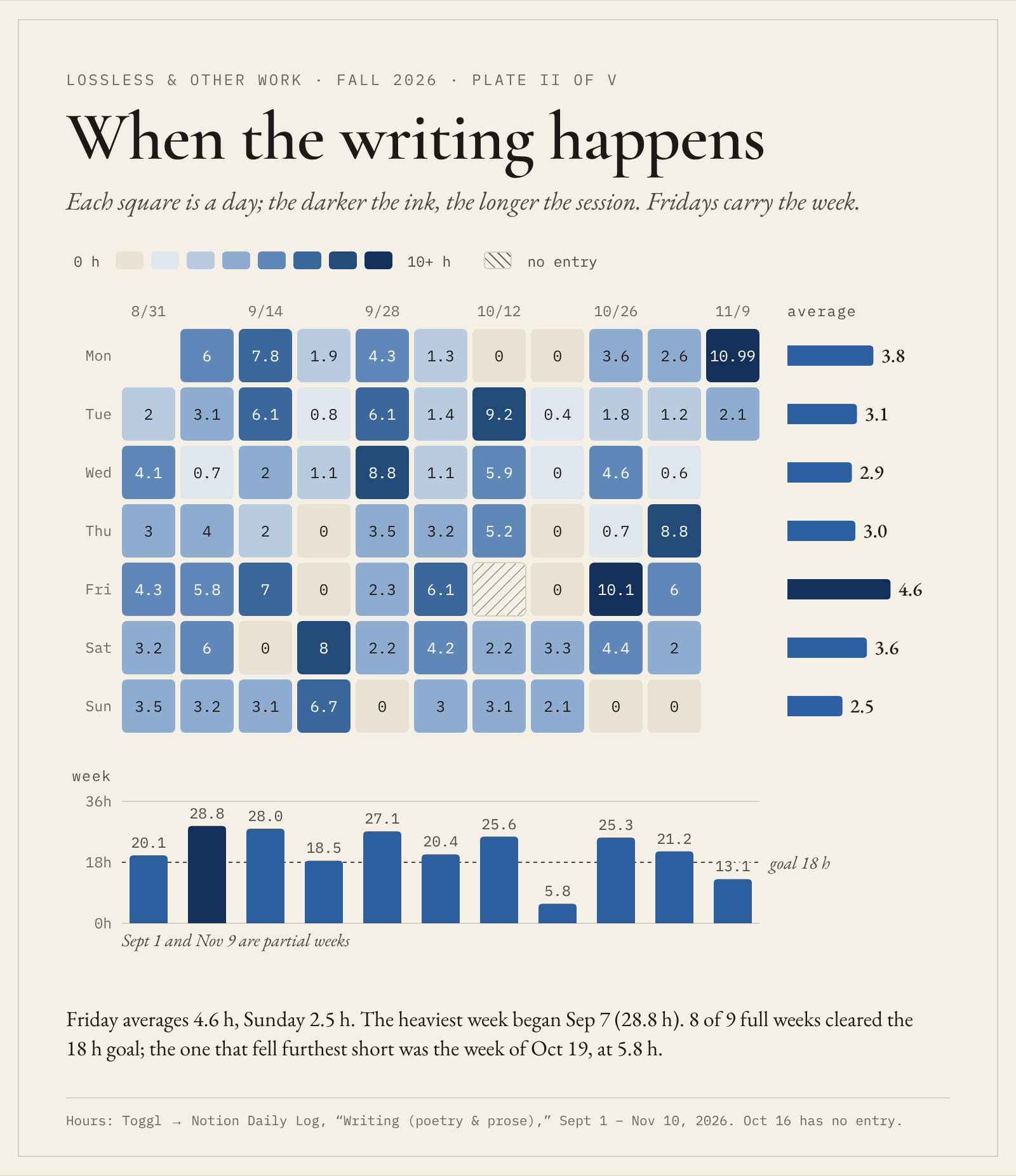
The consistency & regularity of my own creative process quickly convinced me that superlative writing requires more than divine inspiration—it requires consistent, calculated, conscious practice that improves, like a workout split, with adjustment.
How I Spent a Year of Writing
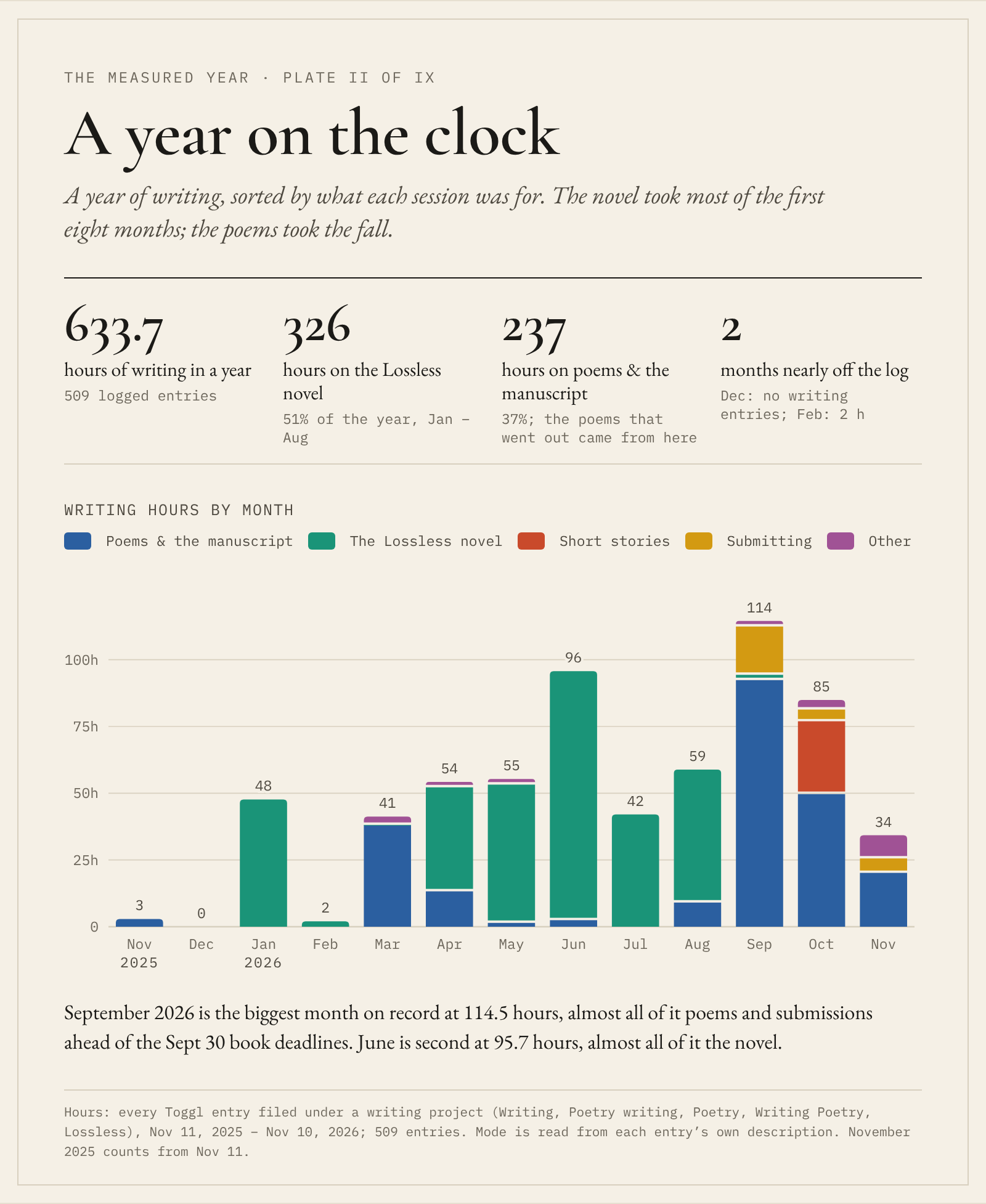
I never seriously considered the quality of my writing to be related to the mode or methods of its production. I am naturally predisposed to believe that superior writing (and, by extension, superior writers) have an innate preternatural ability—something between a talent and an instinct—that allows them to produce incredible work at will.
This data has made me partially reconsider that assumption. I explore the origins and adherents of what I call fuzzy writing in an upcoming post, but I consider its fundament in broad strokes below.
Since about the 17th century—esp. the tail end of the Renaissance—the proponents of the Western canon predominately believe that great writers have unique insight into the compelling, universal qualities of sublimity & mundanity alike.
Using their natural abilities, they alone can realize the loftiest material, making it accessible & interesting through the medium of beautiful language.
The anatomy of editing
Proponents of this belief in fuzzy writing also tend to consider creative writing unteachable, and, accordingly, since you’re either born with an ability to translate the untranslatable or you aren’t, great writing must have a rare & specific composure—something like a soul—that the average person can’t match.
This, of course, explains the related disgust for best seller lists dominated by celebrity writers & self-help gurus—a feeling I empathize with—and several other assumptive conclusions that may harm both the production & consumption of writing.
This sometimes ridiculous belief in magical, fuzzy writing has legitimate origins; it persists mostly because literary gatekeepers (read: publishers) perpetuate assumptions that continue to dominate creative institutions.
Three brief reasons that explain contemporary belief in fuzzy writing:
- The indecipherable, unpredictable nature of publishing. Because publishers explain neither their acceptances (personal letter) nor rejections (form letter) writers develop a self-protective belief: if you are published it’s due to luck, and if you aren’t, it isn’t because of any shortcoming in the quality of your writing.
- The necessarily self-congratulatory attitudes of top-tier creative writing programs. These programs exist in a precarious relationship with the labor market and they necessarily replace the conviction that conventional work produces successful outcomes (often, rightfully) with the conviction that honing certain sensibilities & discerning taste is far more useful.
- The opaque operations of institutional gatekeepers. In every case of my success—from scholarships to awards, to acceptances, to fellowships, to publications—I’ve submitted my work to a professor, judge, editor, or publisher who has selected my work over a pile of as many as tens of thousands of others.
Takeaways
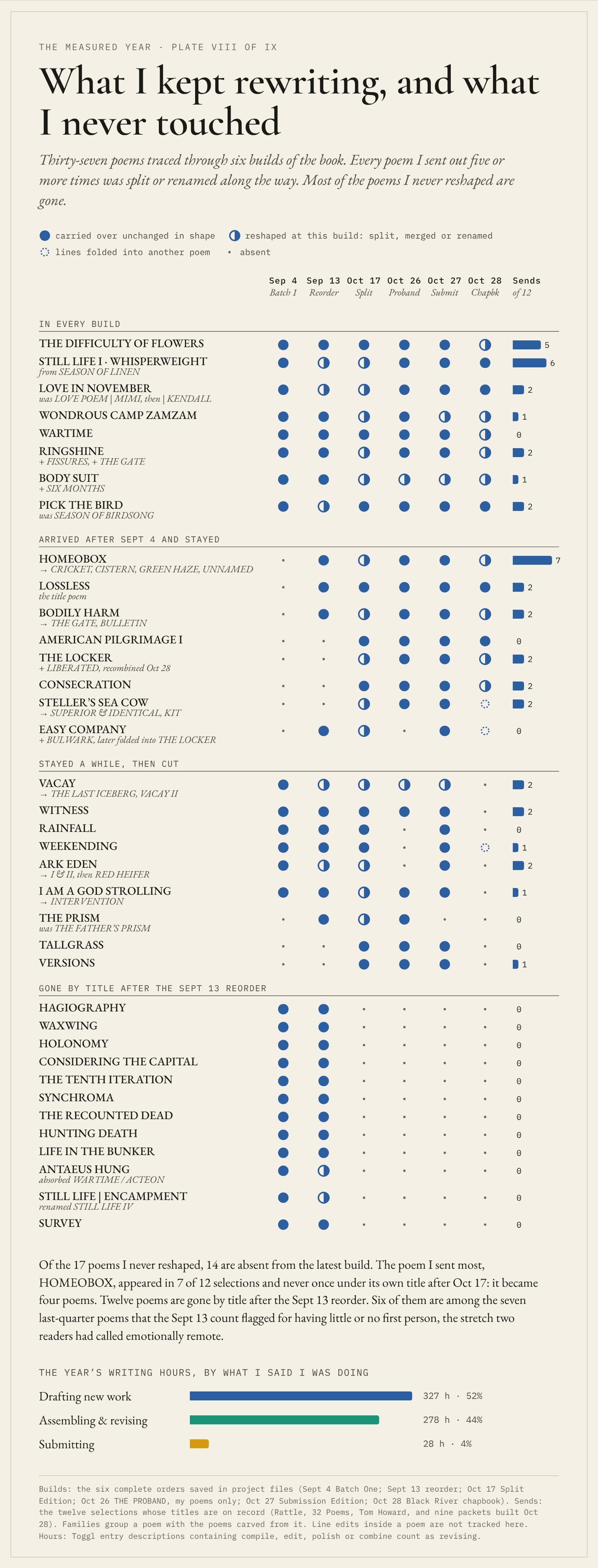
On several occasions a single piece of mine (The Difficulty of Flowers) has received the highest honor available to it at one publication & been rejected outright elsewhere.
I don’t know the reason for either the success or the failure, and, worse, on a certain level, neither does the judge. Of course, we consider this the very proof that art is subjective, and that above a certain level of competence the quality of one piece cannot be distinguished statistically from the next except by taste.
Despite my inborn subscription to this magical “fuzzy view” of writing, I’ve spent years of my free time working alongside dozens of intelligent people using a variety of languages (python, css, c++, etc.) to disprove the assumption that universal literature is not statistically (that is to say objectively describable).
Beloved literature does, in fact, rely on certain, definable qualities; furthermore, these qualities—like figurative elements & semoiotic construction—recur in different forms in pieces that appear on their face to be superficially distinct. My site prosedata.com is a result of such an effort.