Month One, Measured
In its first month of preview, Poetic.ly measured 1,095 published stories and essays and mapped 2,571 prize records. Here are the three clearest findings, figures you can turn in your hands, and the limits of what we know so far.


What a month of counting looks like
Poetic.ly opened in preview a month ago on a wager: that part of what decides a literary career can be counted, and that counting it in public helps writers more than guessing about it in private. Over the month we built three instruments and pointed each one at the public record.
- Fabulist, Poetic.ly's prose-measuring engine, read 1,095 stories and essays printed in ten American literary journals between 2000 and 2026. It measures how prose is built on 36 counts, among them how long the sentences run, how much of the page sits inside quotation marks, how much happens inside a character's head, and how far into a story the first trouble arrives.
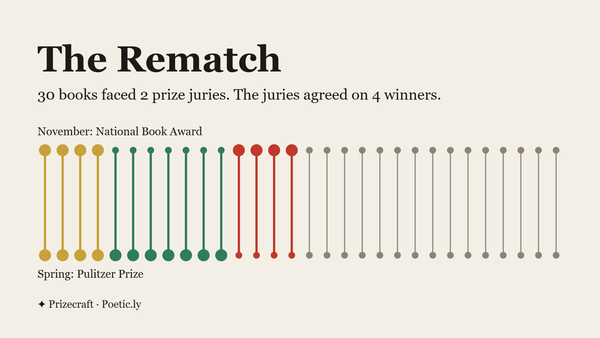
- The Gatekeeper Atlas gathers 2,571 public records from thirteen American book prizes, from the Pulitzer Prize and the National Book Award to first-book prizes such as the Yale Series of Younger Poets. It names who won, who was a finalist and who judged: 1,461 people in all.
- The Insiders directory lists 145 editors, agents and prize judges, each with the route they publish for submissions.
Numbers like these need a reason to exist. Two critics supply ours.
Two ways of seeing a field

Pierre Bourdieu, the French sociologist, spent much of his career on a question writers prefer not to ask: who decides that a book is good? In The Rules of Art (1992; English translation by Susan Emanuel, 1996) he answered that the decision is never the author's alone. Value is made by what he called the field: the editors, prize juries, reviewers, teachers and fellow writers whose agreement makes a book matter.
“The producer of the value of the work of art is not the artist but the as a …”

Franco Moretti, the Italian literary historian, gave us a way to look at such a field. In “Conjectures on World Literature” (New Left Review, 2000) he proposed distant reading: studying hundreds or thousands of works at once by counting their features, instead of reading a few dozen closely. His argument was that some patterns cannot be seen up close.
“… distance, let me repeat it, is a condition of knowledge: it allows you to focus on units that are or : devices, themes, tropes—or genres and systems.”
Put the two together and you have this month's method. Bourdieu says a book's value is produced by a field of believers. Moretti says a field can only be seen from a distance. So we built one instrument for the people who confer value and one for the prose they confer it on, and stood far enough back from both to see a shape.