30 Books Were Judged for Both the National Book Award and the Pulitzer. The Juries Agreed on 4.
✦ Prizecraft | Vol. 1, No. 6 ✦ 2 prizes, 2 sets of judges, about 6 months apart. What happens when the same book faces both? 30 Rematches, 4 sweeps + 7 reversals.

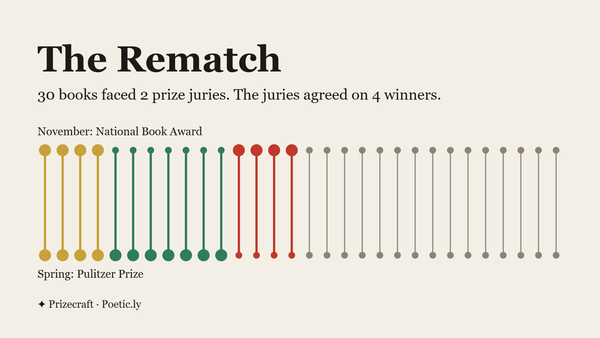
Whenever a prize is announced, a small, suspicious part of me wonders whether a different room of judges—equally serious, equally sure—would have chosen a different book. Two readers can finish the same novel & disagree about it, & nobody finds that strange; it becomes interesting when the readers are prize juries & the disagreement is on the record. Lucky for the suspicious, the experiment has been run. Since 2000, 30 books of fiction & poetry have been honored by both the National Book Award, decided in November, & the Pulitzer, announced the following spring. I call each of these a Rematch: one book, a second jury & a second verdict.
Inside this post
- 🥊 The Rematch: my term for 1 book facing 2 juries
- 🤝 4 books that won both
- 🔄 7 books that lost in November & won in spring
- 🥈 4 National Book Award winners the Pulitzer passed over
- 📋 All 30, in 1 table
- ✍️ Insights for Writers & Readers + Try it now
How rare a Rematch is
Between them the 2 prizes named more than 500 winners, finalists & longlisted books in these 2 categories. Only 30 appear on both sides: 13 in fiction & 17 in poetry. Most celebrated books of any year are celebrated by one jury & passed over by the other. Put differently, “the best book of the year” is, in most years, a title held by at least 2 books at once.
A note on the count: the database holds the National Book Award’s poetry longlists but not yet its fiction longlists for 2013 to 2025, so the fiction figure may rise by a few.
When the juries agree
4 books won both prizes: Robert Hass’s Time and Materials, Colson Whitehead’s The Underground Railroad, Frank Bidart’s Half-light & Percival Everett’s James. That is 4 in 27 years of awards, & 2 of the 4 arrived in back-to-back years, 2016 & 2017.
When the second jury reverses the first
7 books lost the National Book Award & then won the Pulitzer months later: The Known World, Versed, All the Light We Cannot See, The Tradition, Postcolonial Love Poem, Tripas & Be With, which had not even reached the National Book Award’s finalists. 5 of the 7 are books of poems; poetry, it appears, does its best work on appeal.
The reversal runs the other way too. 4 National Book Award winners reached the Pulitzer’s final 3 & stopped there: The Corrections, The Echo Maker, Tree of Smoke & The Intentions of Thunder.
Part of the explanation is mechanical. A National Book Award jury of 5 votes & is done (No. 4). A Pulitzer jury only nominates, & a board holds what I called the second key. The sociologist Pierre Bourdieu described literary value as something conferred on a book by those with the standing to confer it—critics, juries, academies—rather than a property the book carries on its own; which is to say that different authorities can confer it differently. The Rematch is that idea made visible. The book did not change between November & April. The room did.
Keep reading · free with a Poetic.ly account
You’ve read the first third. The rest is for subscribers, & subscribing is free.
Still inside:
- 📖 When both juries stop short
- 📖 Insights for Writers & Readers
- 📖 Try it now
- 📖 The series: how literary prizes are decided
A free account takes an email address & about 10 seconds. It also brings you The Letter, our weekly newsletter.