2026 National Book Award Winners: What the Results Show About How Literary Prizes Are Decided
✦ Prizecraft | Vol. 1, No. 2 ✦ The 5 winners of the 2026 National Book Awards, my predictions scored against them, and what the results show about how a jury weighs a book against a writer’s record.

A prize announcement takes about four seconds: a name, a title, applause. Everything a reader or a writer can learn from it comes afterward. The reader wants to know why that book was chosen over four others. The writer wants to know what it would take to be the person walking to the stage. On the morning of Wednesday, Nov. 18, I published my predictions for the 77th National Book Awards, along with a method for reading whatever the juries decided. That night the juries decided. They proved most of my predictions wrong and, I think, most of the method right, and the second result is the more useful one, so it is the subject of this post.
The awards were handed out on Wednesday, Nov. 18. This post is dated three days later on purpose: a results list takes an hour, and I wanted the analysis, which meant scoring my own picks, checking this year’s winners against 13 years of Fiction winners & the Foundation’s 5 Under 35 lists, and counting who published whom.
This is Vol. 1, No. 2 of Prizecraft, our investigations into who wins literary prizes and why, with tools to plan your own path. No. 1 made the predictions. This issue scores them, and it adds one new term of mine that the results made necessary.
Inside this post:
- 🏆 The 5 winners + the 5 presses behind them
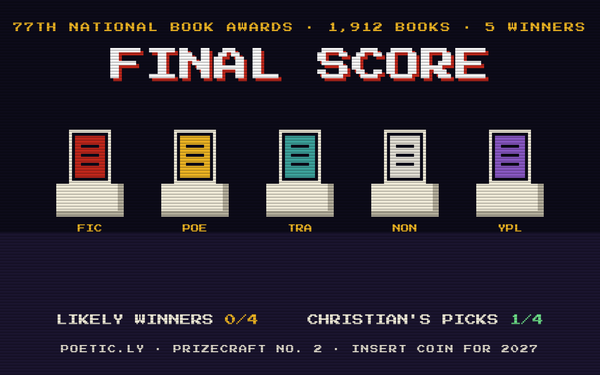
- 🧮 Christian’s picks, scored: 1 for 4 (my “likely winners”: 0 for 4)
- 🗳️ The Two-Vote Test results for Fiction & Poetry
- 🏠 “House laurel”: my term for the honor 4 of the last 13 Fiction winners already held
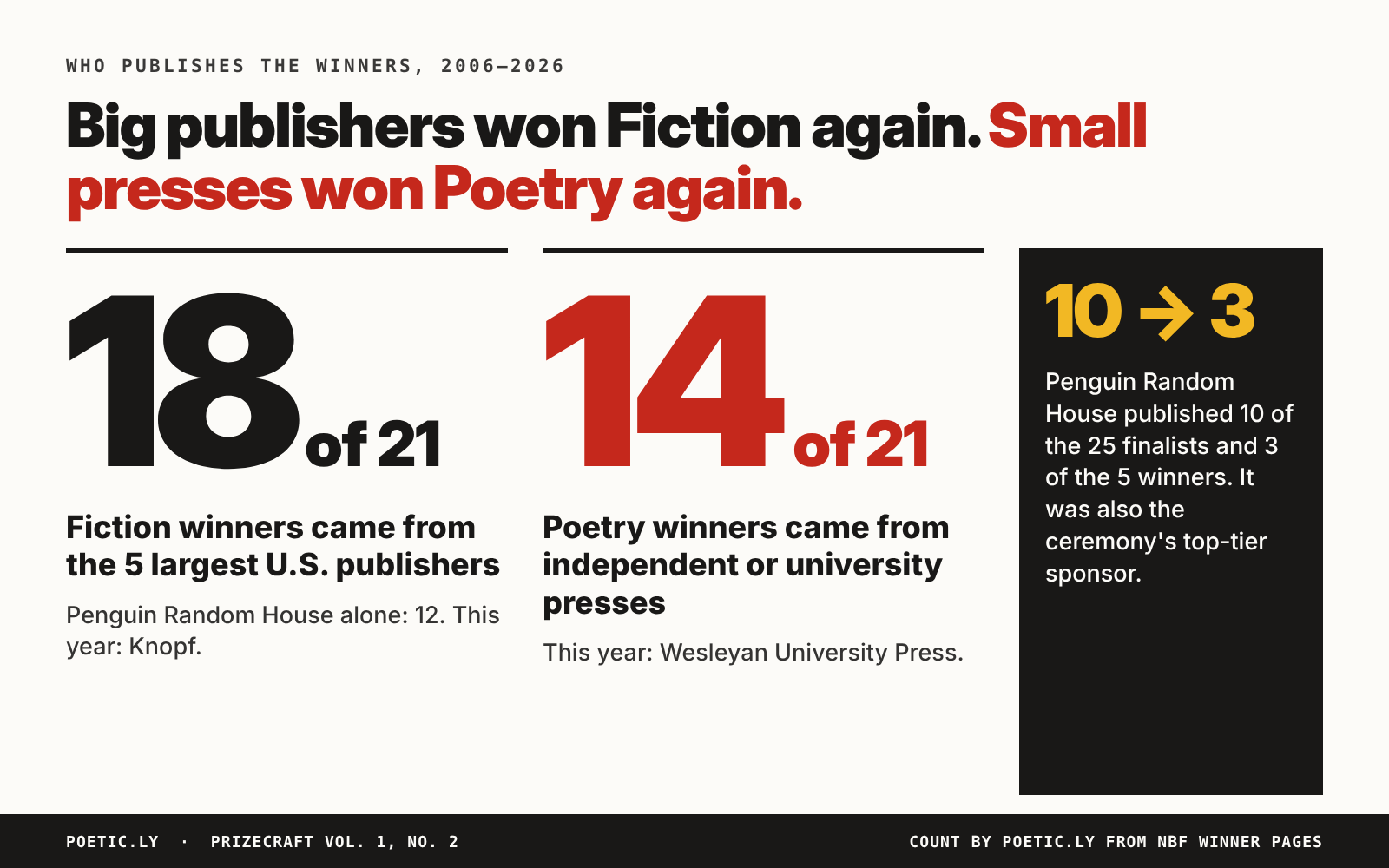
- 🏢 18 of 21 & 14 of 21: the publisher split, 1 year longer
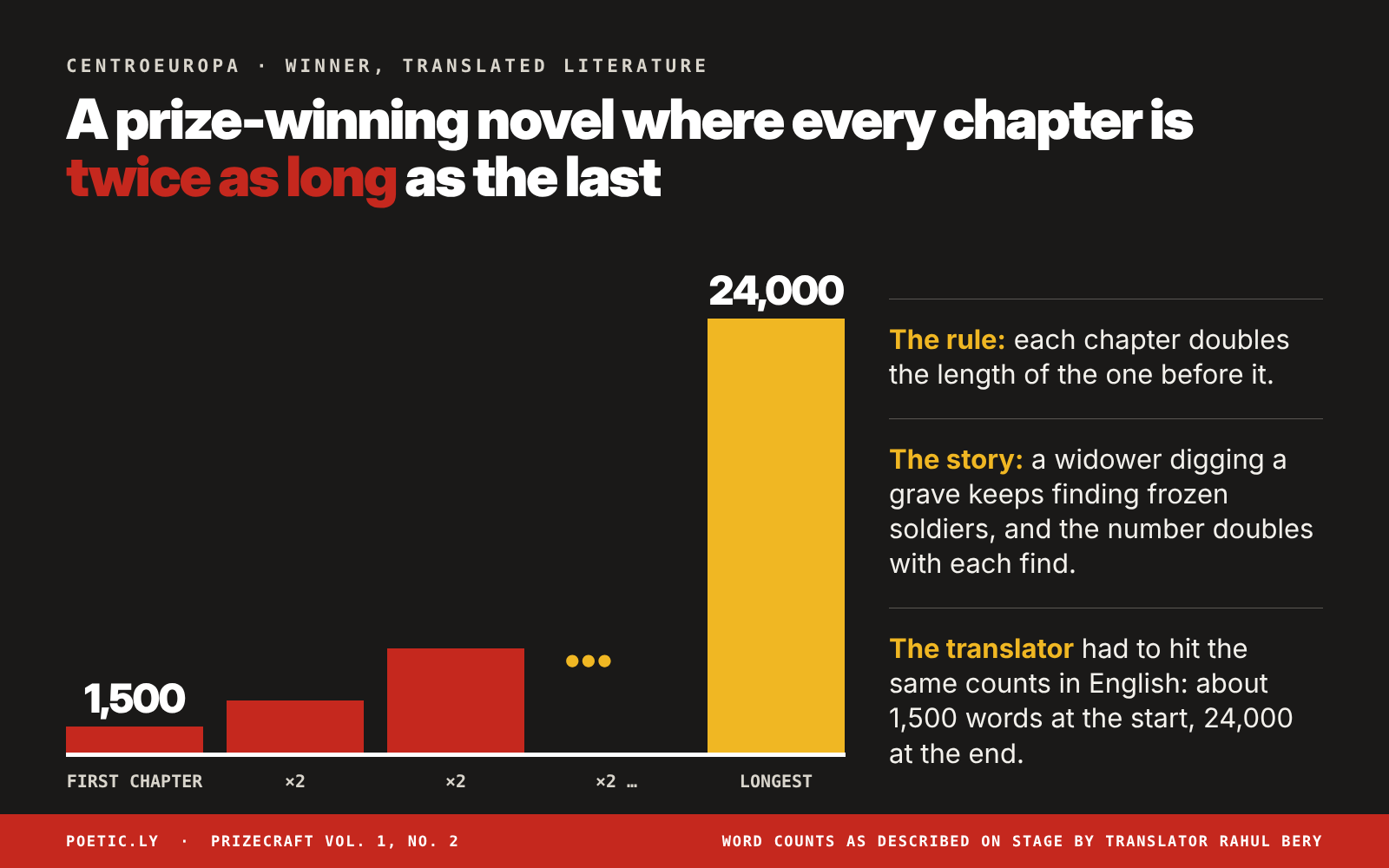
- 📐 1,500 → 24,000: the winning novel whose chapters double
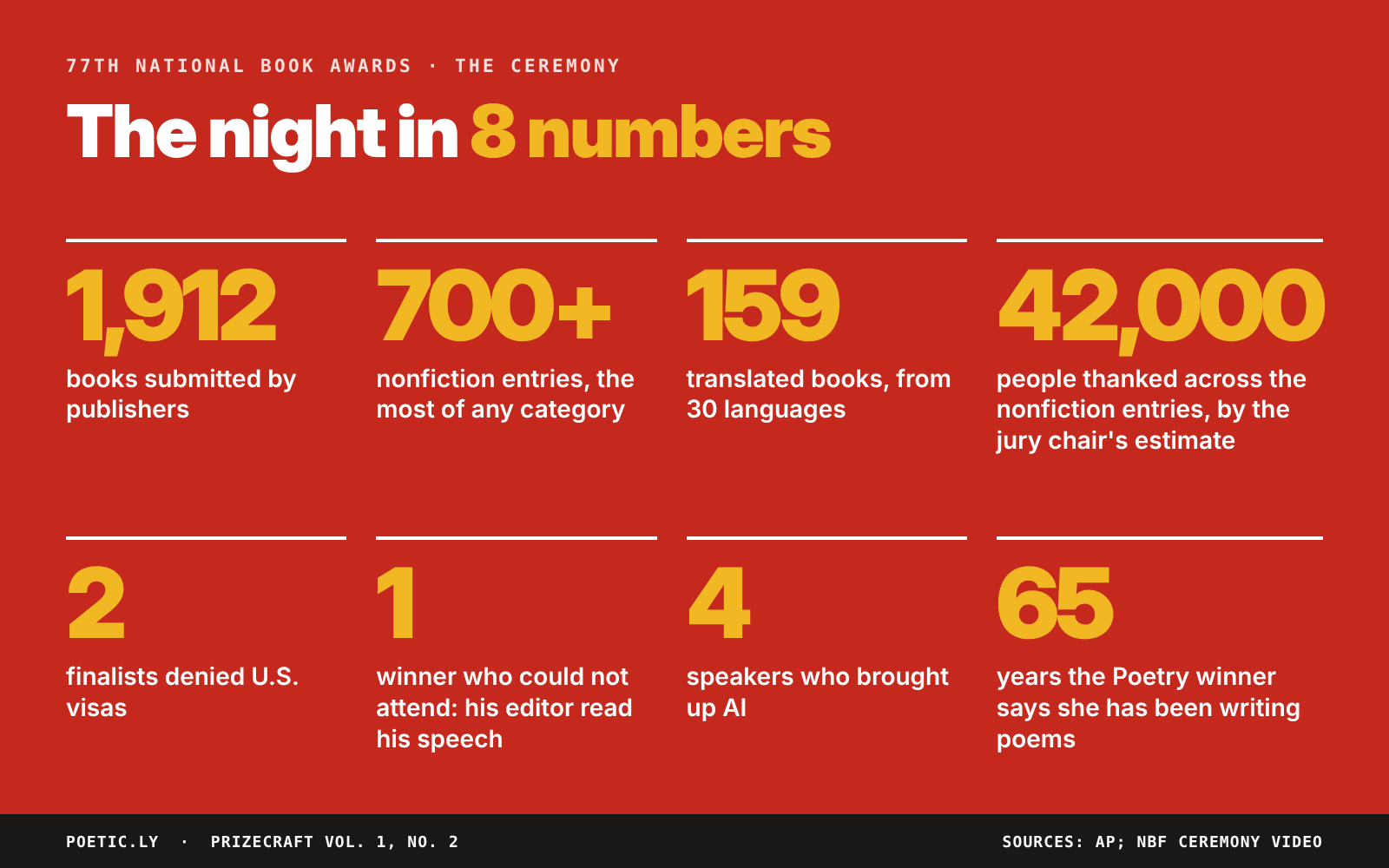
- 🎙️ The night in 8 numbers: 2 visas, 1 absent winner, 4 mentions of AI
- 💡 Insights for Writers & Readers
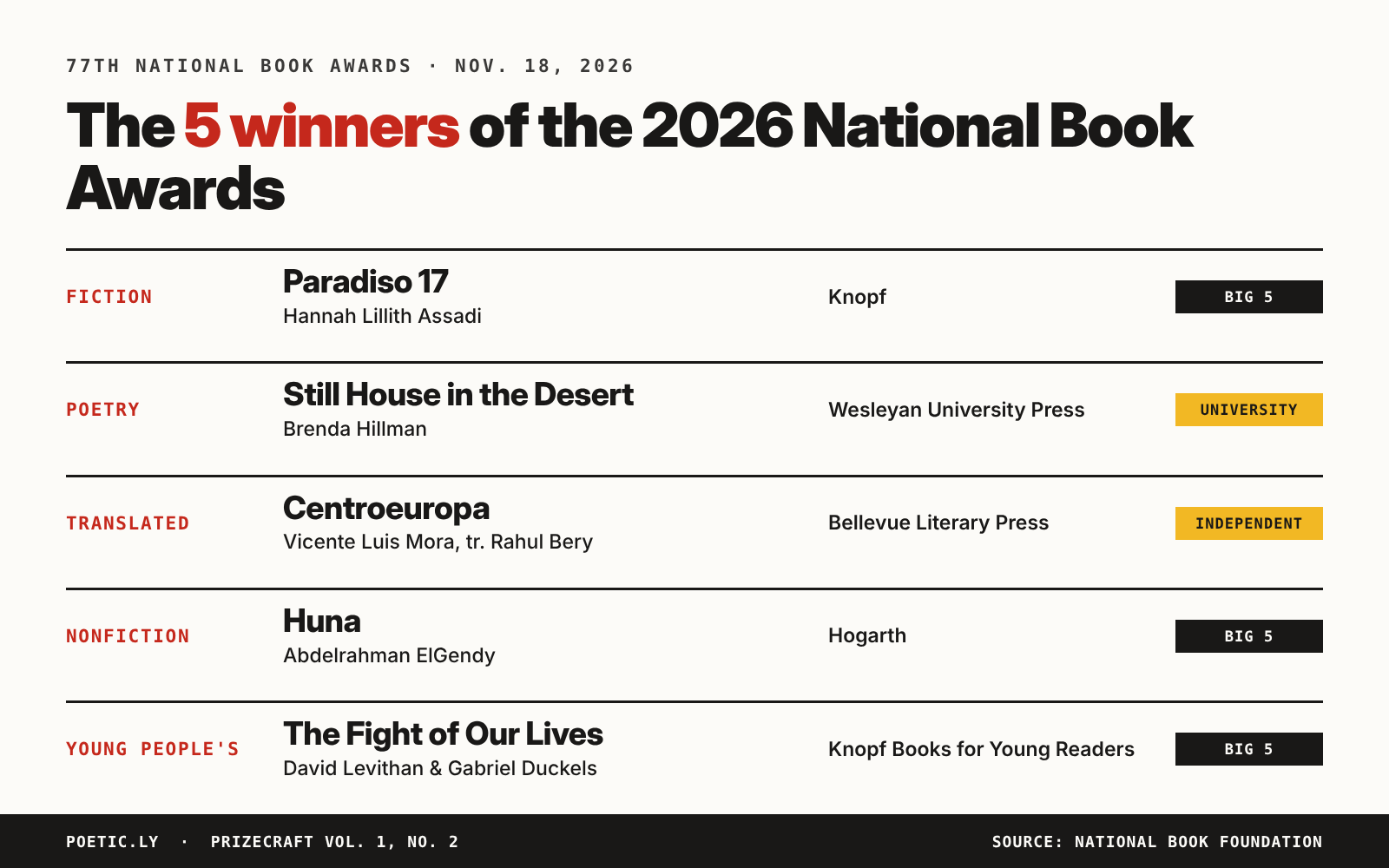
🏆 The 5 winners
The National Book Foundation named one winner in each of five categories on Nov. 18 at Cipriani Wall Street in New York, at a ceremony hosted by the actor Kyle MacLachlan. Each winner receives $10,000. Poetic.ly covers fiction and poetry, so those two get most of the attention below.
- Fiction: Hannah Lillith Assadi, Paradiso 17 (Knopf). Assadi’s third novel follows Sufien, a Palestinian man born shortly before the Nakba of 1948, through Kuwait, Italy, New York and Arizona. The novel begins at the end of his life and ends at its beginning. The judges’ citation calls it a portrait of “rupture and endurance.”
- Poetry: Brenda Hillman, Still House in the Desert: An eco-contemplation (Wesleyan University Press). Hillman’s twelfth collection describes her childhood home after her mother’s death, room by room and object by object. According to the Foundation’s page for the book, it completes a four-book series about time.
- Translated Literature: Vicente Luis Mora, Centroeuropa, translated from the Spanish by Rahul Bery (Bellevue Literary Press).
- Nonfiction: Abdelrahman ElGendy, Huna: A Memoir of Revolution, Prison, and Becoming (Hogarth).
- Young People’s Literature: David Levithan & Gabriel Duckels, The Fight of Our Lives: AIDS in America (Knopf Books for Young Readers).
Two lifetime honors were also given. Salman Rushdie received the Medal for Distinguished Contribution to American Letters from the novelist Kiran Desai, and the pediatrician and author Perri Klass received the Literarian Award for her work putting books into children’s medical checkups.
🧮 My scorecard: 1 for 4
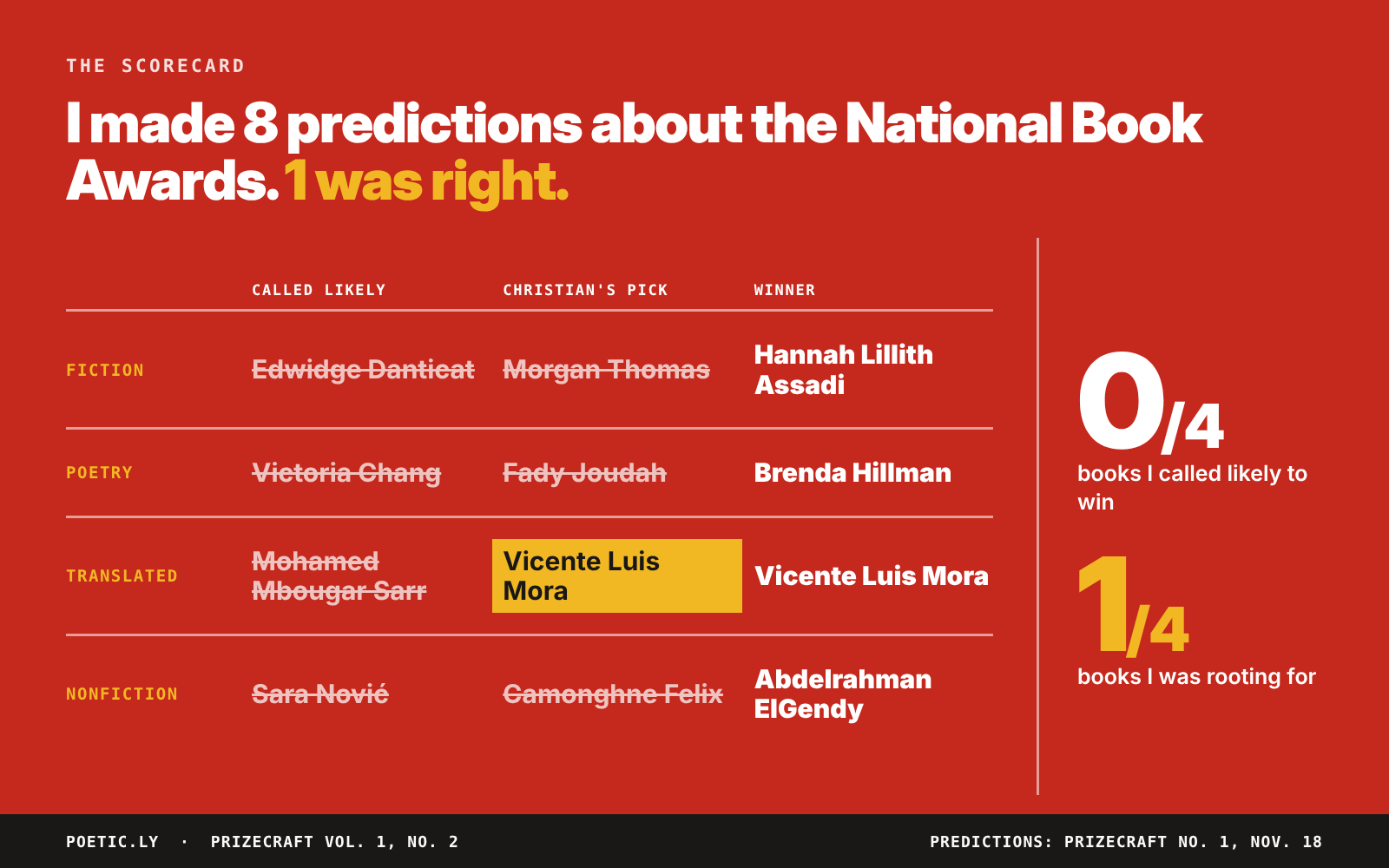
I promised to score my picks, and a forecaster who misses should say so near the top of the page, so here is the result. In No. 1 I named four books as the likely winners: Edwidge Danticat’s Dèy, Victoria Chang’s Tree of Knowledge, Mohamed Mbougar Sarr’s Pure Men and Sara Nović’s Mother Tongue. None of them won. I also named four books I was rooting for, and one of those did win: Centroeuropa.
The misses are worth more than the hit. I chose the likely winners by the two things the method says a jury weighs. The first is critical support. The second is what I call prelaurels: the degrees, fellowships, earlier prizes and earlier nominations a writer holds before a major win. On those two measures Danticat was the obvious choice in Fiction, because this was her third time as a finalist and she had never won. The Fiction jury chose someone else, and the reason it could do so is the reason I am adding a term to this series.
🗳️ The Two-Vote Test, scored
My formula from No. 1 was that a prize is a book plus a record. A jury weighs both, and I gave names to the two ends of the scale. The book vote rewards a book on its pages alone, as if it had arrived without an author. The career vote rewards a writer’s whole body of work, delivered through the one book in front of the jury. The Two-Vote Test asks five questions to tell them apart. Was the winner a finalist before? Do reviews praise the body of work more than this book? Did the book beat a debut with equally strong reviews? Is it the writer’s first or second book? Would it plausibly have won with a stranger’s name on the cover?
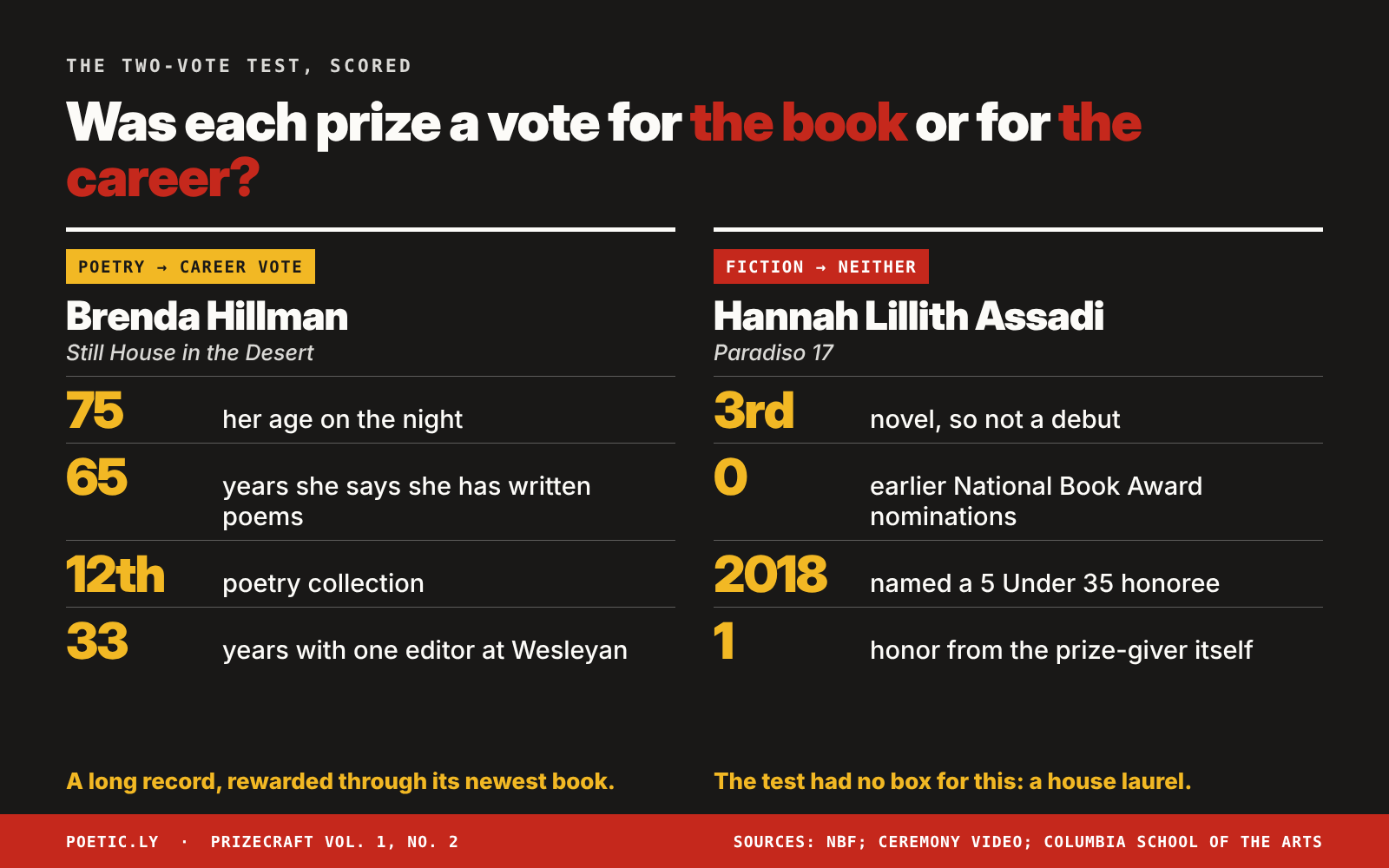
Poetry was a career vote. I predicted the career vote would decide Fiction. It appeared one category over. Brenda Hillman told the room she is 75 and has been writing poems for 65 years. This is her twelfth collection and the last volume of a four-book series. She has published with Wesleyan for decades, and she thanked Suzanna Tamminen, who she said has been her editor there for 33 years. The Foundation longlisted her in 2013 for Seasonal Works with Letters on Fire, which went on to win the Griffin Poetry Prize, but she had never been a finalist until this year. Her husband, the poet Robert Hass, won this same award in 2007, and she told the audience the two medals would now make a matching set. None of this lowers the book. It means that the jury could honor a book and a life’s work with a single decision, which is the respectable case for the career vote that I made in No. 1.
Fiction was neither. Paradiso 17 is Assadi’s third novel, so it fails the test’s question about first and second books. She had never been longlisted or named a finalist, so it fails the question about earlier nominations as well. It beat a debut (Morgan Thomas’s Mad Eden, my own pick) and a three-time finalist in the same field. The test returned a split result, and a split result usually means the instrument is missing a part.
🏠 House laurel: the honor the test was missing
I call it a house laurel when a writer’s prelaurels include an honor from the same institution that later awards the prize. Assadi holds one. In 2018 the National Book Foundation named her to 5 Under 35, its annual list of five fiction writers under 35 who have published a first book. The Foundation’s staff do not choose the list. Each honoree is selected by a writer the Foundation has already recognized, and Assadi was chosen by Claire Vaye Watkins, who had been a 5 Under 35 honoree herself in 2012.
One house laurel would be an anecdote, so I counted. The program began in 2006 and had named 100 writers by 2025. Since 2014, the first year one of them won, 4 of the 13 National Book Award winners in Fiction have come from that list: Phil Klay (honoree and winner in the same year, 2014), Charles Yu (honoree 2007, winner 2020), Justin Torres (honoree 2012, winner 2023) and now Assadi (honoree 2018, winner 2026). Three of those wins fall in the last seven years. Two of this year’s five Fiction finalists were on the list as well, because Valeria Luiselli was an honoree in 2014.
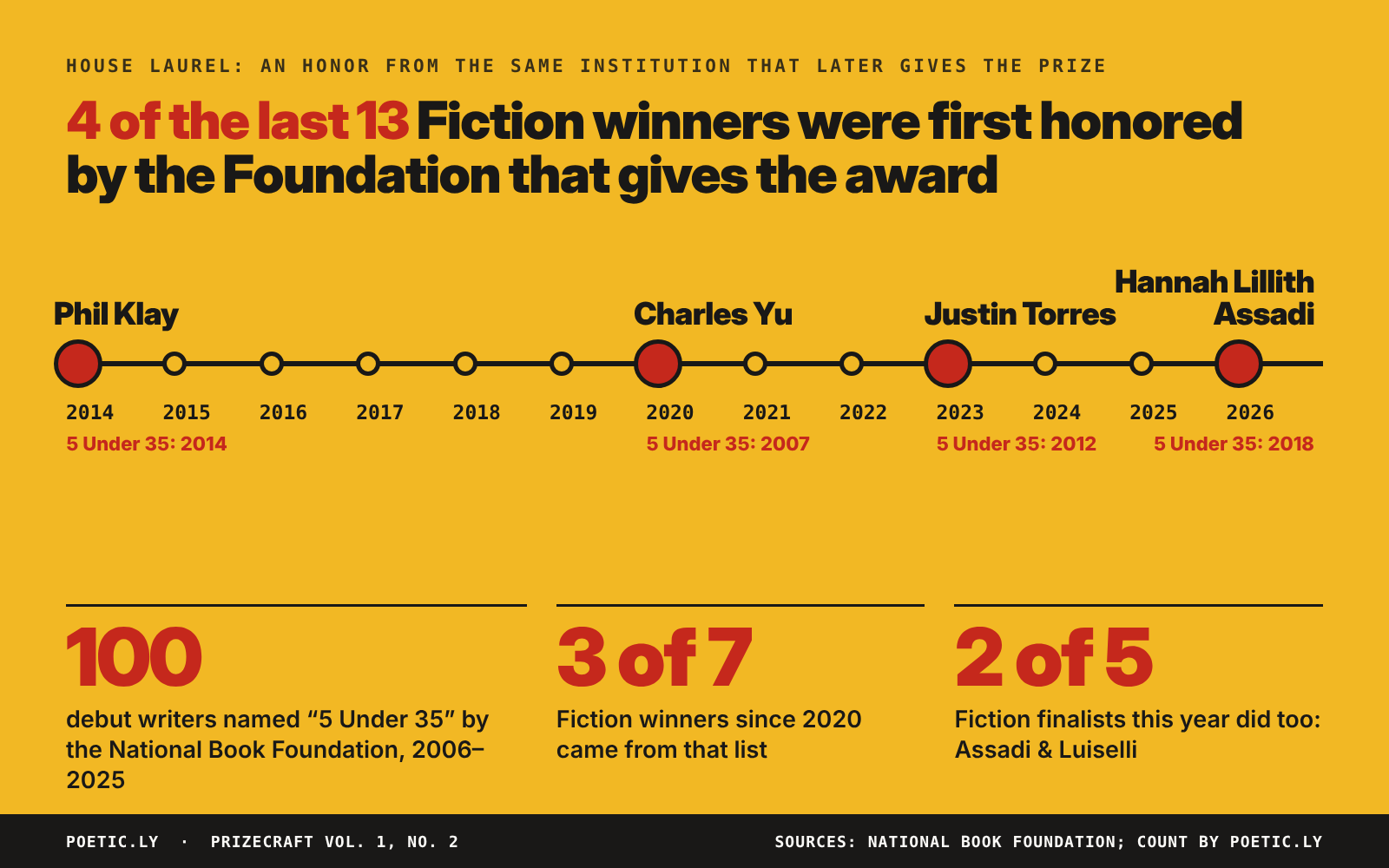
In No. 1 I borrowed a word from the French sociologist Pierre Bourdieu. In The Rules of Art he calls the process by which literary recognition is granted consecration, and he argues that it is handed down by people and institutions that were recognized first. I showed it running in a circle among the judges: one jury seat in four since 2008 went to a writer the award had already honored. The house laurel is the same circle seen from the writer’s side. A finalist chooses a young writer for the Foundation’s list. Eight years later a jury convened by the same Foundation gives that writer its largest prize.
There are two ways to read the count, and both can be true. The first is that the selectors are good at their job: they identify the strongest young writers early, and strong young writers go on to write strong books. The second is that an early honor from the prize-giver makes a writer familiar to exactly the people who later serve as judges. This year’s evidence favors the first reading more than I expected, because not one of the five Fiction judges had ever been a winner, finalist or longlisted writer for the award. I am adding a sixth question to the test anyway: has the institution giving this prize honored this writer before, in any of its programs?
🏢 The publisher split held for another year
In No. 1 I reported that from 2006 to 2025, 17 of 20 Fiction winners came from the five largest American publishing companies (Penguin Random House, HarperCollins, Simon & Schuster, Macmillan and Hachette), while 13 of 20 Poetry winners came from independent or university presses. Add this year’s results and the counts are 18 of 21 and 14 of 21. Knopf, which published Paradiso 17, belongs to Penguin Random House, and that company has now published 12 of the last 21 Fiction winners. Hillman used part of her speech to say that university presses rarely get the credit they deserve.
The scholar James F. English argues in The Economy of Prestige (2005) that a prize is an exchange: it turns money and sponsorship into prestige, and it turns critics’ esteem into sales. For one evening that exchange could be seen in a single ballroom. Penguin Random House published 10 of the 25 finalists and 3 of the 5 winners, and the chair of the Foundation’s board thanked it from the stage as the ceremony’s top-tier sponsor. I am not suggesting that the sponsorship influenced five independent juries. I am pointing out that the company with the most books in the room and the company underwriting the room were the same company, and that nobody present would have found this remarkable. That it is unremarkable is English’s whole point.
For writers the practical lesson from No. 1 was right in both categories: a poetry manuscript’s likeliest road to this award runs through a small press, and a novel’s runs through a large one.
📐 The pick I got right: a novel whose chapters double
How much can a rule do for a novel? I said in No. 1 that I root for books that change what their form can hold, and the one pick of mine that won is the purest example on any of this year’s lists. Centroeuropa is set in Prussia in the early 1800s. A widower named Redo Hauptshammer digs into frozen ground to bury his wife and finds the preserved bodies of soldiers. He keeps digging and keeps finding more, and according to the Arts Fuse review the number of bodies doubles with each discovery.
The form does the same thing as the story. According to the publisher’s description, each chapter is double the length of the one before it. Accepting the award, Rahul Bery gave the scale: the first chapter runs about 1,500 words, he said, and the doubling carries on up to 24,000. He had to reproduce those counts in English, and he said the labor was nearly as painful for him as it must have been for the author. He added that, in a year when everyone is discussing artificial intelligence, he likes to think this is work a computer could not yet do.
Writing under a strict rule that the writer invents has a history. In 1960 a group of French writers and mathematicians founded Oulipo, a workshop devoted to exactly this, and its best-known product is Georges Perec’s novel La Disparition (1969), which never uses the letter e. The question a rule like that must answer is whether it is a stunt or a meaning. In Centroeuropa it is a meaning: the history under Redo’s field grows faster than he can dig, and the reader feels that growth physically, because each chapter takes twice as long to read as the last.
🎙️ The night in 8 numbers
- 1,912 books were submitted by publishers this year, according to the Associated Press.
- 700+ of those were nonfiction, the most of any category, said the Nonfiction chair, Robert Warrior. The Translated Literature chair, Christopher Merrill, said his panel read 159 books from 30 languages.
- 42,000 is Warrior’s estimate of the people behind the nonfiction entries. He counted the names in the acknowledgments of his panel’s ten longlisted books, found between 19 and 102 per book (an average of 59), and multiplied.
- 2 finalists, ElGendy and the Syrian writer Samar Yazbek, were denied visas to enter the United States, the Foundation told the AP. The State Department declined to discuss individual cases.
- 1 winner could not attend. ElGendy’s editor at Hogarth accepted for him and read his speech, in which he recalled imagining, as a political prisoner in Egypt, the acceptance speech for a memoir he had not yet written.
- 4 speakers brought up artificial intelligence: the host (as a joke), the Young People’s Literature chair, David Levithan and Rahul Bery.
- 65 years of writing poems, by Hillman’s own count. She also asked the press to include poetry on best-books lists, and noted that the poetry award is handed out in the middle of the program.
- 51 years have passed since Salman Rushdie’s first novel, which he said was widely dismissed. He thanked Ursula K. Le Guin, who he said was nearly the only person who liked it.
Assadi closed the ceremony. She said the book began at her father’s deathbed, and that while writing it she lived through private grief for him and public grief for Palestinians in Gaza. She described the result as a story of beauty and pain together. “Isn’t that story all of ours?” she asked, as the AP reported. She also thanked her agent, PJ Mark, and her editor, John Freeman, by name, and writers who keep lists of who represents and edits whom should note both.
One book was absent from the room altogether. Marlon James’s The Disappearers, my biggest snub of the year, was cut between the longlist and the finalists. The AP reports that James told Time he thinks American judges, unlike British ones, feel obliged to push back against popular books. I made the case for his novel in No. 1 and I have not changed my mind.
💡 Insights for Writers & Readers
- 📖 Readers: read Paradiso 17 and then answer the test’s fifth question yourself. Would this book have won with a stranger’s name on the cover? Your answer tells you whether you think this year’s Fiction award was a book vote.
- ✍️ Writers, on house laurels: they exist at every level of publishing. A magazine’s contest winner later appears in its pages, and a press’s first-book prize leads to a second contract. List the institutions you hope will one day publish or honor your work, then find the smaller programs those same institutions run for writers at your stage.
- 📐 Writers, on rules: try the doubling rule at small scale. Write a piece in five parts of 100, 200, 400, 800 and 1,600 words, and notice what the widening space makes you add.
- 🏢 Poets & novelists: the publisher split has now held for 21 years of winners. Plan your submissions with it in mind.
- 👇 Everyone: tell me in the comments which vote you think decided Fiction: the book, the career or the house laurel.
You can watch the whole ceremony on the National Book Foundation’s YouTube channel. The Poetry award begins at 1:35:53 and the Fiction award at 2:05:47.
Sources: National Book Foundation winner pages and ceremony video; Associated Press; Literary Hub; Publishing Perspectives (2018). Speech details are from the ceremony video’s automatic captions and are paraphrased. Publisher, jury and 5 Under 35 counts are by Poetic.ly from the Foundation’s pages.
The series: how literary prizes are decided
- No. 1: 2026 National Book Awards Analysis
- No. 2: 2026 National Book Award Winners: What the Results Show About How Literary Prizes Are Decided (you are here)
- No. 3: How Literary Prize Winners Changed Over 100 Years
- No. 4: Who Decides the National Book Award? 76 Years of Judges, Counted (arrives Sun Nov 22, 10 am ET)
- No. 5: How the Pulitzer Prize Picks a Winner, and Why It Sometimes Picks No One (arrives Tue Nov 24, 10 am ET)
- No. 6: 30 Books Were Judged for Both the National Book Award and the Pulitzer. The Juries Agreed on 4. (arrives Thu Nov 26, 10 am ET)
- Also: Who Publishes Prize-Winning Poetry? The Canon Atlas
✦ Prizecraft is our series on how literary prizes are decided: the juries, the publishers, the numbers, and what writers and readers can do with them. A new part every other day. ✦