Why I'm Testing AI on My Own Fiction
✦ Slopcraft | My AI manifesto ✦ 51% of novelists expect AI to replace them. I ran it on my own pages to find where it helps, where it fails & what stays ours.

AI is coming for creative writing whether writers approve or not, & it gets closer by the day. In a 2025 University of Cambridge survey of 258 published novelists in the UK, 51% said AI is likely to end up replacing their work entirely. In the same survey, 33% already used it somewhere in their process.
I can't stop that change, & neither can you. What a writer can do is find out exactly what these tools are good for & exactly where they fail, on real pages, with the counting left in. That is why I use AI in my own work & publish what happens: I'm trying to establish its true merits & its true limits.
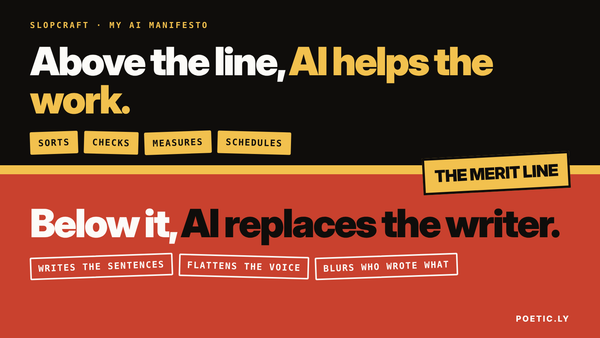
I call the boundary between the two the Merit Line: my term for the point where an AI tool stops helping the work & starts replacing the writer. Readers get honest numbers in place of hype or panic. Writers get tests they can run on their own drafts.
This is the first entry in Slopcraft, my name for this series: 1 writer's tests of AI on real writing, to find where it earns its place & where it turns out slop. It is also my AI manifesto.
Inside this post
- 📈 51%, 33% & 97%: what 258 novelists told Cambridge
- 📏 “The Merit Line”: my term for the point where AI help ends
- 🏛️ Plato to Ted Chiang: 2,400 years of writers testing new tools
- 🧪 3 wins + 4 failures from AI on my own work
- 🛡️ The objective: 3 promises behind every AI review
- ✅ Try it now: find your own Merit Line
The change is already here
The Cambridge report, written by Dr Clementine Collett, shows a profession that rejects AI authorship & feels it arriving anyway. 97% of the novelists were “extremely negative” about AI writing whole novels. Yet a third already use it, mainly for tasks such as finding information, & 39% say generative AI has already cut their income. Collett calls the novel a form of creativity “worth fighting for.” (University of Cambridge)
Slopcraft · The change
258 novelists answered. 51% expect AI to replace their work.
51%
Reject AI writing whole novels
They told Cambridge they were “extremely negative” about it.
Already use AI in their process
Mainly for tasks like finding information, not for the writing.
Say AI has already cut their income
85% expect it to fall further.
Survey of 258 published UK novelists by Dr Clementine Collett, University of Cambridge, 2025.
Those numbers describe an existential change for anyone who writes. A writer who refuses to look at the tools learns nothing about them. A writer who lets the tools write learns nothing either. I want the third option: measure them.
The Merit Line
Every AI tool has a Merit Line. On one side it saves a writer time: it sorts files, checks facts against a record, measures a draft, schedules a post. On the other side it replaces the writer: it produces the sentences, flattens the voice & blurs who wrote what. My first rule for using AI in writing is the one I published this week: don't let AI write for you.
Disclosure: I build Nib™✏️, a manuscript editor that measures a draft & never writes over the writer. Weigh my verdicts with that in mind.
The philosophy behind it
This position is 2,400 years old. Each time a new writing technology arrived, the serious response was the same: test it, name what it gives & name what it takes.
Plato: the maker is a poor judge of the tool. In the Phaedrus (about 370 BCE), the god Theuth presents his invention, writing, to King Thamus & promises it will improve memory. Thamus answers that an inventor is “not always the best judge” of what his invention does to the people who use it, & warns that writing will weaken memory (Jowett translation). The point for us: the companies that build AI can't be the ones who rule on its worth. Writers have to.
Derrida & Stiegler: every writing tool is a drug. The Greek word Plato uses for writing is pharmakon, which means both remedy & poison. Jacques Derrida built his essay “Plato's Pharmacy” on that double meaning, & the philosopher Bernard Stiegler extended it to all technology: the same tool harms & heals, so the work is to learn the dose (Philosophy Now on Stiegler). The Merit Line is my name for the dose.
Kant: critique means finding the limits. When Immanuel Kant called his 1781 book a critique of reason, he did not mean an attack. He meant an examination of what reason can do & where it stops. That is the sense in which I am a critic of AI: I want its true merits & its true limits on the record.
McLuhan: artists go first. Marshall McLuhan argued in Understanding Media that art works like radar, “an early alarm system” that shows a society what a new technology is doing to it while there is still time to respond (McLuhan quotations). If writers refuse to touch the machine, nobody sounds the alarm in our field.
Calvino: the machine combines, the person means. In his 1967 lecture “Cybernetics and Ghosts,” Italo Calvino imagined a machine that writes literature by running every possible combination of words. He concluded that the machine can produce the combinations, but the poetic effect happens only when one of them strikes a living person with a history & an unconscious (CCCB Lab on the lecture). That is the limit side of the Merit Line, stated 55 years before ChatGPT.
Vara & Chiang: writers already running the test. The novelist Vauhini Vara had an early AI model help her write “Ghosts” (The Believer, 2021), an essay about her sister's death, & kept testing the tools on her own writing in her 2025 book Searches. Ted Chiang argued in The New Yorker in 2024 that art comes from making a great many choices, & that a prompt hands most of those choices to the machine. One writer tested the tool on her own grief; the other named what it can't do. I want both halves: the test & the limit.
Slopcraft · The philosophy
Writers have tested new tools for 2,400 years.
Plato
The inventor is not the best judge of the invention.
Kant
Critique means finding what a power can do & where it stops.
McLuhan
Art is radar: an early alarm for what a technology is doing to us.
Calvino
The machine combines. Meaning happens in a person.
Derrida
Writing is a pharmakon: remedy & poison in 1 word.
Vara
A novelist tests AI on her own essay about grief.
Chiang
Art comes from choices a prompt can’t make.
Dates are first publication or first delivery. Sources linked in the text above.
What I've measured so far
I have run 2 public tests. I used Sudowrite, an AI writing app, on a 10,337-word story of my own, & it failed 4 of my 5 tests (the full review). I also assigned an AI the build of our full-text library. Its reports climbed to 102,326 while the library held 469, & I had to push our launch back a week (the full account).
The same tools also did real work. In the 24 hours after I found the library error, the AI re-measured 506 prose pieces from 11 journals in an afternoon & exported 705 industry contacts for Query™. One Sudowrite plugin had my narrator ask me which language his mother used to speak, a question that sent me back into my own story.
Slopcraft · The Merit Line so far
AI earned its place 3 times. It failed me 4 times.
Where it earned its place
Prose pieces re-measured in 1 afternoon
From 11 journals, after we rebuilt the analyzer.
Industry contacts exported for Query™
Minutes of work in place of days.
Plugin question worth keeping
It had my narrator ask which language his mother spoke.
Where it failed
Of my story read at once
1,000 of 10,337 words.
Cargo lists treated as true
I changed a fact. The app kept all 3 versions.
Full texts, where the reports said 102,326
0.46% of the count was the real library.
Did its writing sound like me?
It did not.
From 2 public tests in November 2026: Sudowrite on a 10,337-word story draft & the Poetic.ly library build.
Next in Slopcraft: I will put 100 prizewinning stories through AI feedback tools & publish what the machines say about fiction that judges have already rewarded.
The objective
There has to be a valiant objective in all of this, & mine is plain: keep the writing human by knowing the machine exactly. Fear tells a writer nothing about a tool, & neither does a sales page. A count does. So every AI review I publish keeps 3 promises.
Slopcraft · The objective
3 promises behind every AI review I publish.
Real pages
I test on a manuscript I care about, never on demo text.
Every count
I publish the wins & the failures, with the numbers.
My own sentences
AI sorts, checks & measures. It does not write for me.
Christian Harder, Poetic.ly, November 2026.
Readers get a straight account of what these tools do to a manuscript. Writers get the 5 tests & the numbers behind every verdict, so each of you can decide where your own Merit Line sits.
Try it now
- List every task you gave an AI tool this month. Mark each one “it helped” or “it replaced me.”
- Run the 5 tests on the writing app you pay for.
- Check 1 number an AI gave you this week against its source.
Tell us where your Merit Line sits.