
How National Book Award Winners Have Changed in 76 Years
✦ Prizecraft | Vol. 1, No. 3 ✦ What does a prize-winning poem or story sound like, who decides, and has it changed? 76 years of winners + judges, measured, in a 3D model you can turn.


Is there a recognizable prize-winning style, and can it be counted? I wanted an answer that did not depend on anyone's taste, mine included. So we took a poem or a short story by every National Book Award winner in Fiction and Poetry we could find in the journals that first printed them, from 1950 to 2026, and measured each one with the same tools: Nib™✏️ for the language, Fabulist™ for the shape of a story. The clearest result is in the poems. The median winning poem of 1950–79 used “I,” “me,” “my” or “we” 14.3 times per 1,000 words. The median winning poem since 2000 uses them 41.7 times. I call that number the I-rate, and I built the 3D model below so you can turn 76 years of it in your hands.
Drag to turn the model · scroll or pinch to zoom · tap any light for the writer, the piece and a link to read it. Three views: Poems, Stories, Judges. Each view has its own measures along the top right.
Inside this post
- 🧊 1 model in 3D: 62 poems, 17 stories + 667 judges’ seats, 1950 to 2026
- 🗣️ The I-rate: my term for “I” per 1,000 words. 14 then, 42 now
- 📖 Stories: first person 17% then, 59% now + fewer quotation marks
- 🎓 Judges: 0 writing degrees in the 1950s, 56% in the 2010s
- 🔎 A searchable directory of every winner & every judge
- ✍️ Insights for Writers & Readers + Try it now
What a winning poem sounds like
When I taught English literature I gave students one test for a lyric poem: find the pronoun and you have found the speaker. The I-rate turns that test into a number. Nib™✏️ counts every first-person word in a poem (I, me, my, mine, we, us, our) and divides by the poem’s length, so a 100-word poem and an 800-word poem can be compared.
Among 27 poems by winners of the 1950s, 60s and 70s, the median I-rate is 14.3. Among 23 poems by winners since 2000, it is 41.7. A third of the early poems (33%) used more than 30 first-person words per 1,000. Since 2000, 78% do.
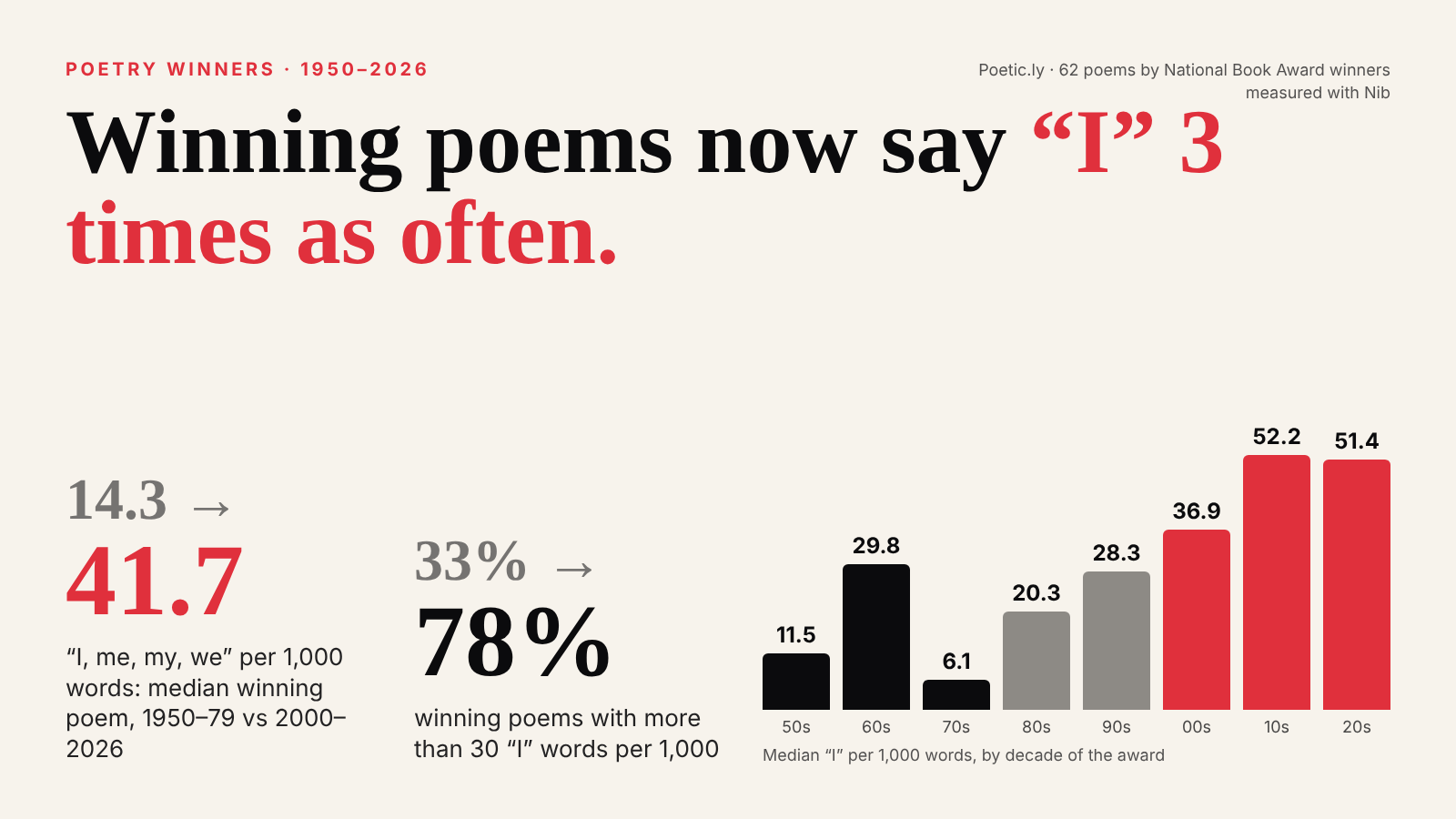
The decade bars hold the surprise. The I-rate did not climb steadily. It fell to 6.1 in the 1970s, the lowest of any decade, and then rose for 40 years. The poems behind that low bar are easy to name: James Merrill’s “Trees Listening to Bach” and Frank O’Hara’s and A. R. Ammons’s pieces contain no first-person word at all, and John Ashbery’s 784-word “Syringa” has 3.8 per 1,000. At the other end, Lucille Clifton’s “Jasper, Texas, 1998” (116 per 1,000) and Patricia Smith’s “Sophiatown Symphony” (110) say “I” in roughly 1 word of every 9.
That dip matches what critics say happened. In Lyric Shame (Harvard University Press, 2014), Gillian White argues that from the 1970s on, American poets and critics grew embarrassed by the personal, expressive “I” and began to treat a poem that sounded like one person confessing as naive. She names the feeling in her introduction: “what I call lyric shame.” Her claim matters here because our count gives it a date and a size. The prize’s poems avoided “I” most in exactly the decade she identifies, and the prize has spent the years since reversing it. White’s introduction is excerpted here.
Two smaller changes travel with it. Lines that end without punctuation, so the sentence runs over the line break, rose from 47.5% to 62.5% of lines. And 52% of recent winning poems ask at least 1 question, against 37% before 1980.
What a winning story sounds like
Fiction winners are novelists, so their short stories in journals are rarer: we found 17, of which 12 are by winners from 1957 to 1999. To see the present clearly we set those 12 beside the 469 short stories Fabulist™ has measured from 6 literary journals between 2000 and 2026 (The Georgia Review, The Iowa Review, Ploughshares, The Kenyon Review, The Threepenny Review and Fugue). These are different kinds of sample, and I say so plainly: the left number is prize winners, the right number is the magazines that today’s prize winners come up through.
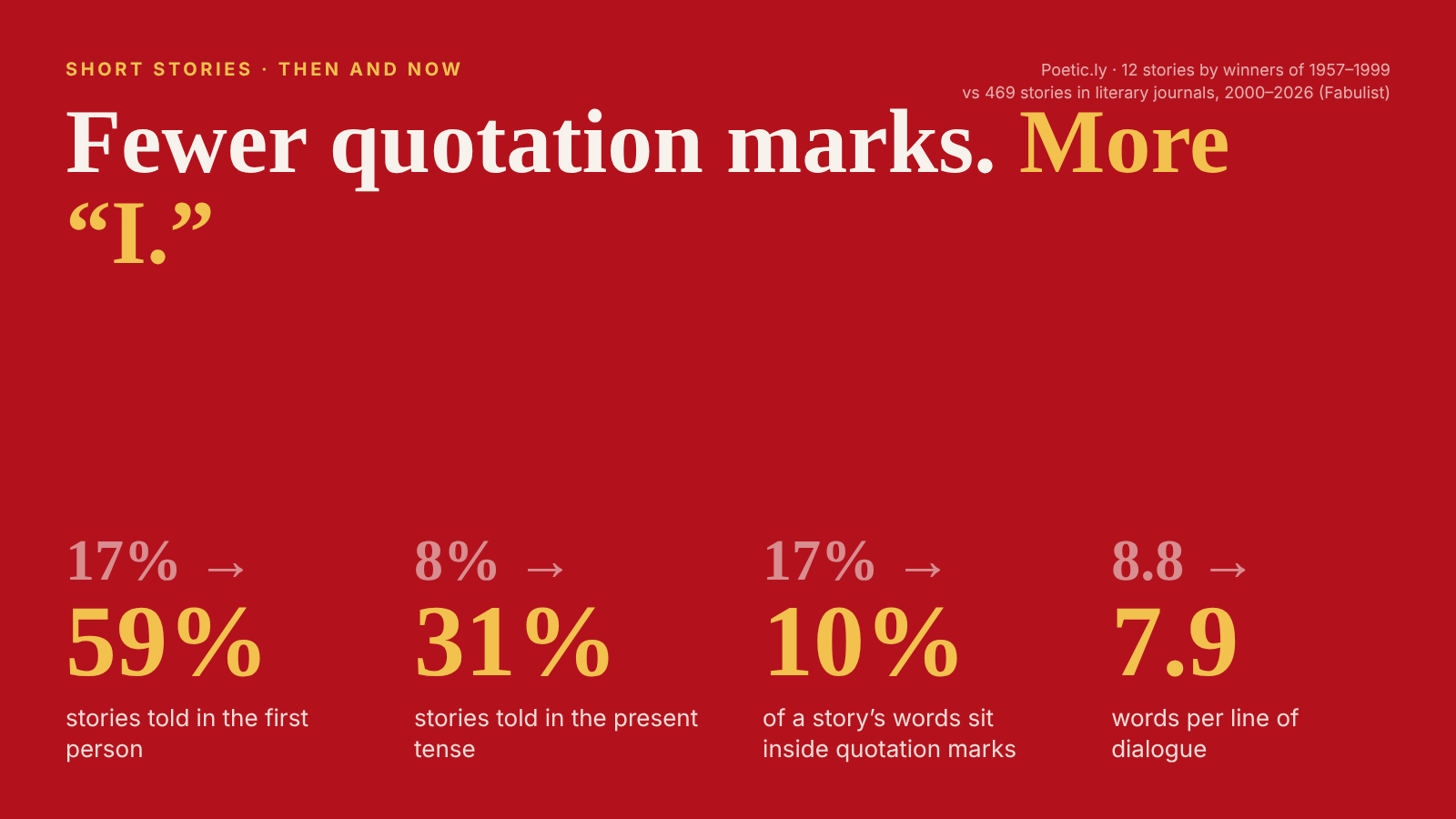
Of the 12 earlier stories, 2 are narrated by an “I” (John Irving’s “Vigilance” and Ha Jin’s “Emperor”). Of the 469 journal stories, 275 are: 59%. Only 1 of the 12 is in the present tense, Don DeLillo’s “Coming Sun. Mon. Tues.” from 1966; 144 of the 469 are, or 31%. And the share of a story’s words that sit inside quotation marks fell from 17% to 10%. Characters still talk, but more of the talk has moved into the narrator’s own telling.
The present tense has been argued over before. On October 11, 1987, William H. Gass published an essay in The New York Times Book Review titled “A Failing Grade for the Present Tense,” complaining of a wave of young, school-trained writers who all narrated in it. Gass gave the habit a failing grade. The count says the habit stayed: nearly 40 years later it is the tense of almost a third of the stories in the journals we measured.
Who decides
A prize has two sides, the books and the people who choose them. For the second side we used the Index of Major Literary Prizes, a public dataset built by the scholars Claire Grossman, Juliana Spahr and Stephanie Young and published by the Post45 Data Collective. It lists every National Book Award judge from 1950 to 2020 with their degrees: 607 seats in Fiction and Poetry. We added the 60 seats from 2021 to 2026 from the National Book Foundation’s own pages.
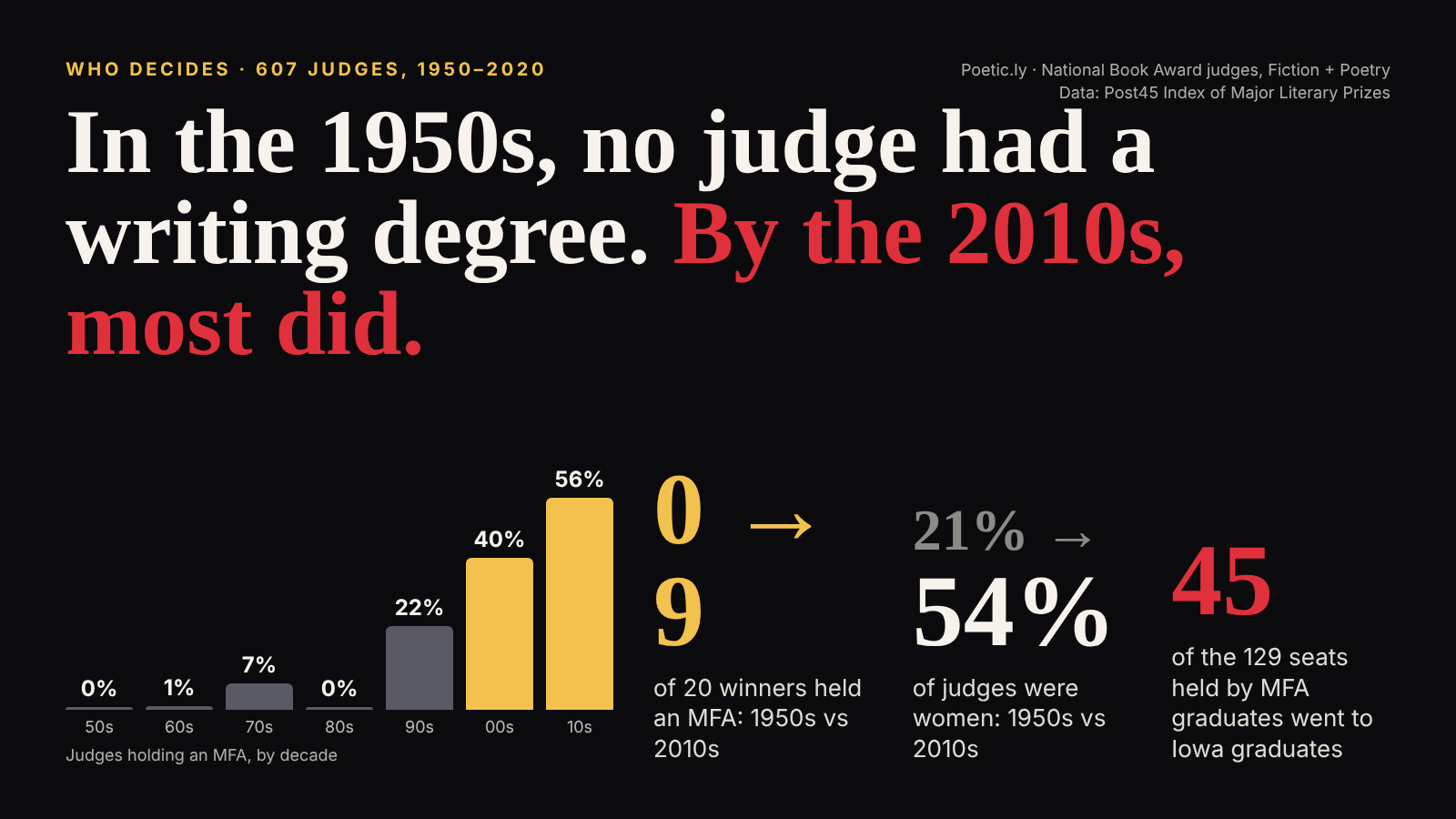
In the 1950s, none of the 104 judges held a Master of Fine Arts in writing. In the 2010s, 56 of 100 did, and among poetry judges it was 34 of 50. The winners changed more slowly: 0 of 20 winners in the 1950s had the degree, and 9 of 20 in the 2010s. Of the 129 judges’ seats held by someone with an MFA, 45 went to graduates of one program, the Iowa Writers’ Workshop. (I am an Iowa MFA and a former fellow there, which I mention every chance I get. This time the data gave me an excuse.) Women held 21% of the seats in the 1950s and 54% in the 2010s.
Grossman, Spahr and Young draw a hard conclusion from the wider dataset of 50 prizes: writers with a degree from an elite university are, in their words, “nine times more likely to win” than writers without one. Poets & Writers reports on their work here, and the data is public. Our model adds one thing to theirs: it puts the judges’ credentials on the same timeline as the sound of the winning work, so you can watch the two change together. It cannot tell you that one caused the other, and I will not pretend it can.
Every winner, every judge
Search 153 winners and 667 judges’ seats by name, year, writing program or journal. Where we measured a poem or story, its title links to the journal page on JSTOR, where you can read it in full.
Insights for Writers & Readers
For readers: when a shortlist is announced, you now have 3 things to check that are not opinions. How often does the book say “I”? Is it told in the present tense? And who is on the jury, and where did they train? None of these decides whether a book is good. Together they tell you how close a book stands to the center of its moment.
For writers: the numbers describe what won, not what will win. A high I-rate did not win Lucille Clifton a National Book Award; the poems did. What the count can do is show you where your own manuscript sits. If every poem in it has an I-rate above 60, you are writing inside the strongest current of the last 25 years, and a judge has read a great deal of it. If none does, you are writing against that current, as Ashbery and Merrill did in the 1970s, when that was the current.
Try it now
- Paste a poem of yours into Nib™✏️ and read the “First person” line. That is your I-rate.
- Do the same with a poem you love from before 1980, and one from the last 5 years.
- Open Fabulist™ and compare a story of yours with the 469 journal stories on point of view, tense and dialogue.
- Look up the judges of the prize you most want in the directory above, and read one book by each.
How we measured, and what is missing
- 62 poems and 17 stories, 1 per winner, read from the journals that printed them (The Kenyon Review, Poetry, The American Poetry Review, Ploughshares and others) through JSTOR. Only the measurements appear on this page.
- The piece is the one we could find closest to the award year. Some are years away from it: the Adrienne Rich poem is from 1987, the Louise Erdrich story from 1985.
- Seven pieces by fiction winners turned out to be essays, memoir or translation and were left out. No Poetry award was given from 1984 to 1990.
- 74 winning books, most of them novels, have no short piece we could measure. Reading those books themselves is the next step, and the model will grow as we do.
- Judges’ degrees are coded through 2020. The 2021–2026 judges are listed but not yet coded.
✦ Prizecraft is our series on how literary prizes are decided: the juries, the publishers, the numbers, and what writers and readers can do with them. Earlier: Vol. 1, No. 1. ✦


