2026 National Book Awards Analysis: 10+ Historic Wins/Snubs/Losses
[Prizecraft | Vol. 1, No. 1] The likely winners, the biggest snubs, and what 75 years of winners had already won


Every reader has closed a celebrated book and wondered who decided it was the best of the year, and on what grounds. Every writer has wondered something sharper: what it would take for that to be them. Literary prizes sit exactly where those two questions meet, which is why they are argued about so fiercely and understood so poorly. A prize presents itself as a judgment on one book. Look at enough winners, though, and it begins to look like a second judgment as well, on a whole life of writing, of which the winning book is only the latest and most visible part.
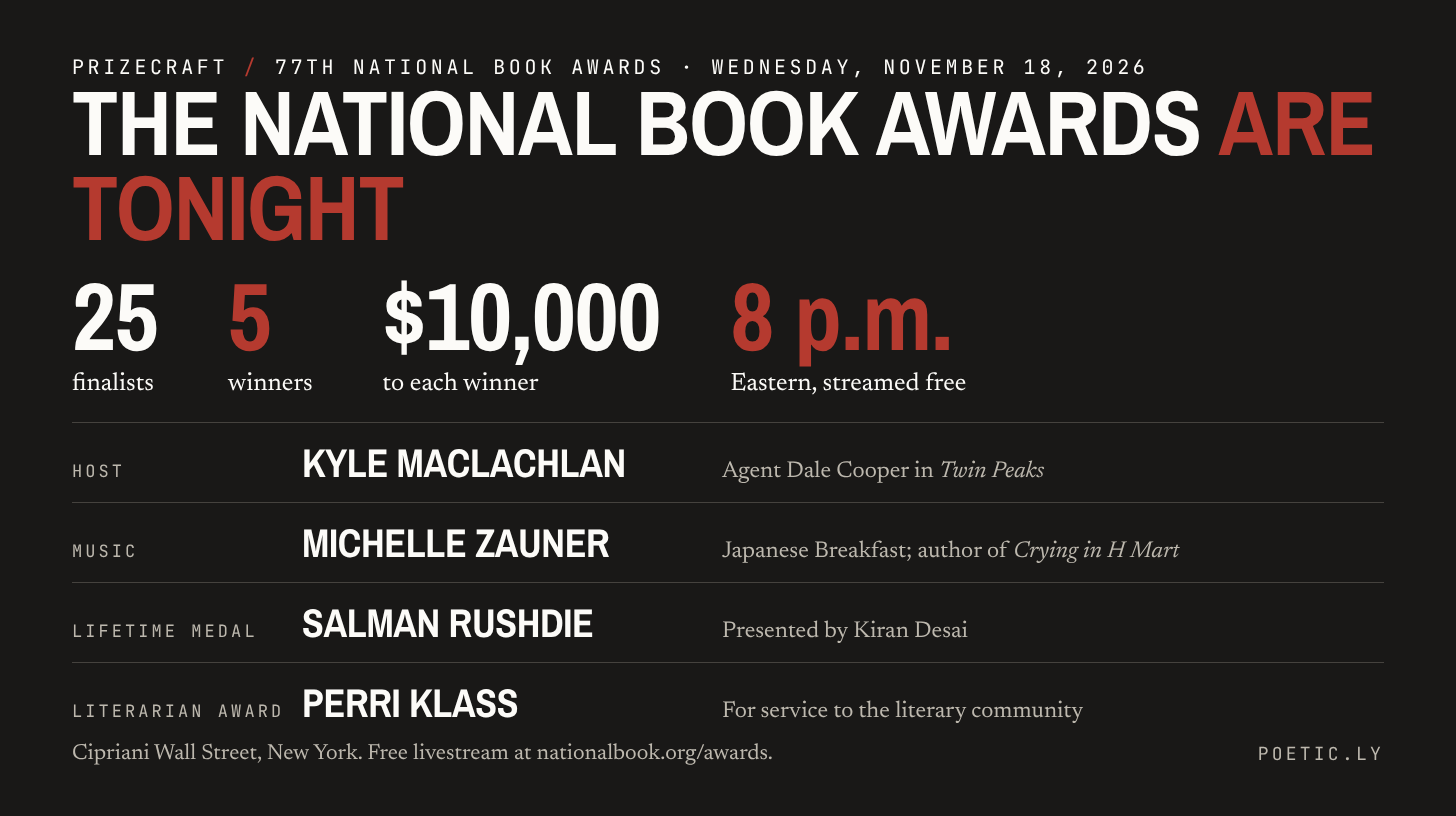
Tonight at 8 p.m. ET, the 77th National Book Awards name five winners from 25 finalists. The National Book Awards are among the most closely watched literary prizes in the United States. They began in 1936 as a booksellers' prize and took their modern form in 1950, when William Carlos Williams and Nelson Algren were among the first winners. A win brings $10,000, a bronze medal and a statue, and it puts a book in front of readers who would not otherwise have found it.
Officially, each award goes to a single book published in the past year. In practice, the choice is often also a judgment on the writer's whole record: the degrees, fellowships, earlier prizes and earlier nominations that came before this book.
This is Vol. 1, No. 1 of Prizecraft, our investigations into who wins literary prizes and why, with tools to plan your own path. Later issues compare this year's finalists with every finalist of the last decade, trace the schools, teachers and editors the winners share, and look closely at the books the prizes missed.
Inside this post:
- 📊 Data on each Fiction and Poetry winner since 1950
- 🏅 Prelaurels: my term for the record a writer brings to a prize
- 🕰️ How winners' credentials changed over 75 years
- 🧑⚖️ Tonight's 10 judges + who they'll probably choose
- 🏢 Who publishes the winners, and tonight's finalists
- 🔥 The biggest snubs of 2026, starting with Marlon James, plus five historic ones
- 🗳️ The book vote & the career vote: my terms for what the Fiction jury may really be deciding tonight
- 🏆 Likely winners + Christian's picks for winners
- 🧪 The Two-Vote Test: score tonight's winners yourself
- 💡 Insights for Writers & Readers.
📊 A Quick Primer on the Winners:
When a book wins, we tell the story backward from the stage: a writer, a book, a verdict. The more useful story runs forward, through everything the writer had collected before the book ever reached a jury. I call that collection the prelaurels: the degrees, fellowships, earlier prizes and earlier nominations a writer holds before the big win. Readers rarely see them. Juries see them constantly, in author bios, in jacket copy and in their own memories of earlier prize seasons, and they shape what a jury expects a winning writer to look like.
To make the prelaurels visible, I built an interactive slider that moves through every National Book Award winner in Fiction and Poetry from 1950 to 2025.
For each winner it shows the winning book, its critical reception, & what was already on the author's record: major prizes, fellowships, writing degrees and earlier books. The data comes from the Post45 Data Collective's Index of Major Literary Prizes, built by the scholars Claire Grossman, Juliana Spahr and Stephanie Young.
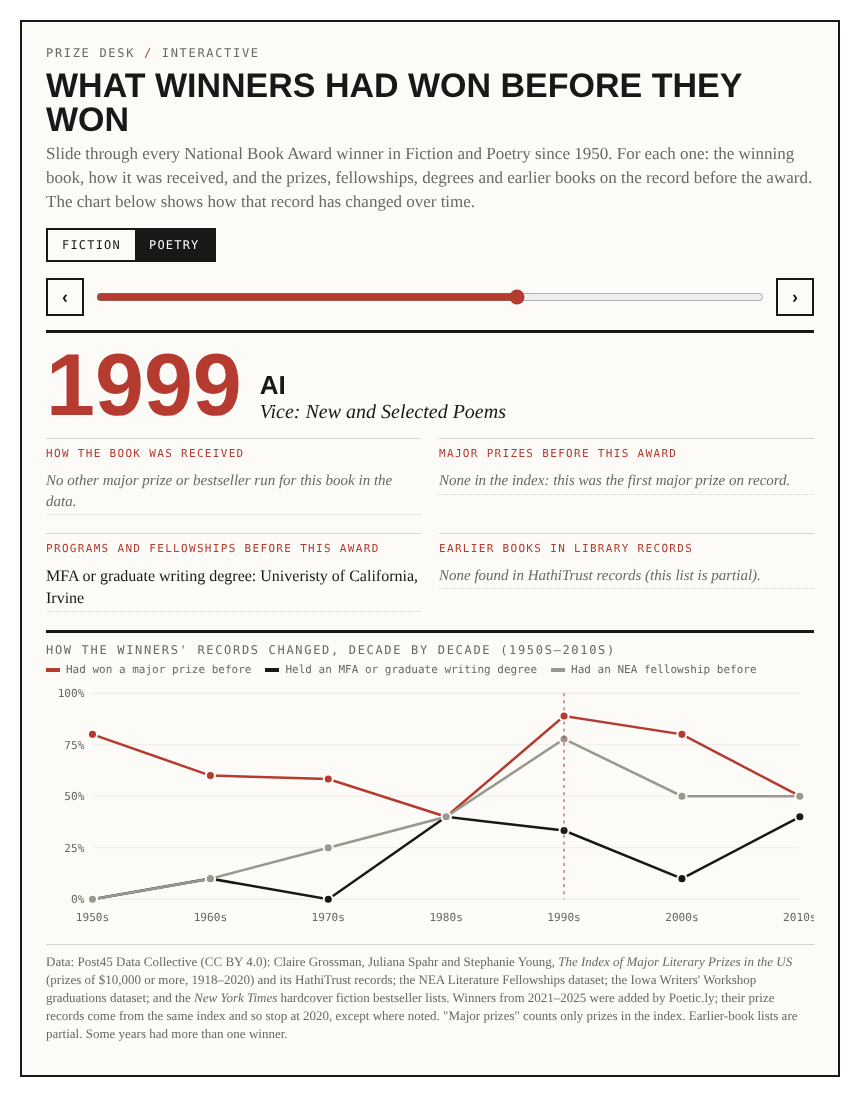
Try the slider on Poetic.ly: poetic.ly/national-book-awards-2026
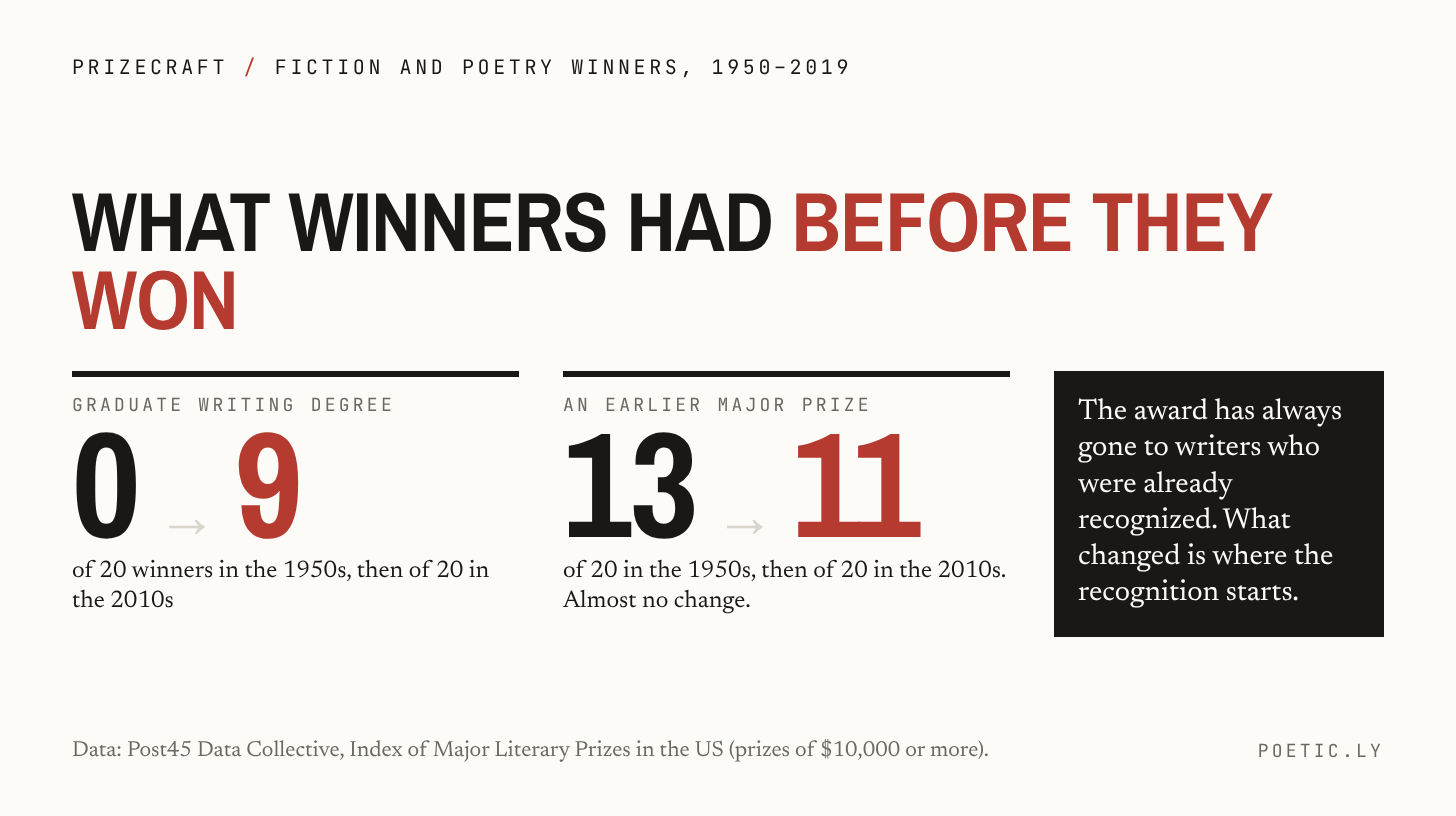
The biggest change is the writing degree. An MFA, or Master of Fine Arts, is a two- or three-year graduate program in which writers study craft and critique one another's manuscripts in small seminars called workshops. In the 1950s, none of the 20 Fiction and Poetry winners held an MFA or any other graduate degree in creative writing. In the 2010s, 9 of the 20 did. I should declare an interest: I hold one of those degrees, from the Iowa Writers' Workshop, so I am describing a road I have walked myself. One of my classmates there, Carmen Maria Machado, became a Fiction finalist in 2017 for Her Body and Other Parties.
This year's finalists show the same road. Abdelrahman ElGendy, a Nonfiction finalist for Huna, his memoir of six years in prison in Egypt, wrote most of the book in the United States while earning an MFA at the University of Pittsburgh. Asked about it by the Los Angeles Review of Books, he was candid about what a book like his can come to stand for: for many people, he said, it "means literary accomplishment and clout and whatnot." That is the prelaurel economy, described from the inside by a writer wary of it.
What barely changed is more revealing than what did. In the 1950s, 13 of 20 winners had already won another major prize before their National Book Award. In the 2010s, 11 of 20 had. The award has always gone mostly to writers who were already recognized. The French sociologist Pierre Bourdieu, in The Rules of Art, called this process consecration: in his account, literary recognition is handed out by people and institutions who were recognized first, so the authority to crown a writer passes down from those already crowned. Prelaurels are consecration you can count. What our numbers add to Bourdieu is where the counting now begins. For a growing share of winners, the first step is no longer a prize at all but a graduate writing program.
Who decides tonight
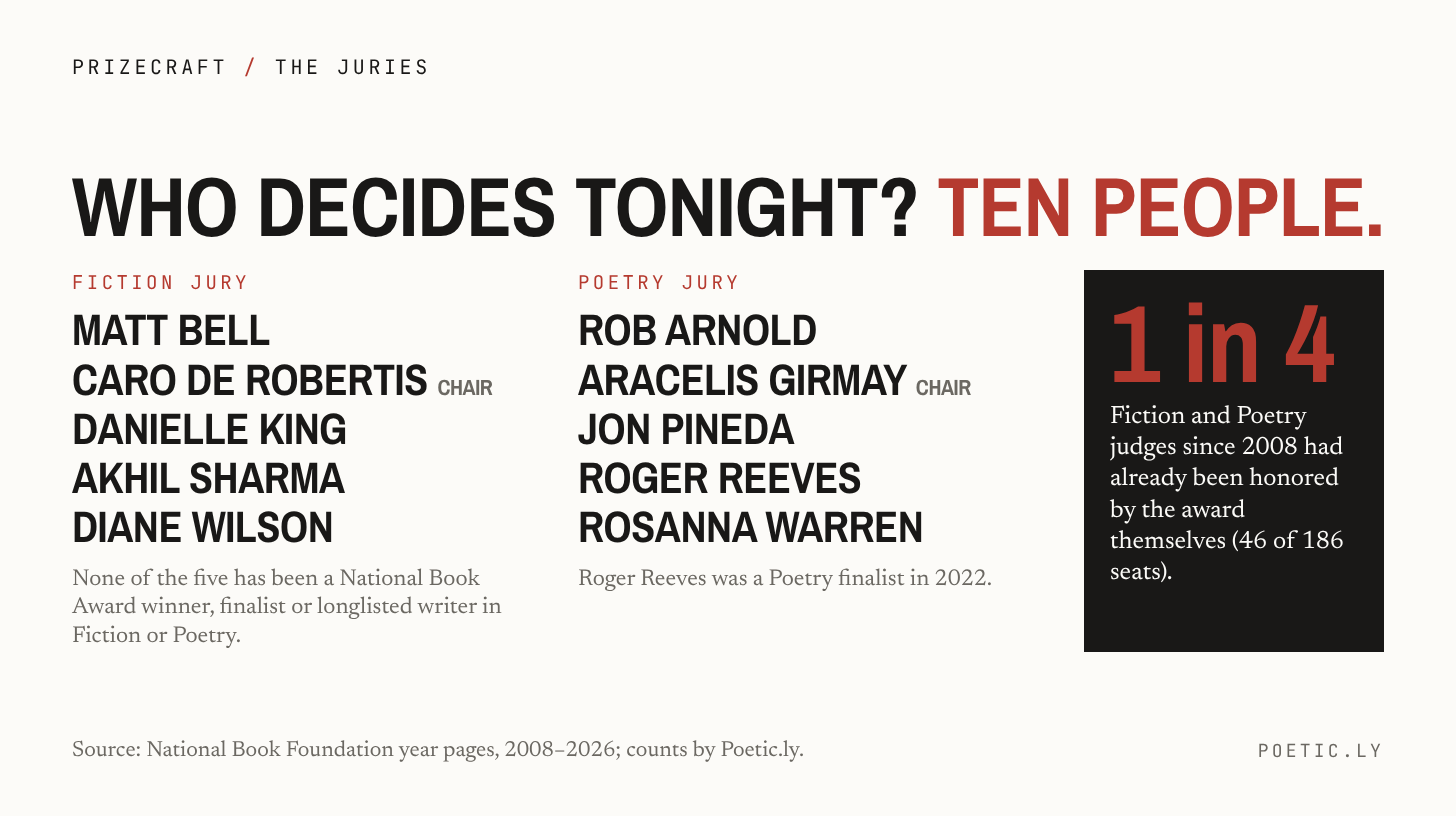
Each category is decided by a jury of five judges, most of them working writers, who read every book submitted, narrow them to a longlist of ten in September, cut that to five finalists in October, and choose one winner. This year's Fiction jury is Matt Bell, Caro De Robertis (chair), Danielle King, Akhil Sharma and Diane Wilson. The Poetry jury is Rob Arnold, Aracelis Girmay (chair), Jon Pineda, Roger Reeves and Rosanna Warren.
We counted every Fiction and Poetry judge since 2008. One seat in four (46 of 186) went to a writer who had already been a winner, finalist or longlisted writer for this same award. Put plainly, the prize often hands its decision to people it has already honored, which is Bourdieu's consecration running in a circle. This year's Fiction jury breaks the circle: none of its five members has that history. On the Poetry jury, Roger Reeves was a finalist in 2022. A jury with no personal stake in the award's past may feel freer to reward a book that doesn't resemble that past. Keep that in mind when we get to my picks.
Who publishes the winners
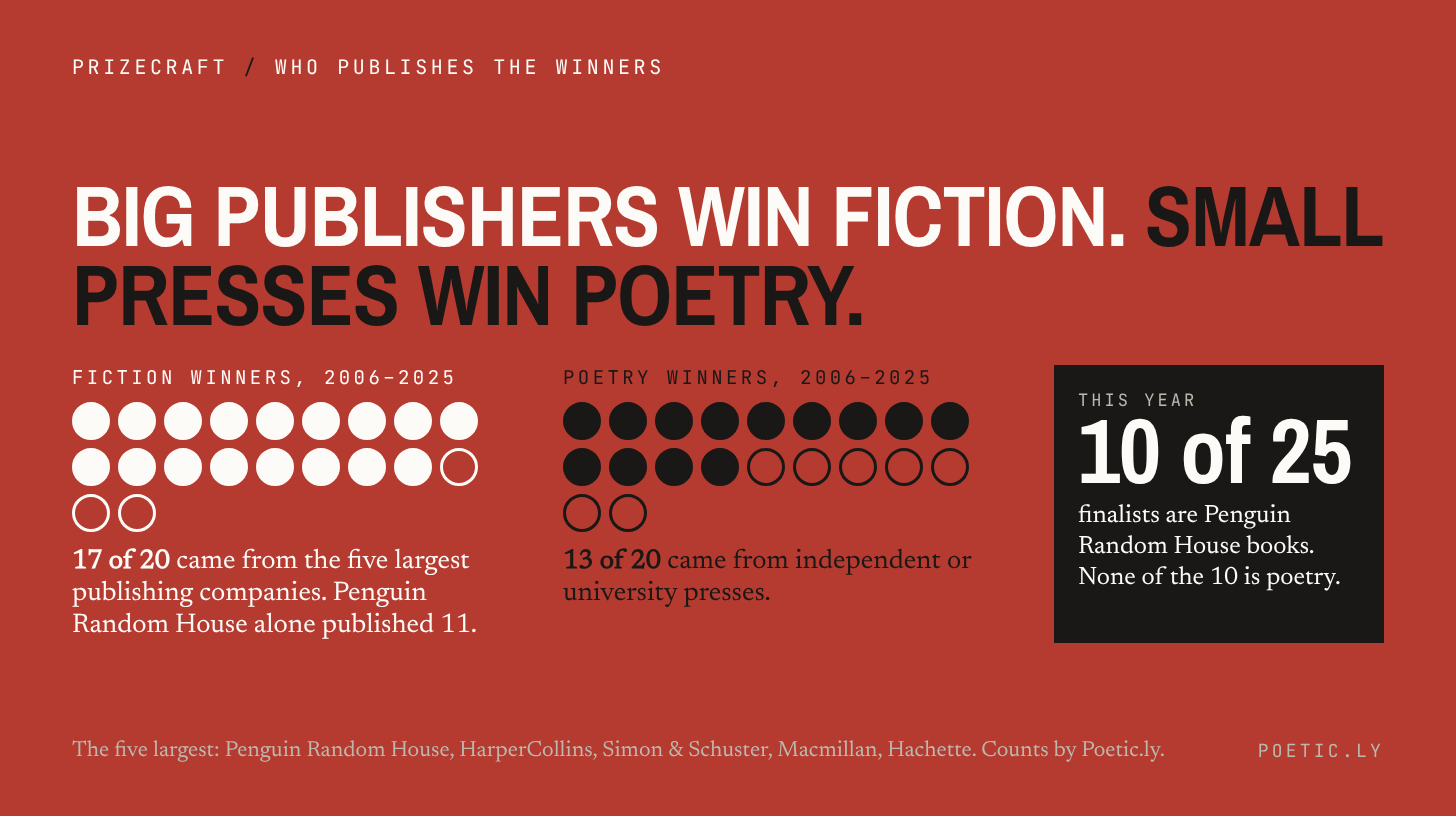
From 2006 to 2025, 17 of the 20 Fiction winners were published by one of the five largest publishing companies: Penguin Random House, HarperCollins, Simon & Schuster, Macmillan and Hachette. Penguin Random House alone published 11. In Poetry the pattern reverses. Thirteen of the 20 winners came from independent presses, which are publishers not owned by those five companies, or from university presses, which are run by universities. Small presses publish much of American poetry, partly because poetry rarely sells in the numbers the largest companies need.
This year's finalists follow the same split. Penguin Random House published 10 of the 25 finalists, and none of those 10 is a poetry book. Four of the five Poetry finalists come from independent or university presses: Graywolf, Milkweed, Wesleyan and the University of Chicago Press.
The scholar James F. English explains why this matters in The Economy of Prestige (2005), the most thorough study of how modern prizes work. He opened an earlier essay on prizes, "Winning the Culture Game" (New Literary History, 2002), by calling the prize the form of cultural capital "so widely talked about, and yet so little explored by scholars." His argument is that a prize is an exchange: it converts one kind of value into another, turning critics' admiration into sales and public attention, and turning money and sponsorship into prestige. Seen that way, the split shows the exchange running in opposite directions in the two forms. A Fiction win turns a large publisher's investment into prestige and further sales. A Poetry win turns a small press's prestige into the national attention it could never afford to buy. For writers, the practical lesson is simple: a poetry manuscript's likeliest road to this award runs through a small press, and a novel's runs through a large one.
The book vote and the career vote
My shortest way of putting it: a prize is a book plus a record. Every jury weighs both, and the balance it strikes decides the winner. I use two terms for the two ends of that balance. The book vote rewards a book as if it had arrived without an author, on the strength of its pages alone. The career vote rewards a writer's whole body of work, delivered through the one book in front of the jury.
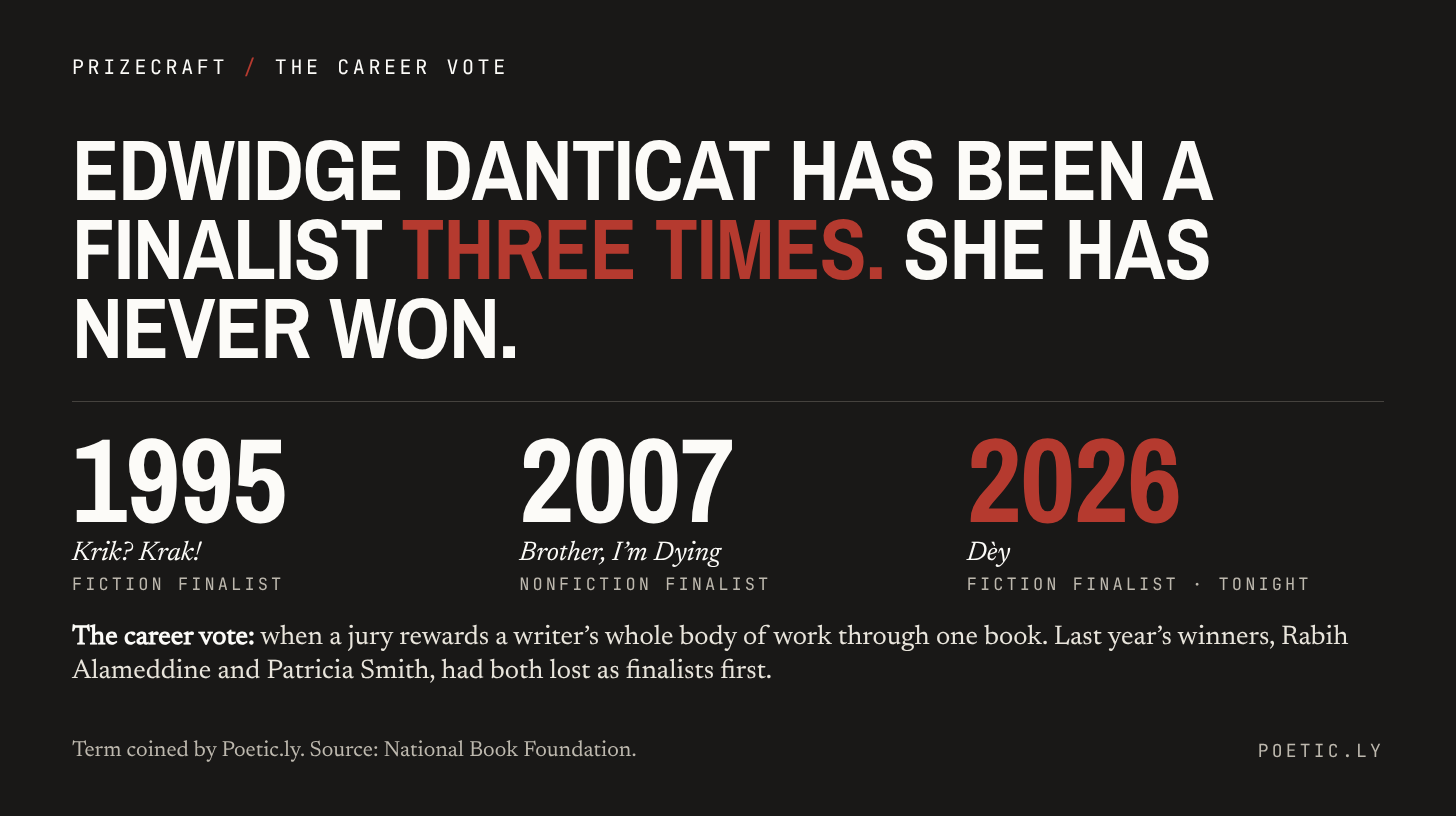
Edwidge Danticat is this year's clearest case. Her novel Dèy (Knopf) follows Magnolia, a Haitian American real estate agent in Miami who survives a mass shooting and struggles to tell her family the truth about it. Danticat was a Fiction finalist in 1995 for her story collection Krik? Krak! and a Nonfiction finalist in 2007 for her memoir Brother, I'm Dying. She has never won. NPR opened its report on this year's finalists by asking whether the third time is the charm. A win for Dèy would be a win for one novel and also for thirty-one years of work. There is recent precedent: last year's winners in Fiction and Poetry, Rabih Alameddine and Patricia Smith, had both been finalists before, and lost, before they won.
The career vote is not a criticism of juries, and there is a respectable case for it. A body of work is a larger achievement than any single book in it, and a prize that only ever rewarded single books would keep overlooking the writers who changed literature slowly, over decades. The cost falls on the debut. A first book has no record to vote for, so it can only win a book vote, which means a jury has to set every reputation in the room aside and judge the pages alone.
Who will probably win, and who I want to win
These are two different questions, so I am answering them separately.
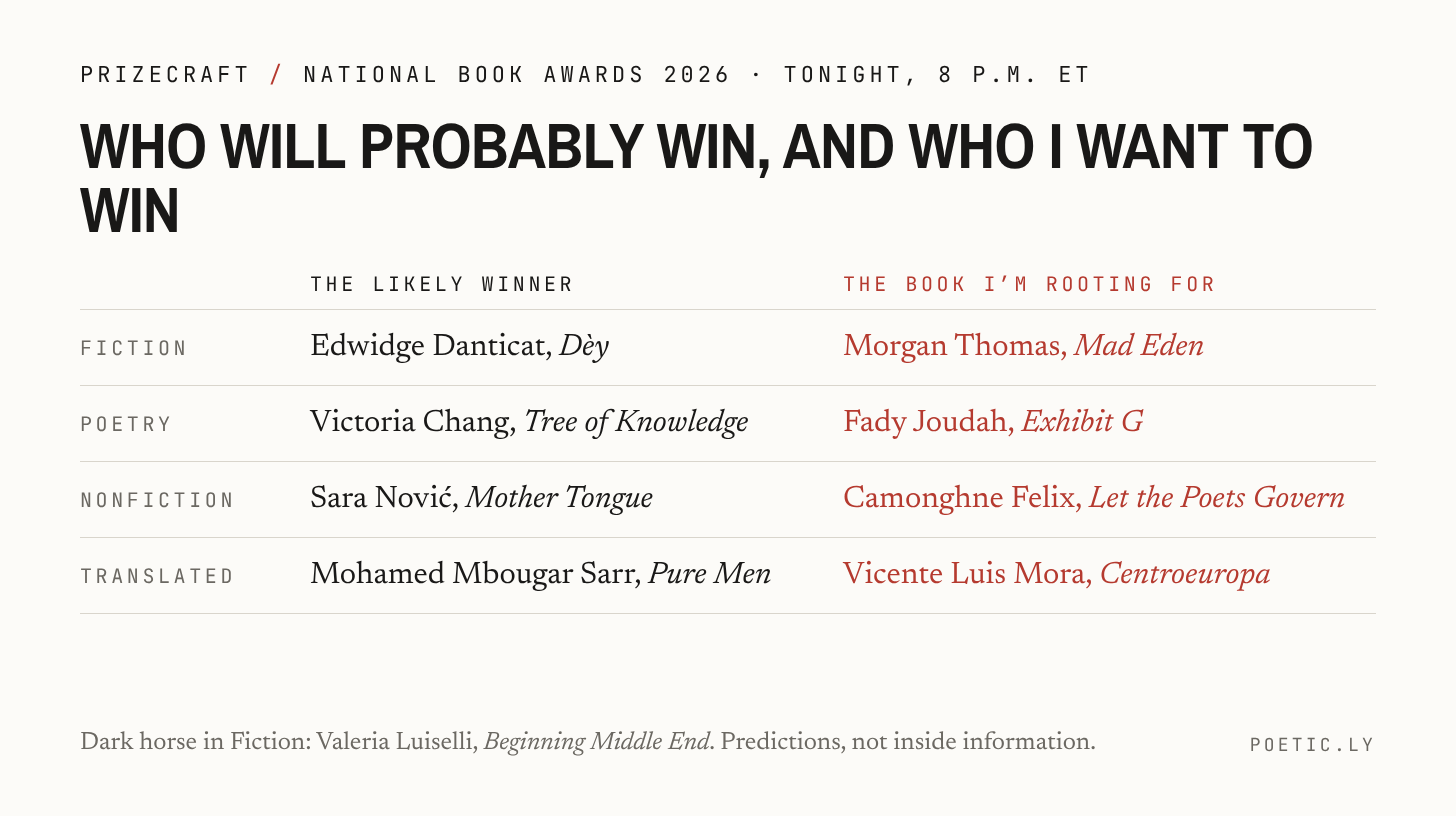
The likely winners are the books with the broadest critical support and the strongest prelaurels: Danticat in Fiction; Victoria Chang's Tree of Knowledge in Poetry, which Library Journal compared to the major works of Wallace Stevens; Mohamed Mbougar Sarr's Pure Men in Translated Literature; and, with low confidence, Sara Nović's Mother Tongue in Nonfiction.
The books I am rooting for are the ones that change what their form can hold:
- Fiction: Morgan Thomas, Mad Eden. A debut novel that contains a second book inside it: a fantasy serial posted anonymously to online forums. Kirkus called its portrait of internet subculture "excruciatingly accurate."
- Poetry: Fady Joudah, Exhibit G. Poems, essays and photographs of Gaza in one volume. The Los Angeles Review of Books argues that Joudah's shifting pronouns, with "they" becoming "we," turn one speaker into a voice shared by a whole community. I'd put it more strongly: the grammar itself does the work of solidarity.
- Nonfiction: Camonghne Felix, Let the Poets Govern. Part memoir and part call to action, by a poet.
- Translated Literature: Vicente Luis Mora, Centroeuropa, translated from the Spanish by Rahul Bery. The New York Times Book Review, quoted by the publisher, called it "an appealing mix of traditional storytelling and literary gamesmanship."
- Dark horse in Fiction: Valeria Luiselli, Beginning Middle End.
Notice what three of my four picks share: each holds a second kind of writing inside it. A novel contains a serial, a poetry book contains essays and photographs, a memoir contains a manifesto. These are book-vote books. They ask to be judged on what they attempt, and they have little record to lean on. If the career vote holds, Danticat wins. If this jury, with no history in the award, casts a book vote, watch Mad Eden.
The biggest snubs
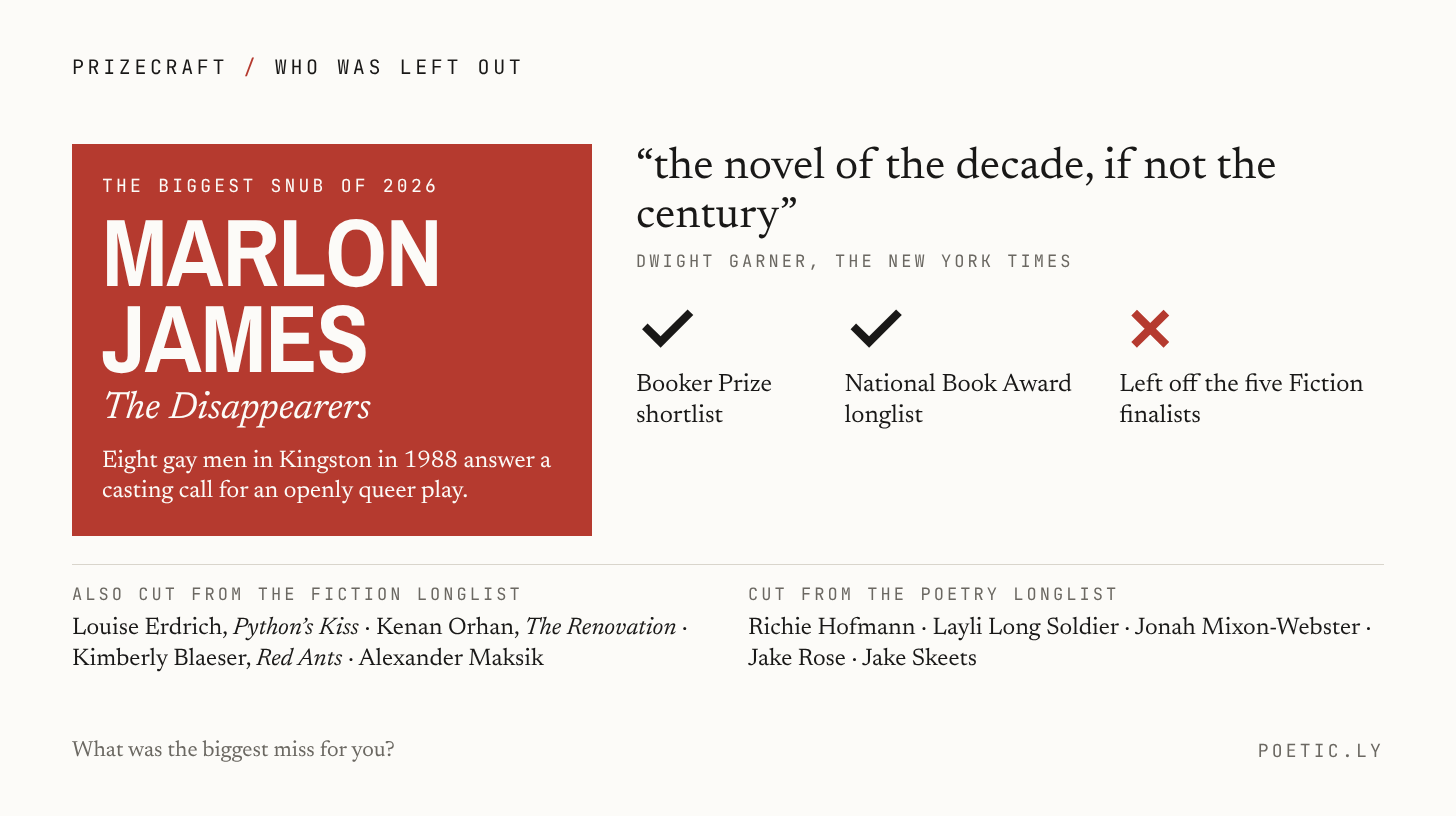
The clearest omission this year is Marlon James's The Disappearers, in which eight gay men in Kingston in 1988 answer a casting call for an openly queer play. It was shortlisted for the Booker Prize. Dwight Garner of the New York Times called it "the novel of the decade, if not the century." The National Book Award jury put it on the Fiction longlist of ten and then left it off the list of five finalists.
Also cut between the longlist and the finalists: Louise Erdrich's Python's Kiss, Kenan Orhan's The Renovation, Kimberly Blaeser's Red Ants and a novel by Alexander Maksik in Fiction; and Richie Hofmann, Layli Long Soldier, Jonah Mixon-Webster, Jake Rose and Jake Skeets in Poetry.
Here English has one more lesson, and it is a humbling one for anyone with strong opinions about prizes, which is to say everyone reading this. He argues that scandal and complaint are not failures of the prize system but part of its engine. Every year's outrage over an omission proves that the prize matters enough to be angry about, and so adds to the very prestige the outrage attacks. So by all means be furious about The Disappearers. I am. We are both taking part in the ceremony.
Five historic snubs, and one reversal
The National Book Award has a long record of passing over books that outlasted the winner. Here are five, and one year when it went the other way.
1987. Toni Morrison’s Beloved lost to Larry Heinemann’s Paco’s Story. Two months later, 48 Black writers published a statement in the New York Times Book Review protesting that Morrison had won neither the National Book Award nor the Pulitzer. Beloved won the Pulitzer that spring.
2004. The Fiction jury chose five little-known finalists, all of them women living in New York City, in a year with new novels by Philip Roth, Cynthia Ozick and Marilynne Robinson. Lily Tuck’s The News from Paraguay won. Robinson’s Gilead went on to win the Pulitzer.
2010. Jonathan Franzen’s Freedom and Jennifer Egan’s A Visit from the Goon Squad were both left off the list of finalists. The Associated Press called it “the Great American Snub.” Jaimy Gordon’s Lord of Misrule, from the small press McPherson & Co., won. Egan won the Pulitzer the next spring.
2015. Hanya Yanagihara’s A Little Life, a 700-page novel also shortlisted for the Booker Prize, lost to Adam Johnson’s story collection Fortune Smiles.
2019. Marlon James’s Black Leopard, Red Wolf was a finalist and lost to Susan Choi’s Trust Exercise. This year’s cut is his second miss.
The reversal, 1974. The National Book Award went to Thomas Pynchon’s Gravity’s Rainbow, shared with Isaac Bashevis Singer. The Pulitzer board rejected the same novel over its own jury’s unanimous choice and gave no fiction prize.
What was the biggest miss for you? Tell us in the comments.
The Two-Vote Test
Here is a tool for tonight. When each winner is announced, ask five questions. If the winner has been a finalist before, if the reviews praise the whole body of work rather than this book, or if the book beat a debut with equally strong reviews, the jury probably cast a career vote. If the winning book is the writer's first or second, or would plausibly have won with a stranger's name on the cover, it was a book vote. Most winners will be a mix, and the mix is the interesting part.
Try it now
- Readers: open the slider and find the year you were born. Read what that year's winner had already won, then run the Two-Vote Test on it and decide whether the award was for the book or for the career.
- Writers: set the slider to the 2010s and list the prelaurels the winners held before they won: the degree, the fellowship, the first major prize. That list is a map of the usual path. You can follow it, or go around it on purpose, but it helps to know where it runs.
- Everyone: post your picks in the comments now, and your Two-Vote score for each winner tonight. I'll score your picks against the results.
I am covering the ceremony live tonight at 8 p.m. ET on Poetic.ly and on Substack Live. Last night's finalist reading is here. The full guide to all 25 finalists, with what critics said about each book, is here: poetic.ly/national-book-awards-2026
Data: Post45 Data Collective (CC BY 4.0), The Index of Major Literary Prizes in the US, by Claire Grossman, Juliana Spahr and Stephanie Young. The decade counts in this post cover winners from 1950 through 2019, and the slider runs through 2025; "major prize" means a prize of $10,000 or more in that index. Jury counts by Poetic.ly from the National Book Foundation's year pages, 2008–2026.


