Who Will Win the 2026 National Book Awards?
All 25 finalists, what critics said, and our picks.


Poetic.ly · Prize Desk. The 77th National Book Awards are announced Wednesday night, November 18, in New York. This is our guide to the field before the envelopes open.
On Wednesday night in New York, 25 finalists will sit down to dinner knowing that 20 of them will go home with $1,000 and a bronze medal. The other five will take $10,000, a bronze medal and a statue—and a line that will follow them through every author bio they ever write. Before the envelopes open, here is how to guess which five, along with everything a reader needs to follow the night and everything a writer needs to understand what is being rewarded.
Inside this post:
- How the National Book Awards began, and how the five categories took their current shape
- All 25 finalists, with each book's subject and publisher
- What critics have said about the leading books, quoted or explained
- The prizes, fellowships and earlier nominations each leading author brings into the room
- The career vote: a term for what this year's Fiction jury may really be deciding
- Our picks in four categories, and the reasons behind each
How the awards began
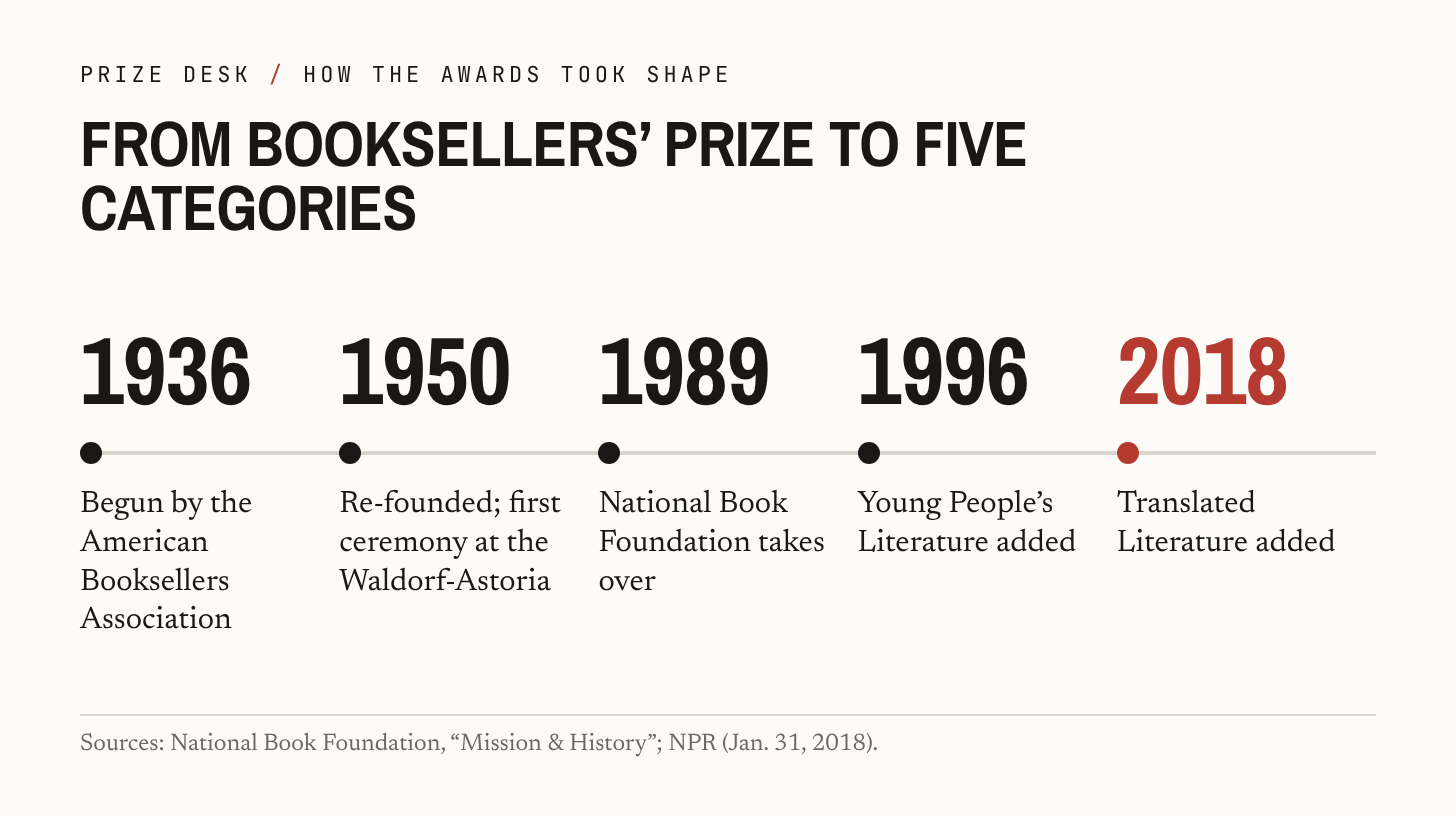
The National Book Awards started in 1936 as a booksellers' prize, given at the American Booksellers Association convention, and stopped during the Second World War. The version that runs today began on March 16, 1950, when publishers, editors, writers and critics met at the Waldorf-Astoria Hotel in New York. William Carlos Williams and Nelson Algren were among the first winners.
Since 1989 the awards have been run by the National Book Foundation, a nonprofit created for that purpose. Young People's Literature was added in 1996. In 2018 the Foundation added a fifth category, Translated Literature, the first new prize in more than two decades. That gives us the five categories decided on Wednesday: Fiction, Nonfiction, Poetry, Translated Literature and Young People's Literature.
Each category moves through three cuts. Publishers submit hundreds of books (from about 150 in Translated Literature to more than 600 in Nonfiction). Each jury names a longlist of ten in September and five finalists in October, and picks one winner in November.
What winners had won before they won
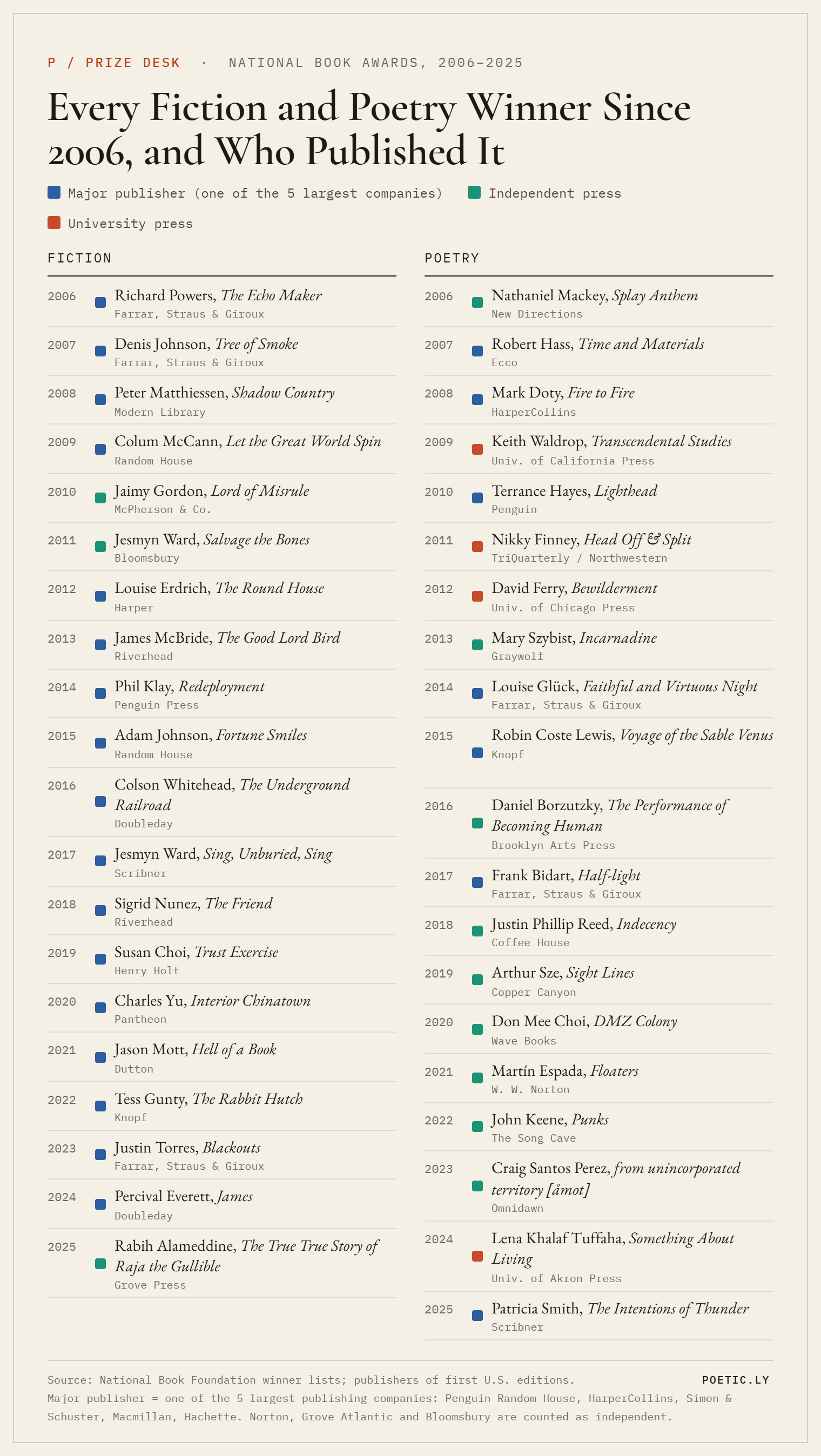
Slide through every National Book Award winner in Fiction and Poetry since 1950. For each one: the winning book, how it was received, and the prizes, fellowships, degrees and earlier books on the record before the award. The chart below shows how that record has changed over time.
How the book was received
Major prizes before this award
Programs and fellowships before this award
Earlier books in library records
How the winners' records changed, decade by decade (1950s–2010s; prize data ends in 2020)
Data: Post45 Data Collective (CC BY 4.0): Claire Grossman, Juliana Spahr and Stephanie Young, The Index of Major Literary Prizes in the US (prizes of $10,000 or more, 1918–2020) and its HathiTrust records; the NEA Literature Fellowships dataset; the Iowa Writers' Workshop graduations dataset; and the New York Times hardcover fiction bestseller lists. Winners from 2021–2025 were added by Poetic.ly; their prize records come from the same index and so stop at 2020, except where noted. "Major prizes" counts only prizes in the index. Earlier-book lists are partial. Some years had more than one winner.
Fiction: five novels, one career on the line
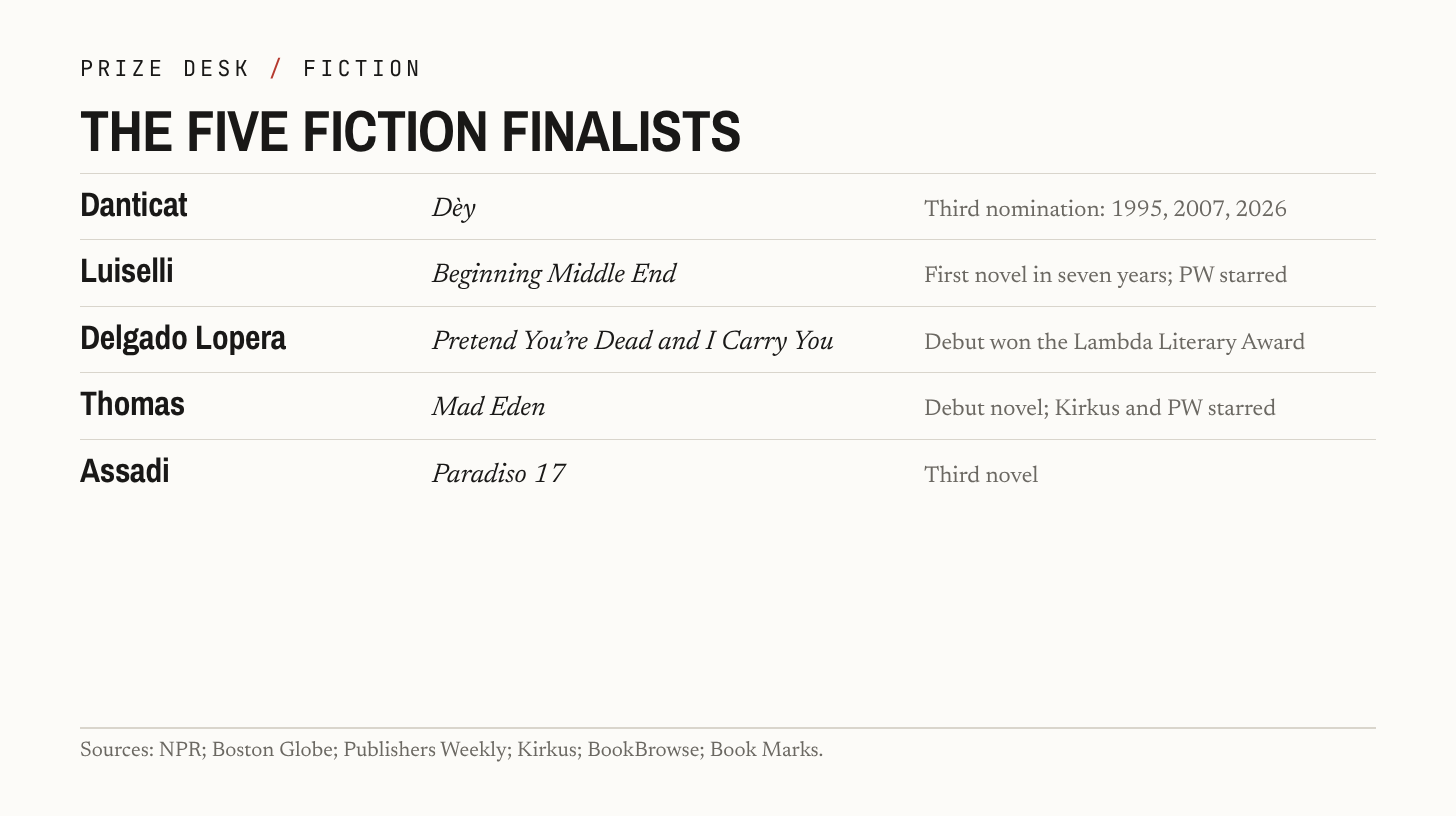
Edwidge Danticat, Dèy (Knopf). Danticat's fifth novel follows Magnolia, a Haitian American real estate agent in Miami, after she survives a mass shooting at a shopping mall and tells no one she was there. The title is the Haitian Kreyòl word for mourning. The Boston Globe reads its structure as an inversion of her earlier novels-in-stories, The Dew Breaker and Claire of the Sea Light: here the book keeps a novel's social sweep but runs on a short story's compressed clock, three weeks that end with the shooting at Marjory Stoneman Douglas High School in February 2018. The New York Times reviewed the book and ran a second piece on the story behind it. Bookreporter called it "an A+ addition to an already impressive oeuvre."
What she brings in: Danticat is a finalist for the third time. Krik? Krak! was a Fiction finalist in 1995, and Brother, I'm Dying was a Nonfiction finalist in 2007. She has never won.
Valeria Luiselli, Beginning Middle End (Knopf). Luiselli's first novel in seven years picks up the family of Lost Children Archive: a divorced mother and her twelve-year-old daughter driving through Sicily, where the mother's grandmother grew up. The book opens with the daughter asking whether her mother will "finally write a novel with a beginning, a middle, and an end." Publishers Weekly gave it a starred review and called it a masterpiece. The Chicago Review of Books made the more critical point: the novel is organized almost identically to Lost Children Archive, and the daughter remembers scenes from that earlier book as her own memories.
Julián Delgado Lopera, Pretend You're Dead and I Carry You (Liveright). A father-daughter saga set in the underground queer community of Bogotá, organized around what the book calls "Travesti Lore." Delgado Lopera built it from five months of research in Colombia in 2019 and a decade of drafts. Dwight Garner of the New York Times called Delgado Lopera "a writer who is grinding their own colors."
What they bring in: the debut novel Fiebre Tropical won the Lambda Literary Award and was a finalist for the Kirkus Prize and the Aspen Words Literary Prize.
Morgan Thomas, Mad Eden (MCD/Farrar, Straus and Giroux). A debut novel about Ro, a patient navigator at a gender-affirming care center in Florida, who becomes absorbed in "Mad Eden," a fantasy serial posted anonymously to autism forums. Both Kirkus and Publishers Weekly gave it starred reviews; Kirkus praised its portrait of internet subculture as "excruciatingly accurate."
What they bring in: Thomas's work has appeared in The Paris Review, The Atlantic and The Kenyon Review, and they have held fellowships from MacDowell and the Sewanee Writers' Conference.
Hannah Lillith Assadi, Paradiso 17 (Knopf). Assadi's third novel, after Sonora (2017) and The Stars Are Not Yet Bells (2022). A review collected by Book Marks describes it as a study of inheritance and of "the afterlife of ideology," and grants that its lyricism sometimes tips into sentiment, which the reviewer counts as a risk worth taking.
What she brings in: Assadi was a National Book Foundation "5 Under 35" honoree in 2018. Her debut, Sonora, won the Rosenthal Family Foundation Award from the American Academy of Arts and Letters and was a finalist for the PEN/Robert W. Bingham Prize for Debut Fiction.
The career vote
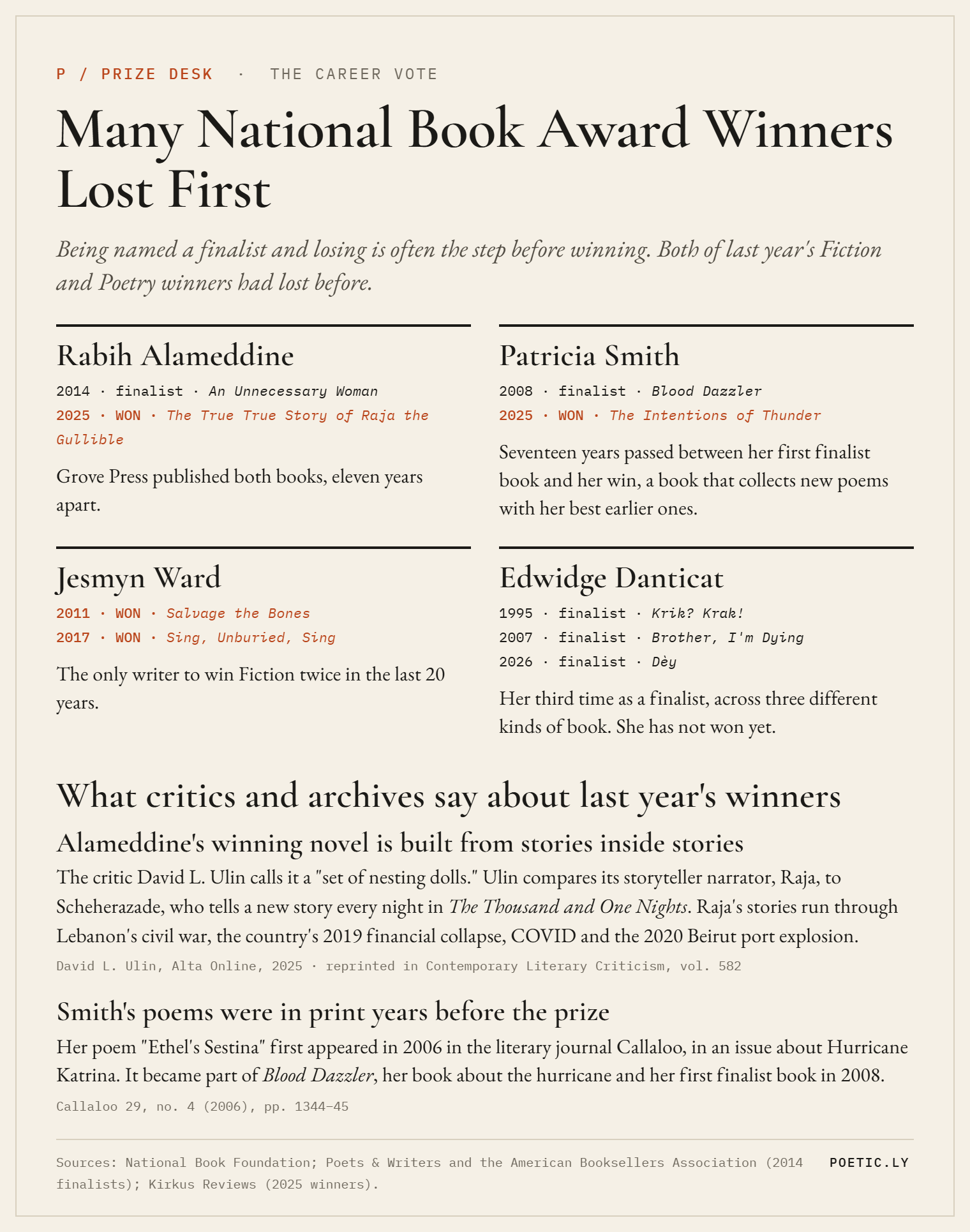
I call it the career vote when a jury's choice reads as a verdict on a writer's whole body of work, delivered through the book in front of it. Danticat is this year's clearest case: thirty-one years after her first nomination, with a story collection, a memoir and now a novel all recognized, a win for Dèy would also be a win for the work that came before it.
The career vote is not a criticism of a jury. It explains why a long-recognized writer can beat a newer book with stronger reviews, and why debut finalists such as Morgan Thomas usually need a jury that is looking at the single book alone.
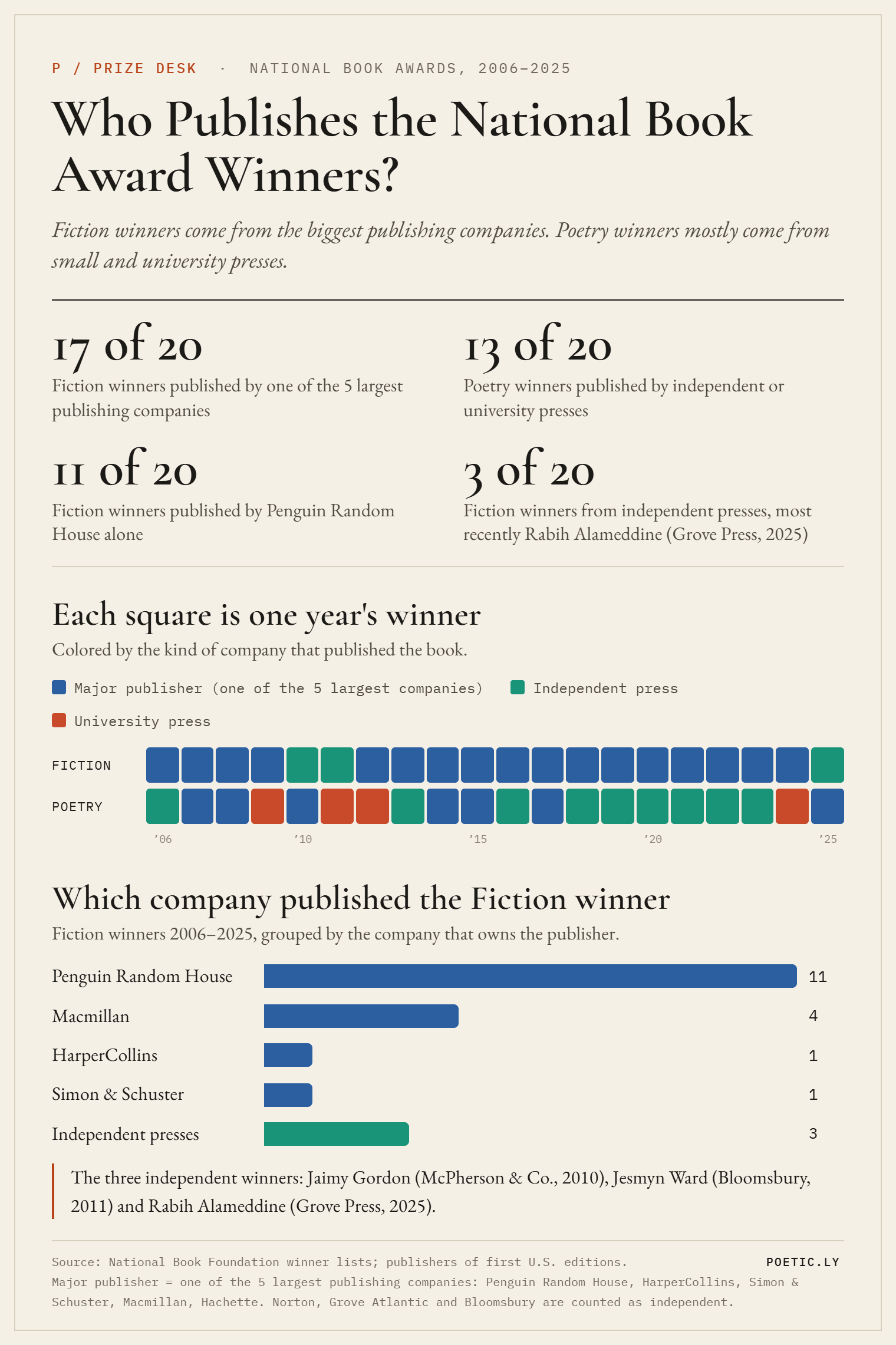
The last sixteen years bear this out. Only two of the sixteen Fiction winners from 2010 to 2025 won with a first book: Phil Klay for Redeployment and Tess Gunty for The Rabbit Hutch. Percival Everett won for James with roughly his thirty-sixth book, and Rabih Alameddine won last year, eleven years after he was first a finalist. Poetry leans even harder toward the whole career: David Ferry won at 88, Frank Bidart won for his collected poems, John Keene and Patricia Smith won for new-and-selected volumes (Smith seventeen years after her first nomination), and Martín Espada won with his twelfth collection. The exceptions matter too. Robin Coste Lewis in 2015 and Justin Phillip Reed in 2018 won with debut collections, which is exactly the opening Morgan Thomas needs.
Poetry: five collections, two of them built with photographs
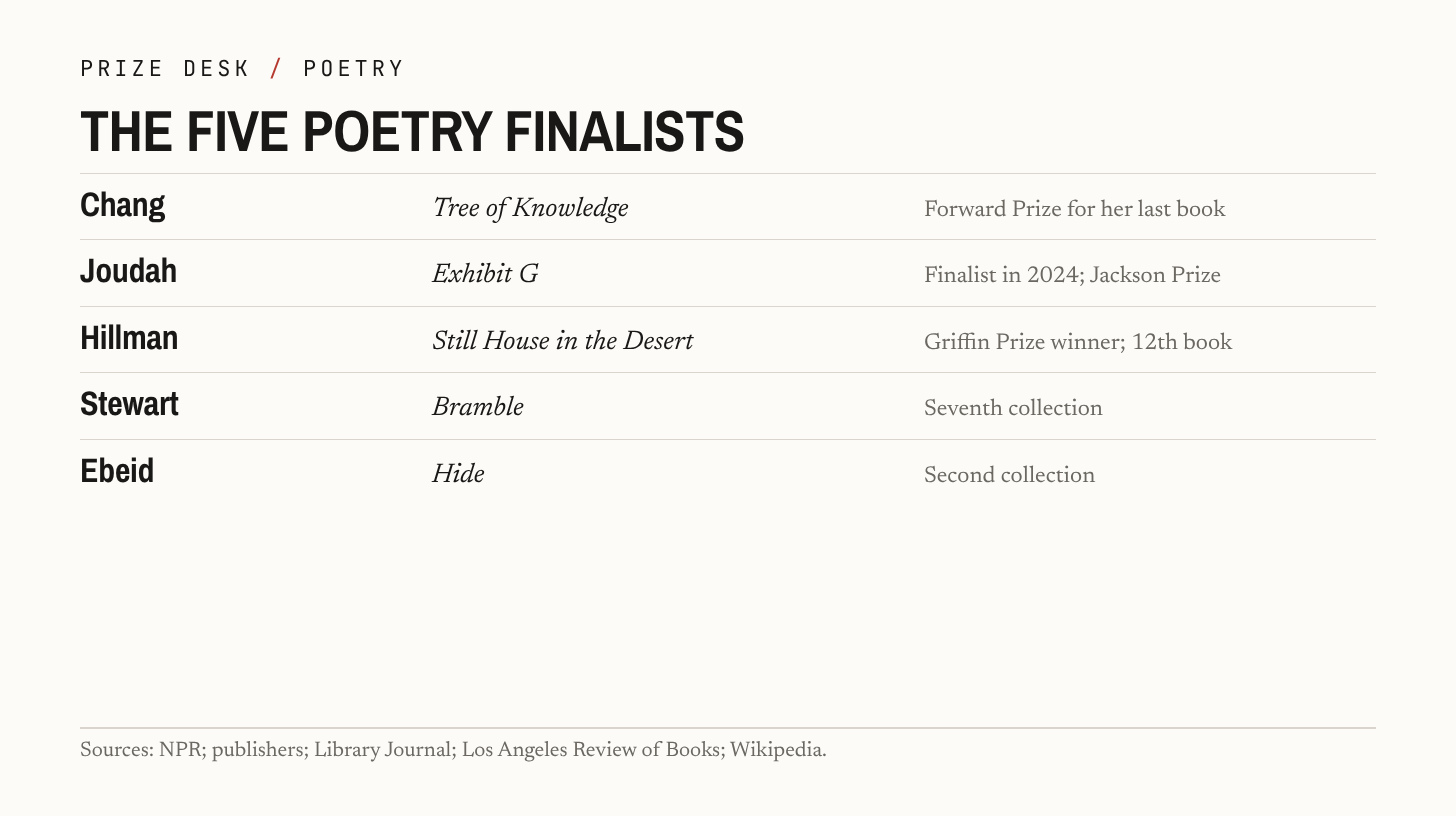
Victoria Chang, Tree of Knowledge (Farrar, Straus and Giroux). Chang's eighth collection began when she watched a large eucalyptus across her street being cut down. The book takes its title from Hilma af Klint's paintings and moves through works by Picasso and Joan Mitchell, with a long poem at its center about the expulsion of Chinese residents from Eureka, California. Library Journal gave it a starred review and compared it to the major works of Wallace Stevens and A. R. Ammons; Publishers Weekly also starred it.
What she brings in: Chang's previous book, With My Back to the World, won the Forward Prize for Best Poetry Collection. She holds a Guggenheim Fellowship, an NEA Fellowship and the Chowdhury Prize in Literature.
Fady Joudah, Exhibit G: Poems, Essays, and Photographs of Gaza (Milkweed). Joudah's seventh collection combines poems, essays and photographs made with the Gaza Soup Kitchen. The Los Angeles Review of Books argues that the book resists calling genocide "unspeakable," and that Joudah's shifting pronouns ("they" becoming "we") turn a single speaker into a communal voice shared with Palestinians in Gaza and in the diaspora.
What he brings in: Joudah, a physician in Houston, was a National Book Award finalist in 2024 for […], a collection whose title is a bracketed ellipsis, the mark for words left out. He won the 2024 Jackson Poetry Prize and held a Guggenheim Fellowship in 2014. He is also a translator of Mahmoud Darwish.
Brenda Hillman, Still House in the Desert: An Eco-Contemplation (Wesleyan). Hillman's twelfth collection returns to her childhood adobe home in Tucson and includes 113 color photographs. It closes a second four-book cycle, a quartet about time (its seasons, days and minutes).
What she brings in: Hillman is a winner of the Griffin Poetry Prize, and her earlier tetralogy on the four elements (Cascadia, Pieces of Air in the Epic, Practical Water, Seasonal Works with Letters on Fire) was called a "Lucretian achievement" by the Colorado Review.
Susan Stewart, Bramble (University of Chicago Press). Stewart's seventh collection takes the bramble of the Book of Judges, a figure of destructive leadership, and builds satires, elegies, meditations and songs around illness and grief. In the London Review of Books, Ange Mlinko calls it the first of her collections to deal directly with personal suffering.
What she brings in: Stewart was a MacArthur Fellow in 1997, won the National Book Critics Circle Award for Columbarium in 2003, and was elected a Chancellor of the Academy of American Poets in 2005.
Carolina Ebeid, Hide (Graywolf). Ebeid's second collection traces her family histories in Palestine and Cuba and includes "spell" poems written to the Cuban American artist Ana Mendieta. The title works three ways: hide as concealment, as animal skin, and as a surface to write on.
What she brings in: Ebeid's debut, You Ask Me to Talk About the Interior (Noemi Press, 2016), was named one of the ten best debuts of the year by Poets & Writers. She has held a National Endowment for the Arts fellowship and a Lannan Foundation residency.
Nonfiction, Translated Literature and Young People's Literature
Nonfiction. The finalists are Colin Asher, The Midnight Special: The Secret Prison History of American Music; Abdelrahman ElGendy, Huna, a memoir of his imprisonment in Egypt; Camonghne Felix, Let the Poets Govern, part memoir and part call to action; Sara Nović, Mother Tongue; and Joseph Osmundson, Spawning Season: An Experiment in Queer Parenthood. Nović's book began as letters to her two sons, one deaf and one hearing, and combines memoir with the history of deaf education. Publishers Weekly called it "a sobering must-read." Nović's earlier novel True Biz was a New York Times bestseller, and Girl at War won an Alex Award.
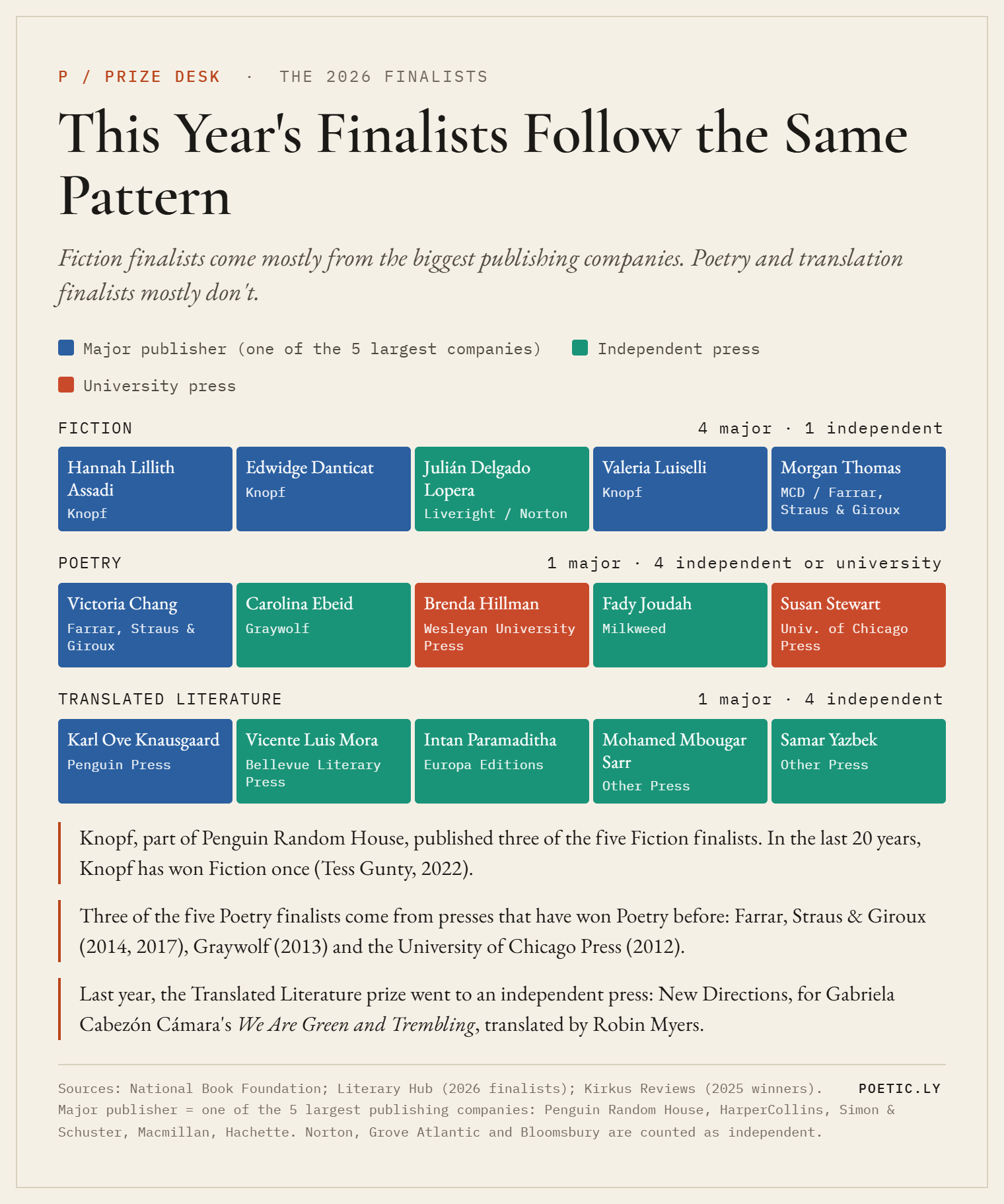
Translated Literature. The finalists are Karl Ove Knausgaard, The School of Night (from the Norwegian, Martin Aitken); Vicente Luis Mora, Centroeuropa (from the Spanish, Rahul Bery); Intan Paramaditha, Night of a Thousand Hells (from the Indonesian, Stephen J. Epstein and Tiffany Tsao); Mohamed Mbougar Sarr, Pure Men (from the French, Lara Vergnaud); and Samar Yazbek, Your Presence Is a Danger to Your Life: Voices of Survival and Witness in Gaza (from the Arabic, Leri Price). Sarr won the 2021 Prix Goncourt, the first writer from sub-Saharan Africa to do so, and his The Most Secret Memory of Men was longlisted for this award. Pure Men, about a professor drawn into Dakar's hidden gay community after a lynching, received a starred review from Booklist. Knausgaard's book divided critics: The Times of London called it a masterpiece, while the Washington Examiner called its 500 pages pedestrian.
Young People's Literature. The finalists are Elana K. Arnold, Holloway; Tae Keller, When Tomorrow Burns; Keala Kendall, That Which Feeds Us: A Hawaiian Gothic; David Levithan and Gabriel Duckels, The Fight of Our Lives: AIDS in America; and Julian Randall, Shook.
Our picks
These are predictions, not inside information. We weigh three things: the breadth of the critical response, each author's record with juries, and the career vote.
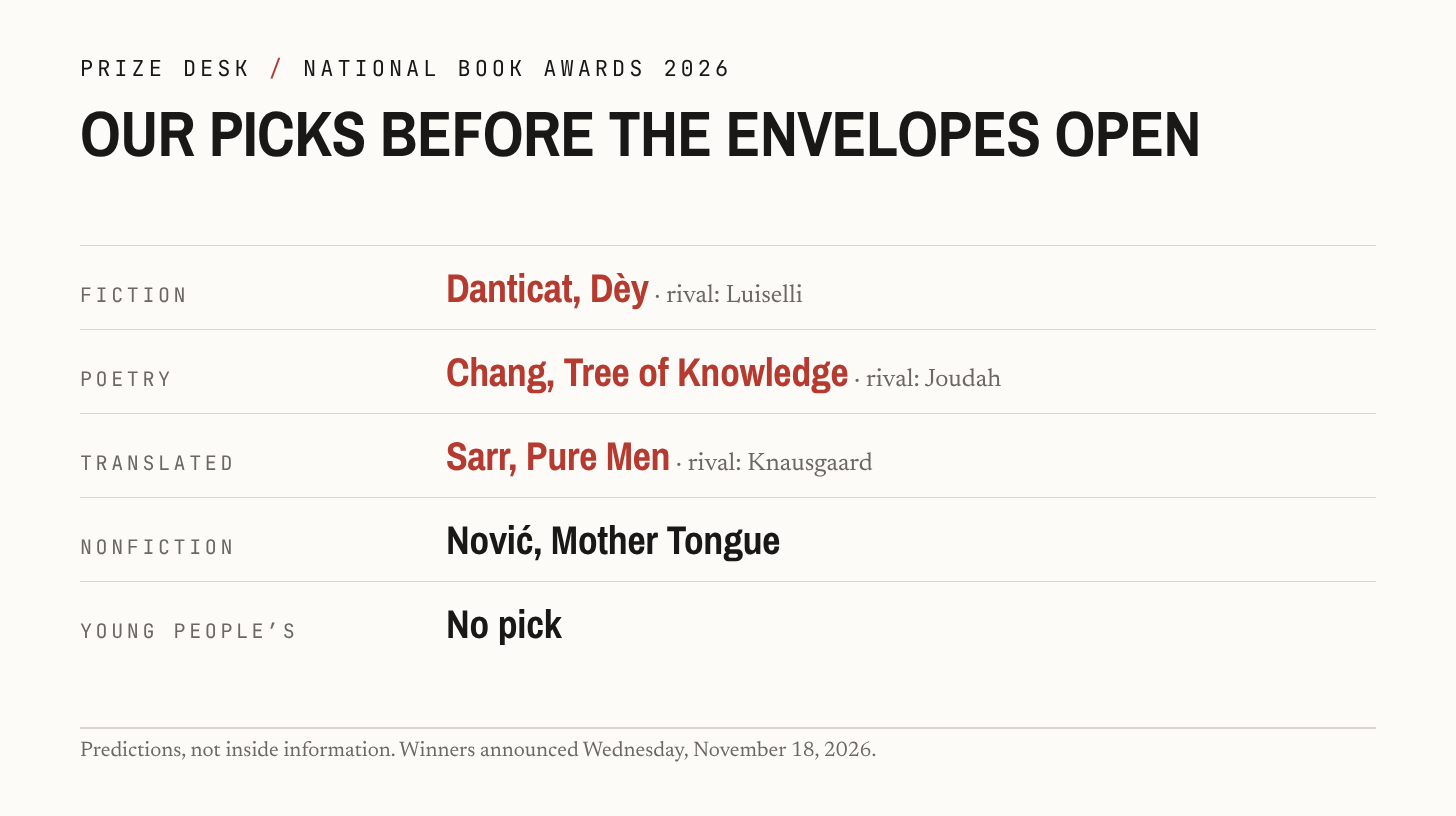
- Fiction: Edwidge Danticat, Dèy. The strongest consensus among reviewers, the most attention from the national press, and the clearest career vote in any category. Closest rival: Luiselli, whose novel Publishers Weekly called a masterpiece. Upset: Morgan Thomas, if the jury reads for the single book.
- Poetry: Victoria Chang, Tree of Knowledge. Two starred trade reviews, a Forward Prize for her last book, and a collection that critics are comparing to Stevens. Closest rival: Fady Joudah, who returns as a finalist two years after […], his 2024 finalist collection.
- Translated Literature: Mohamed Mbougar Sarr, Pure Men. A Goncourt winner with a strongly reviewed book and a previous longlisting from this award. Knausgaard's split reviews weaken his case.
- Nonfiction: Sara Nović, Mother Tongue, with low confidence. It has the strongest trade coverage we found in a category without a clear front-runner, and Publishers Weekly called it "a sobering must-read."
- Young People's Literature: no pick. We have not read deeply enough in this field to make one honestly.
What to watch for on Wednesday
- For readers: the shortlists are the best reading list of the year in five genres. If you read one book from each category this winter, start with our picks above.
- For writers: look at what the finalists have in common before they won anything here. Most of the leading authors arrived with fellowships (Guggenheim, NEA, MacDowell), a prior national prize, or both. The longer record says the same: of the 31 Fiction and Poetry winners from 2010 to 2025, at least 20 held a graduate degree in creative writing. But the record also leaves room for other routes. Louise Glück never finished college, Nikky Finney left graduate school, Arthur Sze left MIT and finished at Berkeley with a self-designed major in poetry, and Justin Torres dropped out of college before he found his way to Iowa. The pipeline is real; it is not the only door. A National Book Award finalist is rarely a first recognition; it is usually the next step on a record that was built one fellowship and one magazine publication at a time.
We will post the winners Wednesday night, with a note on how our picks held up.
Sources: National Book Foundation finalist announcement (Oct. 6, 2026) as reported by NPR and Literary Hub; National Book Foundation, "Mission & History"; reviews and publisher material cited in each section (Boston Globe, New York Times, Bookreporter, Publishers Weekly, Kirkus, Chicago Review of Books, Library Journal, Los Angeles Review of Books, Booklist, Book Marks, The Times, Washington Examiner).


