How Pulitzer Prize-Winners Are Picked
✦ Prizecraft | Vol. 1, No. 5 ✦ A jury reads the books. A board decides. 109 years of what that produces: 10 empty years, 4 two-time novelists + 1 poet who won 4 times.

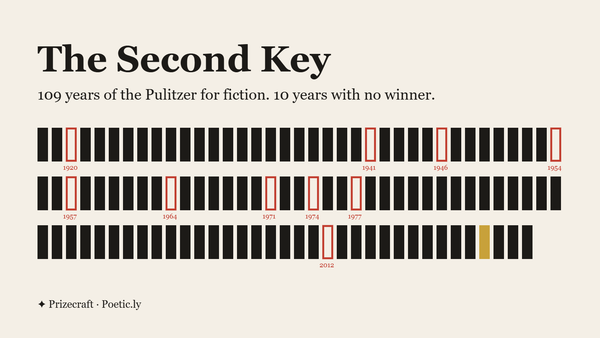
Every spring, when the Pulitzers arrive—an occupational hazard of caring about books—a small, credulous part of me pictures a room of judges arguing, pleading & horse-trading until one book is left on the table. I know better; I picture it anyway. That picture fits the National Book Award, where 5 judges read the field & their vote is final (No. 4 counted all 667 of them). It does not fit the Pulitzer, & the difference explains nearly every strange, stubborn or baffling thing the Pulitzer has done in fiction & poetry since 1918. I call the difference the second key: at the Pulitzer, the people who read the books do not hold the prize. They hold the first of 2 keys.
Inside this post
- 🗝️ The second key: my term for who really decides
- 🚫 10 years the fiction prize went to nobody
- 🔁 4 novelists who won twice + 1 poet who won 4 times
- 📊 27 years of winners: 10 of 27 had been honored before
- 🧭 Insights for Writers & Readers + Try it now
Two keys, one prize
A Pulitzer jury in fiction or poetry is a panel of 3 to 5 writers, critics & scholars. It reads the year’s entries & sends 3 finalists, unranked, to the Pulitzer Board, a body of about 18 people, most of them journalists & academics. The board makes the award by majority vote. It may take one of the 3; by a three-fourths vote it may choose a book the jury never sent; it may also give no prize at all. Put differently, the jury does the reading & the board does the deciding—as clean a division of labor as American letters has managed. (The Pulitzer office describes the process here.)
The critic James F. English, whose book The Economy of Prestige studies how cultural prizes work, argues that a prize draws its attention from the disputes around it as much as from the award itself: the scandal, the snub & the complaint are part of how a prize stays important. The Pulitzer has built that dispute into its machinery. Every year holds a possible disagreement between the readers & the deciders; in most years nobody outside the room learns whether one happened.
Keep reading · free with a Poetic.ly account
You’ve read the first third. The rest is for subscribers, & subscribing is free.
Still inside:
- 📖 The years with no winner
- 📖 Who the Pulitzer returns to
- 📖 Insights for Writers & Readers
- 📖 Try it now
- 📖 The series: how literary prizes are decided
A free account takes an email address & about 10 seconds. It also brings you The Letter, our weekly newsletter.