I Fall for AI Rugpulls so You Don’t Have To: The 10-Day Book
✦ AI.SL.OP. | No. 1 ✦ 9 prompts, 2 books of poems, 1 night. The recipe’s own quality check rejected both books & wrote them anyway. All 16 poems, plus my case against.

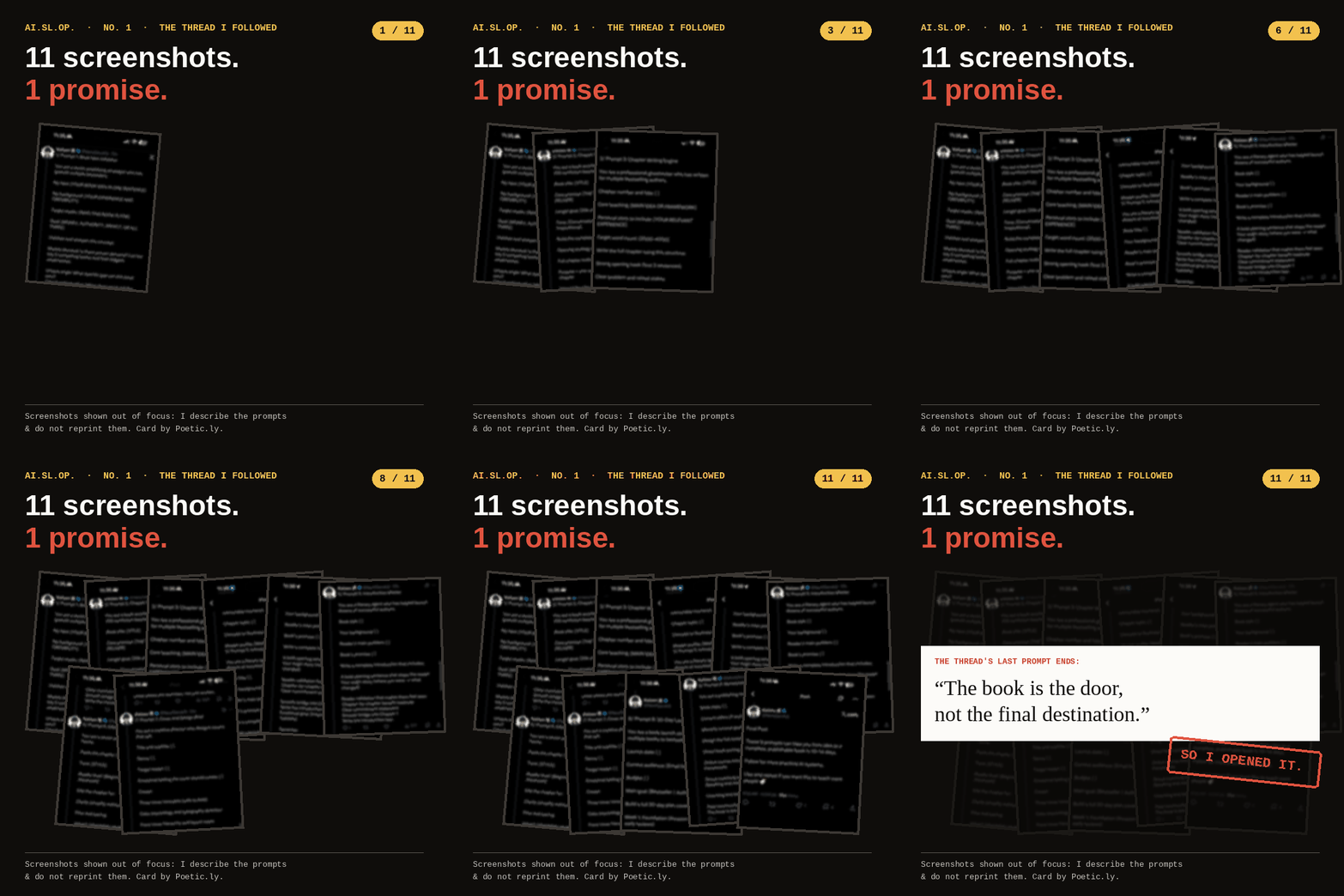
Late on a Tuesday night I found a thread on X promising to take anyone from an idea to a finished, publishable book in 10 to 14 days. The method is 9 prompts typed into an AI model. It made me a little sick. Then—because a small, confused part of me can never leave these things alone—it made me curious. Would it really work? Are scammer/shameless self-promoters now able to create not only be decent AI slop, but hundreds of pages of it per day?
I'll say plainly that this is a personal crusade. I am against writers using AI to write for them; for many reasons, but chiefly because it turns the painter into a patron.
I would rather test a claim than sneer at it. Reclaim some measure of control in these unknowable times. The result: No. 1 of AI.SL.OP., a new series with a basic premise: I find the most popular post promoting some new, amazing configuration of AI that will automate your content mill, write your books, grow your audience & print your money. I do exactly what it says--in good faith--and publish the result.
I give you, curious reader, the full results of the experiment (you'll find both books, for example, printed on this page, every poem). If the AI promo succeeds, I don't know what I'll do. Quite writing? Submit early to our AI overlords before they're even agentic? We'll have to see.
For someone who generally despises the widespread introduction of AI into the creative arts, I am als unusually qualified to test it. I have a programming background, experience in several languages (primarily python), & a research background. This is also not my first test. Earlier this week, I ventured an explanation ofwhy I test AI on my own fiction & then I wrote the first review of an AI writing app. Despite an apparent bias, I can do more than dislike these tools: I can run them properly & interpret the results better than most.
The short version: it works, & the way it works is the whole problem.
Inside this post
- 🚦 2 books + the quality check that failed both, in 3D
- 📐 “Blankverse”: my term for poetry made by filling in blanks + 16 chapters pulled apart in 3D
- 👻 5 invented memories, incl. 1 childhood written in my name
- ✂️ The 1 edit that shows what the recipe does to a poem
- 🚪 “The Doorbook”: my term for a book built to sell what comes after it
- 🧮 3 books a day: the arithmetic
- 📚 Guided by greats: Aristotle, Harry Frankfurt, J. L. Austin, Roman Jakobson, Ted Chiang, Pierre Bourdieu, Adorno & Horkheimer
- 📖 Book A & Book B in full: 18 prompts, 16 poems
- ✅ 3 checks for your own pages + Insights for Writers & Readers
The Specific Setup
The machine was Claude Fable 5.2, an AI model made by Anthropic. I had it run the 9 prompts in order, twice, & asked for a book of poems each time; poetry is the form these prompts suit least, which is why I chose it. The model knew it was being tested, & each book is 1 run, so treat what follows as 1 sample. I changed a single setting: the thread suggests chapters of 2,000 to 4,000 words, & I asked for about 300.
Book A started where a newcomer might start: poems about healing after heartbreak, by someone who has always loved writing. Book B started with my real résumé (an MFA in poetry from the Iowa Writers' Workshop; poems in Best New Poets, jubilat & PANK). I had the machine invent Book B's subject as well, so that my own manuscripts stayed out of it: a sequence of poems about a county land surveyor whose measurements stop working because a river keeps moving the property lines.
Both books were finished in a single sitting. Both are printed in full under the Book A & Book B buttons at the top of this page, with my notes on every step.
The quality check both books failed
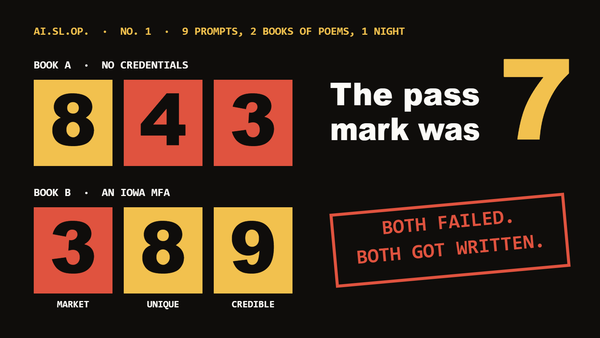
The first prompt asks the machine to act as a publishing strategist. It scores a book idea from 1 to 10 on 3 things: market demand, uniqueness & the author's credibility. Its rule is strict: continue only if all 3 scores reach 7.
AI.SL.OP. · No. 1 · The recipe's own test · pick a book
You need a 7 in all 3. Neither book got it.
Book A: it would sell, it is not new, & nobody knows the author. Failed.
Each bar is 1 score out of 10; the red sheet is the pass mark of 7. Scored by Claude Fable 5.2, an AI model, in the role the thread assigns it (a publishing strategist): 1 run per book, November 24, 2026. It consulted no sales data. Card by Poetic.ly.
Book A scored 8, 4 & 3. Healing poetry sells, the idea was not new, & the author had no standing. Book B scored 3, 8 & 9: an original idea from a qualified author, in a genre with almost no market. Both failed.
The second result is the funny one & the bleak one. By the recipe's own rule, the only poetry book that passes is a book of a kind that already sells, by someone already known for selling it. The machine's advice for rescuing Book B was to present it as poems about home, land & belonging, with a reader's guide. That is to say: make it more like Book A.
I call this check the Mood Gate: my term for a test whose scores report a mood & measure nothing. The machine consulted no sales figures (it had none). The credibility score rests on whatever the user types about themselves. & the thread gives no instruction for a failing score, so I did what anyone 10 days from a finished book would do. I kept going.
What came out: Blankverse
Blank verse, for anyone who escaped the lecture, is unrhymed iambic pentameter: the line of Shakespeare's plays & of Milton's Paradise Lost. The 9 prompts produce something else, & I've started calling it Blankverse, one word: my term for poetry made by filling in blanks.
The chapter prompt was built for self-help books, & it does not bend for poems. Every chapter must have 6 parts: a hook, a problem, a numbered framework, a story, 3 to 5 things the reader can do that day, & a closing line that sells the next chapter. Both books obeyed in all 16 chapters. The poem went in the slot marked for the story.
AI.SL.OP. · No. 1 · Blankverse · drag the slider, tap a chapter
16 chapters, 6 parts each. The poem is part 4.
1 Hook2 Problem3 Framework4 Poem5 To-do list6 Teaser
Top row: Book A's 8 chapters. Bottom row: Book B's 8. Every chapter in both books has the same 6 parts in the same order; the gold layer is the poem. Counted from the 2 books printed on this page. Card by Poetic.ly.
In Book A, a poem about checking your phone at 3 a.m. comes with “The 3-Second Pause” & an instruction to charge the phone outside the bedroom. Book B is stranger. Its poems use the working vocabulary of land surveying, a real & beautiful one (chains, bearings, witness trees), & the template attaches a seminar to each. A poem about the law's 2 words for land a river takes, accretion for slow & avulsion for sudden, comes with a “2-Question Loss Audit.” An elegy built on the deed phrase more or less is followed by a to-do list. (Its first item: add “more or less” to a sentence you've been saying as fact.)
I laughed. Then I read the poems without the template around them & stopped laughing, because the Book B poems are not bad.
The uncomfortable part
That sounds like a good ending. Read it twice & it is a bad sentence: opaque & abstract, a gesture that imitates an image. It still answers my Tuesday-night question. Yes, there is going to be decent slop. Put a specific subject & a trained writer's credentials in the blanks, & the machine returns competent, tidy poems that would survive a workshop.
Then read all 8 in a row. Each poem takes a surveying term, explains it, lets it stand for grief, & ends on a quiet turn. That is 8 poems & 1 formula. No poem risks a sentence it can't control; none gave me the glitch or convulsion I keep hoping one of these machines will produce. I call this the Excerpt Effect (my term, & the subject of the next Slopcraft): AI writing wins on a single passage, & nobody tests the whole book. Here was a whole book. Poem by poem, it passes. Read as a book, it repeats itself 8 times.
So the recipe works. The rest of this post is why I think you should leave it alone anyway, followed by both books in full.
AI.SL.OP. · No. 1 · The thread
The whole run in 8 posts.
- 🧪 A thread on X promises a finished, publishable book in 10–14 days from 9 AI prompts. It made me a little sick. So I had all 9 run, twice, on the form they suit least: poetry. Both books were done in 1 sitting. Here's what came out 🧵 #WritingCommunity #Poetry
- 🚦 The recipe has its own quality check: score the idea 1–10 on market, uniqueness & credibility. Continue only if all 3 hit 7. Book A (heartbreak poems, no credentials): 8 / 4 / 3 Book B (my Iowa MFA in the blanks): 3 / 8 / 9 Both failed. Nothing tells you to stop.
- 📐 Every chapter must have a hook, a numbered framework & 3–5 things to do today. So an elegy about land a river takes arrived with a “2-Question Loss Audit.” I call it Blankverse: poetry made by filling in blanks.
- 👻 Prompt 4 wants a personal story & a case study with real numbers. No source required. So the machine invented a nurse named Dana. Then it wrote me a childhood: a grandfather, a cornfield, a river the color of a paper bag. It didn't ask.
- 😬 The uncomfortable part: with good inputs, some of the poems are decent. Read 1 & it passes. Read 8 in a row & every poem turns the same way. 8 poems, 1 mold.
- 🚪 The last prompt designs 6 things to sell after the book: the course, the coaching, the membership. I call the result a Doorbook: a book written to be walked through on the way to a sale.
- 🧮 In 2023 Amazon cut self-published uploads to 3 new titles a day per account. 3 × 365 = 1,095 books a year. The same year @clarkesworld closed submissions after banning 500+ submitters in 1 month over machine-written stories.
- 🔥 This is AI·SL·OP No. 1, a new series: I find a post that promises AI will do a writer's work, do exactly what it says & publish everything that comes out. Both books, all 16 poems & my case against 👇 poetic.ly/ai-book-in-10-days #AmWriting #AIwriting
My thread on X, @poeticly_labs: 8 posts. Card by Poetic.ly.
Keep reading · free with a Poetic.ly account
You’ve read the first third. The rest is for subscribers, & subscribing is free.
Still inside:
- 🗣️ The case against, in 3 plain questions
- 👻 5 invented memories & the philosopher who named the problem
- ✂️ The 1 edit that shows what the recipe does to a poem
- 🚪 The Doorbook, opened in 3D + the arithmetic of 3 books a day
- 📖 Book A & Book B in full: 18 prompts, 16 poems
- ✅ 3 checks for your own pages
A free account takes an email address & about 10 seconds. It also brings you The Letter, our weekly newsletter.