The Grammar of the Wound, Part One: What a Wound Says
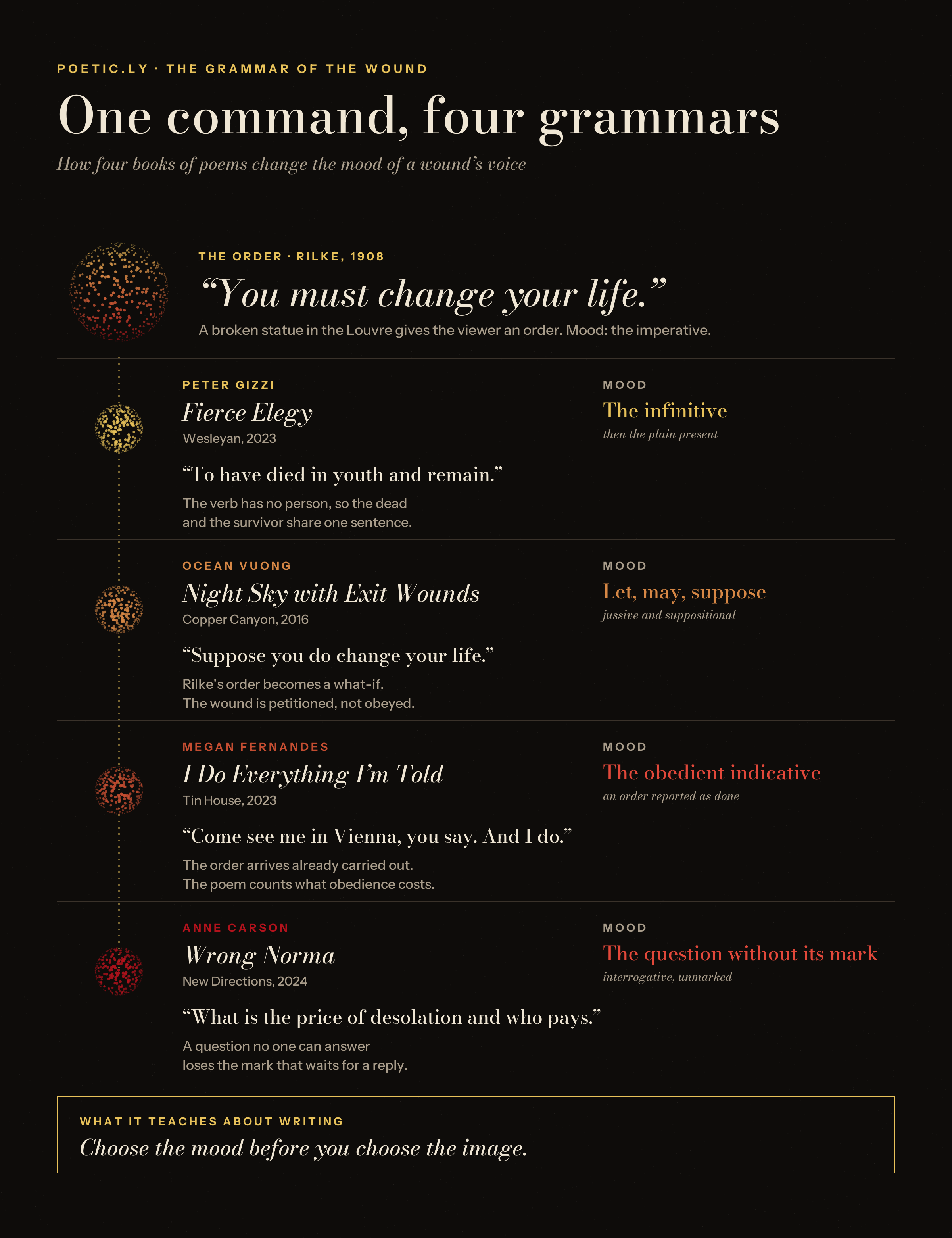
Four books of poems give a wound a voice, and each puts that voice in a different grammatical mood. Part One sets out the argument and reads Peter Gizzi’s Fierce Elegy.


I. What a wound says
This essay reads four recent books of poetry about grief and injury: Peter Gizzi's Fierce Elegy (Wesleyan, 2023), Ocean Vuong's Night Sky with Exit Wounds (Copper Canyon, 2016), Megan Fernandes's I Do Everything I'm Told (Tin House, 2023) and Anne Carson's Wrong Norma (New Directions, 2024). Its argument is that each book lets a wound speak, and that what matters most is the grammar the wound speaks in. Before reading the poems, it helps to see the old scene these books inherit, in which a damaged body or object speaks to the person standing in front of it. That scene appears in three places that later writers keep returning to: a poem by Rilke, an epic by Tasso, and a book of trauma theory by Cathy Caruth.
Rilke’s broken statue
Rainer Maria Rilke (1875–1926) wrote "Archaic Torso of Apollo" in Paris in 1908, after years of working for the sculptor Auguste Rodin, who taught him to look at objects for hours at a time. The poem describes an ancient Greek statue of Apollo in the Louvre whose head, arms and legs have broken away. Only the torso is left. Rilke says that we will never know the god's head or eyes, and yet the stone still glows as if the missing gaze were inside it. Then he makes the poem's strangest claim:
denn da ist keine Stelle, / die dich nicht sieht. ("for there is no place / that does not see you.")
Notation. The statue has no eyes, but it sees. The damage does not end the statue's power to look; it spreads that power across the whole surface.
The poem's final sentence turns from description to command:
Du mußt dein Leben ändern. ("You must change your life.")
Notation. This is the imperative mood: a direct order, addressed to you, the reader, with no reason given. Nothing in the poem tells us why we must change, only that a broken thing has looked at us and we must.
The line has become shorthand for what a lyric poem asks of its reader; the philosopher Peter Sloterdijk used it as the title of a 2009 book. The point to take from it is simple. One of the founding poems of modern lyric ends with an order, and the order is spoken, in effect, by a damaged object. That is what the first version of this essay meant, too briefly, by "an order given by a wound."
Tasso’s bleeding tree
The second scene is older. Torquato Tasso's epic Jerusalem Delivered (1581) tells the story of the First Crusade's siege of Jerusalem in 1099. Two of its characters are lovers on opposite sides. Tancred is a Christian knight. Clorinda is a warrior fighting for the city's Muslim defenders, and Tancred loves her.
In Canto 12, Clorinda rides out at night in armor Tancred does not recognize. He fights her, not knowing who she is, and wounds her mortally. Only when he lifts her helmet does he see that he has killed the woman he loves. In Canto 13, a sorcerer enchants the forest the crusaders need for timber. Tancred enters it and strikes a tall cypress with his sword. Blood runs from the cut, and Clorinda's voice speaks out of the tree. Her soul, she says, is imprisoned there, and he has wounded her a second time. Tancred cannot strike again, and leaves.