How Fast Should You Write a First Draft?
[Draftcraft | Vol. 1, No. 3] Kazuo Ishiguro drafted a Booker Prize winner in 4 weeks. Jack Kerouac said On the Road took 3. What 6 famous fast drafts cost once the rewriting is counted, + how to plan your own.

Every writer who starts a novel faces 1 question before the first sentence: how fast should the first draft go? Write slowly & the book may never reach its ending. Write quickly & the pages may not deserve one. Each November the question gets a deadline, because writers around the world try to draft 50,000 words in 30 days, & that month is now in its last week.
The fast draft has a distinguished record. In the summer of 1987, Kazuo Ishiguro cleared his diary, stopped answering the phone & wrote from 9 a.m. to 10:30 p.m., 6 days a week, for 4 weeks. At the end he had, in his own words, "more or less the entire novel down." The novel was The Remains of the Day, which won the Booker Prize in 1989. Jack Kerouac said On the Road took him 3 weeks. William Faulkner gave As I Lay Dying 6.
Each of those numbers is true, & each leaves most of the work out. I call the missing part Draft Debt: my term for the research, rewriting & waiting that a fast first draft borrows against, & that the writer repays before the book is finished. This is Draftcraft, Vol. 1, No. 3: investigations into how books get drafted & revised + ways to measure your own process. Readers get the real timelines behind 6 famous fast books. Writers get a way to plan a fast draft & the debt that comes with it.
Inside this post
- ⏱️ 1,667 words a day: what a 30-day draft asks
- 💥 252 hours: Kazuo Ishiguro's 4-week "Crash"
- 📚 6 famous fast drafts, on a 3D shelf you can turn
- 🧾 "Draft Debt": my term for what a fast draft still owes
- 🧭 Zadie Smith's 2 kinds of novelist + Walter Benjamin's rule for stopping
- ✅ Try it now: 6 steps for writers & readers
What a 30-day draft asks
The 30-day draft began as an institution. National Novel Writing Month, known as NaNoWriMo, was founded in 1999, & its main event was a November sprint: 50,000 words in 30 days. That is 1,667 words a day (50,000 ÷ 30), every day, with no day off. The nonprofit behind it announced in the spring of 2025 that it was closing, after money trouble, complaints about the conduct of volunteers & moderators, & criticism of its position on AI. Its farewell email, as Lit Hub's James Folta reported, admitted that building a community & being able to sustain it are 2 different matters.
The habit outlived the organization. Folta pointed out that anyone can still write a novel manuscript in November, & writers do. I am taking part in a November novel-writing challenge myself. So the question is a practical one for me this week, & the best evidence on it comes from a writer who ran the experiment on himself & published the results.
The 4-week Crash
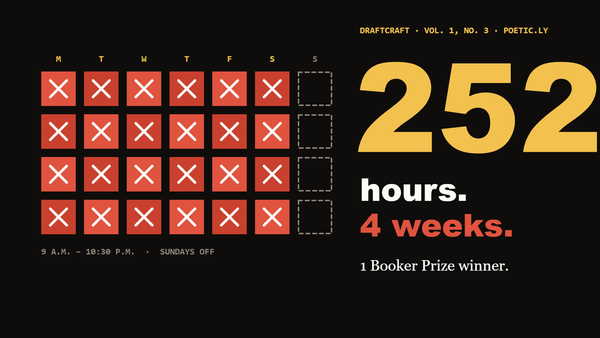
By the summer of 1987 Ishiguro had a problem that success had caused. His second novel had brought invitations, travel & mail, & almost a year after writing an opening chapter he had gone no further. He & his wife, Lorna, made a plan that they called a "Crash." For 4 weeks he would write from 9 a.m. to 10:30 p.m., Monday through Saturday, with 1 hour off for lunch & 2 for dinner. No mail, no phone, no visitors. Lorna took over his share of the cooking & housework.
The arithmetic is worth doing, because it shows what "4 weeks" hides. A day of 13.5 hours minus 3 hours of meals leaves 10.5 hours of writing. Multiply by 6 days & 4 weeks, & the Crash comes to 252 hours. He wrote by hand, ignored style, & let contradictions stand: if an afternoon scene disagreed with a morning one, he kept going. The goal, he explains, was to reach a state in which the fictional world felt more real to him than the actual one.
Draftcraft · Vol. 1, No. 3 · The Crash
Kazuo Ishiguro drafted a Booker Prize winner in 4 weeks. Those 4 weeks held 252 hours of writing.
1
Chapter written in the year before
Almost a year after an opening chapter, he had gone no further.
Stuck
10.5
Hours of writing a day
9 a.m. to 10:30 p.m., minus 1 hour for lunch & 2 for dinner.
No phone. No mail.
6 × 4
Days a week × weeks
Monday through Saturday, in the summer of 1987.
Sundays off
252
Hours in the Crash
10.5 × 6 × 4. The novel won the Booker Prize in 1989.
Whole novel down
Source: Kazuo Ishiguro's own account of writing The Remains of the Day, first published in the Guardian (2014), read at thebookerprizes.com. Arithmetic by Poetic.ly.
Keep reading · free with a Poetic.ly account
You’ve read the first third. The rest is for subscribers, & subscribing is free.
Still inside:
- 📖 What Ishiguro did before & after the Crash
- 📖 6 famous fast drafts, on a 3D shelf you can turn
- 📖 “Draft Debt”: Kerouac’s 3 weeks inside 10 years
- 📖 Zadie Smith’s 2 kinds of novelist
- 📖 Walter Benjamin’s rule for stopping
- 📖 Try it now: 6 steps for writers & readers
A free account takes an email address & about 10 seconds. It also brings you The Letter, our weekly newsletter.