How Langston Hughes Used Color: 229 Poems, Counted
[Imagecraft | Vol. 1, No. 2] Black, white & brown carry 58 in 100 of his color words, & "green" appears 5 times. A count of every color in 229 poems, with 5 tests for your own pages.

A color word is the cheapest image a writer owns. It costs 1 word, it asks nothing of the plot, & a reader sees it at once. That is why beginners spend color freely & why editors cut it: a page where the sky is blue, the grass is green & the dress is red has told a reader nothing the reader did not already assume. The useful question is not whether to use color. It is which colors a writer should spend, & how often.
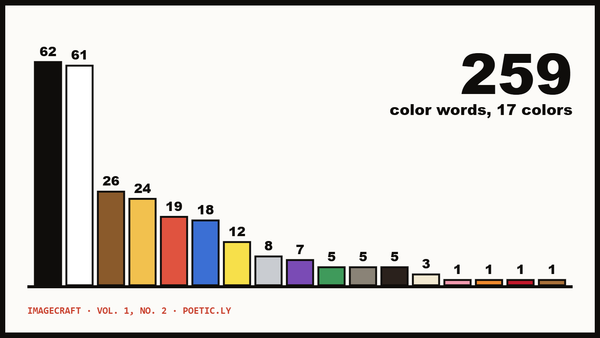
A book that turned 100 this year gives an answer that can be counted. Alfred A. Knopf published Langston Hughes's first collection, The Weary Blues, in 1926. When it came out, the poet Countee Cullen called Hughes "a remarkable poet of the colorful" & wrote that through all his verses "the rainbow riots and dazzles." Hughes's early poems are now in the public domain in the United States, so I tested the claim. I counted every color word in 229 of them. The rainbow is nearly absent. Black, white & brown carry 58 of every 100 color words, & the word "green" appears 5 times.
I call what I found a Short Palette: my term for the smallest set of colors that carries more than half of a writer's color words. This is Imagecraft, Vol. 1, No. 2: investigations into how images work on the page + ways to test your own. Readers get a new way to see why Hughes's poems still hit so hard a century on. Writers get 5 counts to run on their own pages.
Inside this post
- 🎨 Ezra Pound's test for an adjective + the 1926 reviews that called Hughes "colorful"
- 🔢 229 poems, 15,544 words, 259 color words: Christian's count
- 📏 "The Short Palette": my term for the few colors that do most of a writer's work
- 🎛️ 17 colors on a 3D board you can tilt + a line of Hughes for each
- 🌙 The 1 word Hughes used more than any color
- ⚖️ Black & white, 62 to 61, & the philosopher who explains the tie
- ✅ Try it now: 5 counts + insights for writers & readers
What a color word does
In Imagecraft No. 1 I argued that an image earns its place when it comes back: "An image becomes structural when its return changes what the reader knows." A cup that appears once is a detail. A cup that appears 3 times, in 3 different hands, starts to carry the story. Color works the same way, with 1 difference. A cup is an object, & a color is a property that can move from object to object. So a color that returns ties together things that have nothing else in common: a face, a night, a river.
The modern rule for images comes from Ezra Pound's "A Few Don'ts by an Imagiste," which Poetry magazine published. Pound defines an image as "that which presents an intellectual and emotional complex in an instant of time." In plain terms, an image must deliver a thought & a feeling together, at once. He then sets a test for every describing word: "Use no superfluous word, no adjective, which does not reveal something." A color adjective passes Pound's test only when it tells a reader something the noun did not. "Green grass" fails. The question for any poet is which of their colors pass.
The reviewers of 1926 agreed that Hughes was a poet of color & disagreed about whether that was good. Cullen, in Opportunity, praised the rainbow & then complained of "too much emphasis here on strictly Negro themes." Jessie Redmon Fauset, in The Crisis, wrote that the poems were "warm, exotic and shot through with color." Neither critic said which colors. A count can.
The count
I ran a script over the Standard Ebooks edition of Hughes's poetry, which collects every poem of his known to be in the US public domain: 229 poems & 15,544 words from about the first decade of his work, The Weary Blues included. The script looks for 22 color words, from "black" to "amber," & records each use, the poem it sits in & the line around it. It does not count "blues," which names a music & a mood.
It found 259 color words: 1 for every 60 words Hughes wrote (15,544 ÷ 259). That is a modest rate for a poet whom the reviews called colorful, & the colors are unevenly shared. 120 of the 229 poems (52%) contain no color word at all. In the other 109, the same few colors return again & again.
Imagecraft · Vol. 1, No. 2 · The count
I counted every color word in 229 Langston Hughes poems. 3 colors carry 58 in 100.
259
Color words in 15,544 words
1 in every 60 words. 17 different colors in all.
All counted
149
Black, white & brown
62 + 61 + 26. The black, white & brown bars above.
58 in 100
5
Uses of "green"
In 229 poems. 2 of the 5 describe a pair of eyes.
No rainbow here
120
Poems with no color word
52 in 100 poems name no color at all.
Spent with care
"Short Palette" is Christian Harder's term. Counted by script for Poetic.ly, November 2026, on the Standard Ebooks edition of Langston Hughes's Poetry: 229 poems, 15,544 words, all in the US public domain. 22 color words searched; 1 use of "brown" is a surname. Card by Poetic.ly.
Keep reading · free with a Poetic.ly account
You’ve read the first third. The rest is for subscribers, & subscribing is free.
Still inside:
- 📖 “The Short Palette”: my term for the few colors that do most of a writer’s work
- 📖 17 colors on a 3D board you can tilt + a line of Hughes for each
- 📖 The 1 word Hughes used more than any color
- 📖 Black & white, 62 to 61, & the philosopher who explains the tie
- 📖 Try it now: 5 counts for writers & readers
A free account takes an email address & about 10 seconds. It also brings you The Letter, our weekly newsletter.