Why Readers Prefer AI Writing in Blind Tests
✦ Slopcraft | No. 3 ✦ 1,634 readers lost to a coin & 28 MFA readers changed sides. What 2 blind tests of AI writing found, what they never tested & 4 checks for your draft.

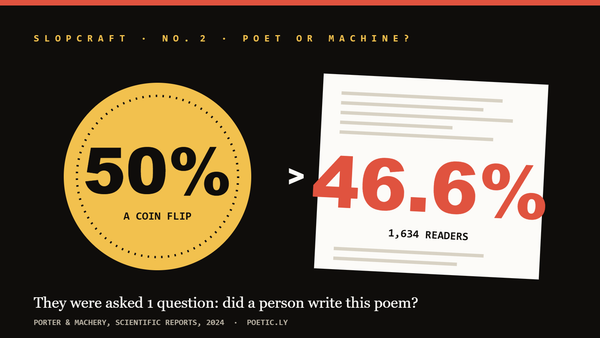
Every time a study lands claiming readers cannot tell human writing from a machine's, a small, perverse part of me hopes it is true—it would at least be interesting—& every time I go to the method instead, where the same thing is always waiting. Hand 1,634 readers a poem & ask 1 question: did a person write this, or a machine? In 2024, 2 researchers in the University of Pittsburgh's Department of History & Philosophy of Science did exactly that, & the readers scored 46.6%. A coin would have scored 50%. Then came the worse news: asked to rate the poems, the readers preferred the machine's.
That result unsettles anyone who reads or writes for the love of it, & a second study, updated in March 2026, unsettled the professionals too: graduates of top MFA programs, reading blind, preferred AI excerpts to excerpts written by their own peers. Both findings are real. Neither means what the headlines say, because each study measured a short passage, & a passage is not a book. Headlines are themselves short passages, of course, which may account for their enthusiasm.
I call that gap the Excerpt Effect: my term for the distance between how well AI writing scores on a short passage & what it can do across a whole book. This is No. 3 of Slopcraft: investigations into AI & literature + tests you can run on your own pages. Readers get a plain account of what the 2 studies found & what they never tested. Writers get the reason an average sentence wins a blind test, the 1917 essay that explains it, & 4 checks to run on a draft.
Inside this post
- 🪙 46.6%: the poetry test 1,634 readers lost to a coin
- 🔄 28 MFA readers + the day they changed sides, in 1 card you can flip
- 📏 "The Excerpt Effect": my term for the 450-word limit behind the headlines
- 🪨 Shklovsky's 1917 answer to why the smooth sentence wins
- 💸 $81 vs. $25,000 + what Ted Chiang & a classicist say the test leaves out
- ✅ Try it now: 4 checks for writers & readers
What 2 blind tests found
The first test belongs to Brian Porter & Edouard Machery, who published it in Scientific Reports in November 2024. They asked ChatGPT 3.5 for a short poem "in the style of" 10 poets, from Geoffrey Chaucer to Dorothea Lasky, took the first 5 poems it produced for each, edited nothing, & set them beside 5 real poems by each poet. Readers labelled 46.6% of the poems correctly. A second group of 696 readers then rated the poems on 14 qualities, including rhythm, beauty & how moving each poem was, & scored the machine higher on 13. The single exception was originality, where the study found no significant difference.
Slopcraft · No. 3 · The poetry test
1,634 readers tried to tell poets from a machine. They scored 46.6%.
50%
A coin flip
What guessing scores when there are 2 answers.
The bar
46.6%
The readers
Share of poems they labelled correctly.
Beaten by a coin
5 of 5
The poems readers trusted least
All 5 were written by real poets.
Real poets, flagged
13 of 14
Qualities rated
696 more readers scored the machine higher on 13.
Machine preferred
Source: Porter & Machery, Scientific Reports 14, 26133 (2024). AI poems by ChatGPT 3.5, unedited; 10 poets, Chaucer to Lasky. Card by Poetic.ly.
The second test raised the stakes from amateurs to professionals, which in this field means people who have paid tuition to argue about sentences. Tuhin Chakrabarty of Stony Brook University, Jane C. Ginsburg of Columbia Law School & Paramveer Dhillon of the University of Michigan recruited 28 writers from MFA programs including the Iowa Writers' Workshop, Michigan, NYU, Columbia & Boston University. Each wrote excerpts of up to 450 words in the style of 50 celebrated authors, among them Han Kang, Annie Ernaux, George Saunders & Marilynne Robinson. AI models did the same job. Then 28 MFA-trained readers & 516 general readers made 10,920 blind choices between a human excerpt & a machine one.
Keep reading · free with a Poetic.ly account
You’ve read the first third. The rest is for subscribers, & subscribing is free.
Still inside:
- 🔄 Why the experts flipped, in 1 card you can flip
- 📏 The Excerpt Effect: 450 words vs. 100,000
- 🪨 Why average wins a blind test: Shklovsky’s 1917 answer
- 💸 What a blind test cannot price: $81 vs. $25,000
- ✅ Try it now: 4 checks for writers & readers
A free account takes an email address & about 10 seconds. It also brings you The Letter, our weekly newsletter.