How Hemingway Wrote Dialogue: The Sun Also Rises, Counted at 100
[Speechcraft | Vol. 1, No. 2] 37% of the novel is speech, & 57 in 100 of its spoken paragraphs carry no tag at all. A count of every line of dialogue, with 4 tests for your own scenes.

I have spent years being told that good dialogue is whatever you take out, & nobody has ever told me how much—a gap I find maddening & faintly thrilling at once, since a gap that size can be measured. Dialogue is the part of a novel where the writer steps back. Narration tells a reader what happened, & dialogue lets the reader overhear it. That is why so much advice about dialogue concerns what to remove: the tag that explains, the adverb that instructs, the line that states what a character feels. The advice is easy to repeat & hard to measure, which is how a good deal of craft advice has survived to such a ripe old age.
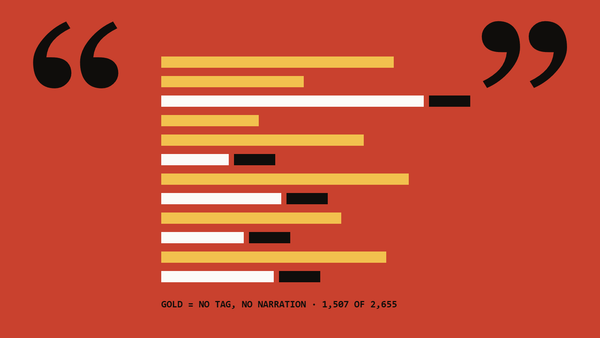
A novel that turned 100 this year offers a way to measure it. Ernest Hemingway published The Sun Also Rises in 1926, & the talk among Jake Barnes, Brett Ashley & their friends in Paris & Pamplona became a model of spare dialogue in American fiction. The text is now in the public domain in the United States, so anyone can count it. I did, out of duty, curiosity & a standing suspicion of received wisdom, in roughly that order. The novel has 2,655 paragraphs that contain speech. 1,507 of them contain nothing else: no "he said," no gesture, no narration.
I call such a paragraph a Bare Line: my term for a line of dialogue that stands alone on the page, with no tag & no narration, so that the reader has to supply who speaks & what the speaker means. This is Speechcraft, Vol. 1, No. 2: investigations into how dialogue works on the page + ways to test your own scenes. Readers get a new way to see why Hemingway's talk still sounds alive. Writers get 4 counts to run on a scene of their own.
Inside this post
- 🧊 Hemingway's iceberg + Adam Gopnik on the novel at 100
- 🔢 67,687 words, 2,655 paragraphs of speech: Christian's count
- 📏 "The Bare Line": my term for speech with no tag & no narration
- 🎛️ 19 chapters on a 3D board you can tilt + the 1 chapter with no speech
- ✂️ Elmore Leonard's 2 tag rules, tested on 890 uses of "said"
- 💬 The last line of the novel & the philosophy of what goes unsaid
- ✅ Try it now: 6 steps + insights for writers & readers
What dialogue has to do
In Speechcraft No. 1 I argued that dialogue has a spoken subject & a practical transaction: 2 people can discuss a window while negotiating who gets to leave. That claim creates a problem for the writer. If the real business of a scene sits under the words, the writer must decide how much of it to bring to the surface.
Hemingway gave the best-known answer in Death in the Afternoon (1932). A writer who knows a subject well enough, he argued, may omit things he knows, & the reader will feel them as strongly as if the writer had stated them. He compared the result to an iceberg, which moves with dignity because of "only one-eighth of it being above water." He added a warning that the people who quote the iceberg almost always drop, the iceberg being by now the most quoted & least finished passage in American craft advice: a writer who omits things because he does not know them leaves only hollow places in the writing. Omission works when knowledge stands behind it.
The centenary has brought the novel back into discussion. Adam Gopnik, in an essay for the Library of America that Lit Hub published on Nov. 12, 2026, does not excuse what has dated: he says a first-time reader now meets prejudice from the opening sentences on. He also defends the plain style as more than a manner, & he asks readers not to miss "the moral force that is at the back of these sensual simplifications." So the critics agree that Hemingway left things out, & that the leaving-out carries meaning. None of them says how much he left out. That part can be counted.
The count
I ran a script over the Standard Ebooks edition of the novel: 19 chapters, 67,687 words—a peculiar way, I grant, to read a book about people drinking in Paris. The script marks every paragraph that contains an opening quotation mark, counts the words inside & outside the quotation marks, & records which speech verbs appear. Hemingway starts a new paragraph for each new speaker, so a paragraph of speech nearly always equals 1 turn in a conversation.
3 results stand out. First, 25,132 of the 67,687 words sit inside quotation marks: 37% of the novel is speech (25,132 ÷ 67,687). Second, the speeches are short. The median paragraph of speech holds 7 spoken words; 1,099 of the 2,655 (41%) hold 5 words or fewer, & 1,930 (73%) hold 10 or fewer. Third, more than half of them stand on the page with nothing around them.
Speechcraft · Vol. 1, No. 2 · The count
I counted every paragraph of speech in The Sun Also Rises. 57 in 100 have no tag & no narration.
37%
Of the novel is speech
25,132 of 67,687 words sit inside quotation marks.
Over 1/3 talk
2,655
Paragraphs of speech
Each new speaker gets a new paragraph.
All counted
1,507
Bare Lines
Speech & nothing else: no tag, no gesture. The gold bars above.
57 in 100
7
Words in the median speech
41 in 100 speeches run 5 words or fewer.
Short on purpose
"Bare Line" is Christian Harder's term. Counted by script for Poetic.ly, November 2026, on the Standard Ebooks edition of The Sun Also Rises (1926): 19 chapters, 67,687 words. A paragraph of speech = any paragraph with an opening quotation mark. Card by Poetic.ly.
Keep reading · free with a Poetic.ly account
You’ve read the first third. The rest is for subscribers, & subscribing is free.
Still inside:
- 📖 “The Bare Line”: my term for speech with no tag & no narration
- 📖 19 chapters on a 3D board you can tilt + the 1 chapter with no speech
- 📖 Elmore Leonard’s 2 tag rules, tested on 890 uses of “said”
- 📖 The last line of the novel & the philosophy of what goes unsaid
- 📖 Try it now: 6 steps for writers & readers
A free account takes an email address & about 10 seconds. It also brings you The Letter, our weekly newsletter.